
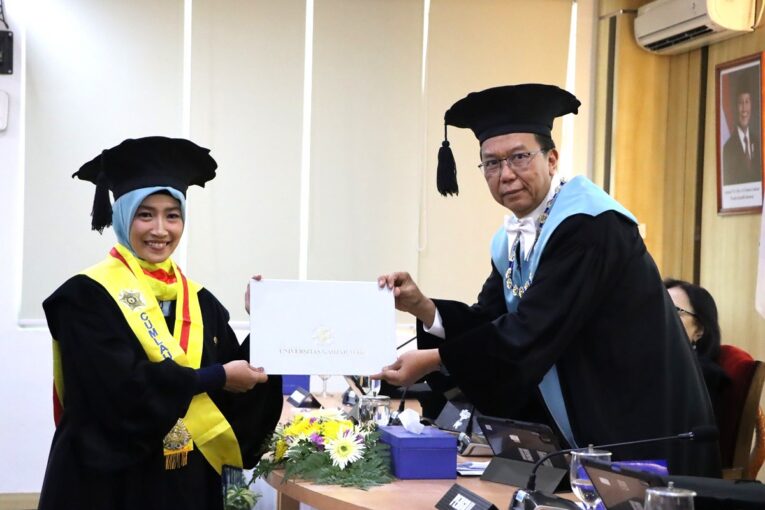
Radhiatul Fitri, S.Psi., M.Psi., Psikolog, has earned a Doctoral degree in Psychology after graduating with cum laude honors from the Open Examination of the Doctoral Program in Psychology, Faculty of Psychology, Universitas Gadjah Mada (UGM), on Friday (August 7). Radhiatul completed her doctoral studies in three years, 10 months, and 15 days, achieving a cumulative GPA of 3.87 and an A grade in her closed examination. She became the 7,399th doctoral graduate of UGM.
Radhiatul defended her dissertation entitled “Childhood Trauma and Maternal Parenting: The Role of Trauma-Specific Reflective Functioning (RF-T) in the Neural Processing of Children’s Emotions and Perceived Parenting Competence.” The study, involving 35 mothers with biological children aged 2–8 years, examined Trauma-Specific Reflective Functioning (RF-T), defined as an individual’s ability to understand and reflect on traumatic experiences they have previously encountered. This ability was examined as one of the mechanisms linking childhood trauma experiences with mothers’ competence in their parenting roles.
The study employed psychological assessments and electroencephalography (EEG) recordings to examine mothers’ brain responses when processing their children’s facial expressions. The findings showed that the ability to reflect on traumatic experiences served as a link between childhood trauma and individuals’ perceptions of their ability to perform their roles as parents.
In other words, childhood trauma does not necessarily determine whether an individual will experience difficulties in parenting. The ability to understand, make sense of, and reflect on those experiences also plays a role in how trauma experiences are associated with parenting competence. This helps explain why individuals with similar trauma histories may exhibit different parenting patterns.
“Trauma does not automatically make someone less capable of parenting. What matters is how they reflect on it, learn from the trauma, and grow through it,” Radhiatul said in summarizing her findings.
The study also identified differences in mothers’ brain responses when processing their children’s facial expressions. Event-Related Potential (ERP) analysis showed that childhood trauma was associated with weaker maternal neural responses when viewing happy facial expressions in children, but this pattern was not observed for fearful or angry expressions. Brain connectivity analysis also indicated that participants with lower RF-T abilities exhibited patterns of neural activity associated with more automatic information processing and more limited response regulation.
The study also produced a methodological innovation in the form of AI-Generated Indonesian Child Facial Expression Stimuli (AI-ICFE), a set of Indonesian children’s facial-expression stimuli developed using artificial intelligence for EEG experiments. The development of these stimuli was part of an effort to provide research materials that are more contextually relevant to Indonesian children.
As a follow-up to her research, Radhiatul proposed the development of Mentalization-Based Treatment (MBT) and the use of the validated Indonesian version of the FMTQ questionnaire as a screening instrument in maternal and child health services. She also plans to present the research findings to psychologists at community health centers (Puskesmas) across Yogyakarta City.
In her remarks, supervisor Supra Wimbarti, M.Sc., Ph.D., Psikolog, described Radhiatul’s research as a topic that remains relatively underexplored, particularly because it connects childhood trauma experiences with participants’ brain activity after they have reached adulthood. She also suggested that the findings be followed up with the Ministry of Women’s Empowerment and Child Protection so that their potential applications could reach the national level.
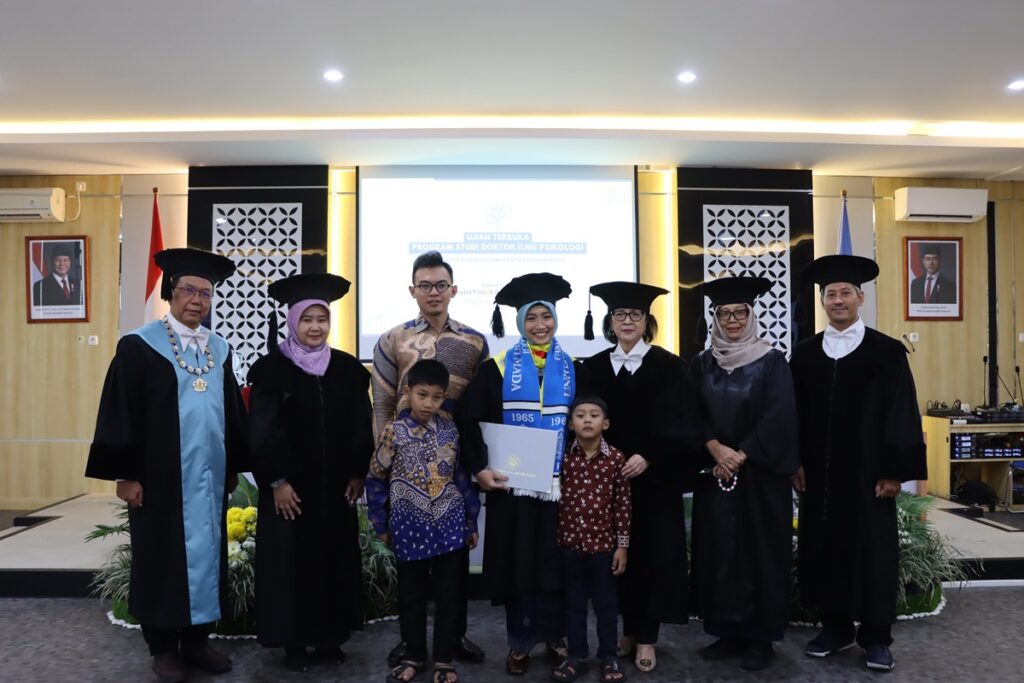
The dissertation was supervised by Supra Wimbarti, M.Sc., Ph.D., Psikolog, as promoter, and Dr. Nita Handayani, S.Si., M.Si., as co-promoter. The examination committee consisted of Rahmat Hidayat, S.Psi., M.Sc., Ph.D.; Dra. Sri Kusrohmaniah, M.Si., Ph.D., Psikolog; Sutarimah Ampuni, S.Psi., M.Si., M.Psych., Ph.D., Psikolog; Dr. dr. Ahmad Asmedi, M.Kes.,Sp.N.Subsp.ENK(K); and Dr. Galang Lufityanto, S.Psi., M.Si., Ph.D., Psikolog.
During her doctoral studies, Radhiatul published three articles related to her dissertation topic in the Asian Journal of Psychiatry, International Journal of Psychophysiology, and European Journal of Trauma & Dissociation. She was also invited to serve as a reviewer for the journal Translational Psychiatry. She previously completed her undergraduate and Master’s degrees in Clinical Professional Psychology at Universitas Ahmad Dahlan and taught at the Faculty of Psychology, Universitas Mercu Buana Yogyakarta, from 2018 to 2025 before pursuing her doctoral studies at UGM in 2022.
At the conclusion of the examination, Radhiatul shared a reflection: “Trauma is not the end of the story. What determines the future is not merely the wounds we have experienced, but our ability to give them meaning and continue choosing to grow.”
Writer: Erna Tri Nofiyana
Photo: Faculty Documentation