

Unit Pengembangan Alat Psikodiagnostika (UPAP) of Gadjah Mada University (UGM) Faculty of Psychology unveiled innovative testing tools during an event held on Friday (25/9). They introduced the Gadjah Mada Psychological Research and Assessment Integrated System (GMPRAISe), AJT classical test tool, and reference books and manuals on testing instruments.
GMPRAISe is a digital psychological assessment service platform developed by UPAP, in collaboration with PT Adaptive Solution Tematica, UGM Department of Computer Science (DTI), and the IT Division of the UGM Faculty of Psychology. Mikael Reno Prasasto, S.Psi., the project manager, explained that GMPRAISe was also developed to support future research.
The design of GMPRAISe stems from the limitations of paper-and-pencil-based psychological assessment systems, which require more resources, costs, effort, and time for administration and scoring. GMPRAISe was developed as a more flexible and affordable online, computer-based psychological assessment service, while maintaining test results equivalent to those of paper-based psychological assessments.

Reno explained that GMPRAISe features a number of capabilities, including a variety of tests integrated into a single question bank; the ability to take assessments online either in person at the UGM Faculty of Psychology or from home; security measures to minimize test item leaks; and automated test scoring.
As of September 2026, users have been able to access the Gadjah Mada Scholastic Test (GMST) through the GMPRAISe website. Moving forward, UPAP will integrate other psychological tests into this service through the gradual digitization of testing instruments and discussions with internal units of the UGM Faculty of Psychology. Reno hopes that GMPRAISe can evolve into a test center that is easily accessible to users.
“In October, we will complete the digitization of the AJT so that it can be integrated into GMPRAISe, and then in November, we hope to open a test center using GMPRAISe,” he said.
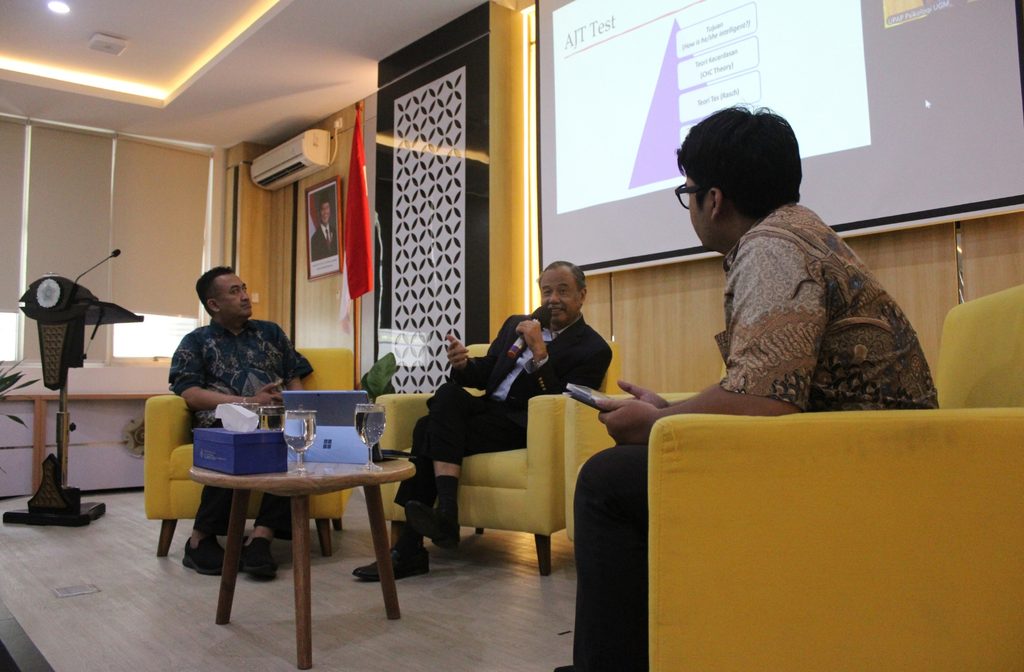
In addition to GMPRAISe, UPAP also launched the AJT Klasikal cognitive test tool, developed by Wahyu Widhiarso, S.Psi., M.A., and Urip Purwono, M.Sc., Ph.D., Psychologist. The series of activities began with an explanation of the AJT test by Urip, followed by a presentation on the development of Classical AJT by Wahyu.
“We’re still discussing the name ‘Classical AJT.’ However, this is an AJT that can be administered without a tester, unlike the usual individual-based version,” he said.

On the same occasion, UPAP introduced the AJT cognitive test book, which includes an introduction to cognitive testing, the rationale behind the Cattell-Horn-Carrol (CHC) theory, the development of norms, validity and reliability, as well as the eight broad abilities assessed in the AJT test. Dra. Retno Suhapti, S.U., M.A., hopes that this book will serve as a guide to the AJT for practitioners, educators, and parents of test-takers who receive the test results.

The event concluded with the official release of the new testing tools by Rahmat Hidayat, S.Psi., M.Sc., Ph.D., the dean of the UGM Faculty of Psychology for the 2021–2026 term. Rahmat hopes that the launch of GMPRAISe and Classical AJT will drive the development of testing and assessment tools so that academics, practitioners, and the general public can benefit from them.
Author: Kayla Anindya Sashikirana
Editor: Erna Tri Nofiyana