
•  About UGM
  •  Academic Portal
  •  IT Center
  •  Library
  •  Research
  •  Webmail
  • English
    • Bahasa Indonesia
    • English
Universitas Gadjah Mada
  •  About Us
    •  Faculty at a glance
    •  History
    •  Heads of Faculty
    •  Academic Staff
    •  Administrative Staff
    •  Quality Assurance
  •  EDUCATION
    • Undergraduate Program Psychology
    • International Undergraduate Program
    • Professional Psychology Program
    • Master of Psychology Program
    • Doctorate Program
  • Research and Community Service
    • Research and Community Service Roadmap
    • Research
    • Publication
    • Community Service
    • Collaborations
  •  Student
    • Prospective Student
    •  Student Conduct Code
    • Collaboration Agreement Internship Vacancies
    • Scholarship
    •  Student Organization
  •  Facilities
    •  Laboratories
    • Research Group
  • Home
  • Release
  • UGM Psychology Researchers Reveal Complex Relationship Between Morality and Number of Children Across 51 Countries

UGM Psychology Researchers Reveal Complex Relationship Between Morality and Number of Children Across 51 Countries

  • Release
  • 4 May 2026, 16.09
  • Oleh: Humas
  • 0

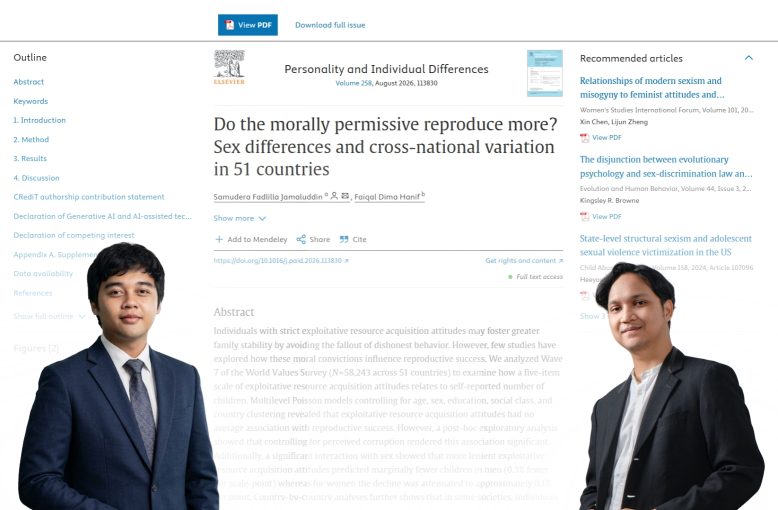
Yogyakarta, May 4, 2026 — The persistence of corruption cases and integrity crises in society indicates a serious issue related to individuals’ attitudes toward how wealth or resources are obtained for their families. A recent study conducted by researchers from the Faculty of Psychology at Universitas Gadjah Mada, published in the journal Personality and Individual Differences, sheds interesting light on this issue.

The study examines the relationship between exploitative attitudes in acquiring resources and reproductive success. The research, conducted by Samudera Fadlilla Jamaluddin, S.Psi., M.Sc., and Faiqal Dima Hanif, S.Psi., analyzed data from more than 58,000 respondents across 51 countries using the World Values Survey database. The results show that the relationship between moral attitudes toward resource acquisition and the number of children is not universal, but highly dependent on social, cultural, and gender contexts.

“These findings show that human reproductive behavior cannot be explained simply through individual traits. Social and cultural contextual factors play a very important role,” the research team explained.

Furthermore, the study found that in some contexts, more permissive moral attitudes are actually correlated with having fewer children, particularly among men. In addition, perceptions of corruption and country-specific social norms also moderate this relationship.

The Dean of the Faculty of Psychology at Universitas Gadjah Mada, Rahmat Hidayat, S.Psi., M.Sc., Ph.D., expressed appreciation for this achievement. “This publication demonstrates the capacity of academics at the Faculty of Psychology UGM to produce global data-based research relevant to fundamental issues of human behavior. We hope these findings enrich scientific perspectives while also contributing to evidence-based policymaking,” he said.

This study uses a multilevel statistical analysis approach to comprehensively capture cross-country variation. As such, the results not only contribute to the development of theories in evolutionary and social psychology but also open opportunities for further research on family dynamics and shifts in social values across societies.

Editor: Fauzi
Editor-in-chief: Zufar

Tags: Faculty of Psychology UGM Scientific Publication SDG 10: Reduced Inequalities SDG 3: Good Health and Well-being SDG 5: Gender Equality SDGs

Berita Terkini

  • Developmental Psychology Expert Emphasizes the Importance of Early Childhood Care Standards Following Daycare Abuse Case in YogyakartaMay 13, 2026
  • Faculty of Psychology UGM Welcomes Visit from 132 Participants of SMAS Trimurti SurabayaMay 13, 2026
  • HPU of the Faculty of Psychology UGM Enhances Reproductive Health Awareness through Cervical Cancer EducationMay 12, 2026
  • Researchers from UGM Faculty of Psychology and International Partners Validate Indonesian-Language Depression Assessment Tool to Strengthen Mental Health ServicesMay 12, 2026
  • UPAP Conducts First Trial of Digital PAPs Test PlatformMay 12, 2026
Universitas Gadjah Mada

Faculty of Psychology
Universitas Gadjah Mada

Jalan Sosio Humaniora Bulaksumur
Yogyakarta 55281 Indonesia
fpsi[at]ugm.ac.id
+62 (274) 550435 (hunting)
+62 (274) 550435 ext 158
psikologiugm
psikologiugm
psikologi_ugm
Kanal Psikologi UGM

© Universitas Gadjah Mada

KEBIJAKAN PRIVASI/PRIVACY POLICY

[EN] We use cookies to help our viewer get the best experience on our website. -- [ID] Kami menggunakan cookie untuk membantu pengunjung kami mendapatkan pengalaman terbaik di situs web kami.I Agree / Saya Setuju