
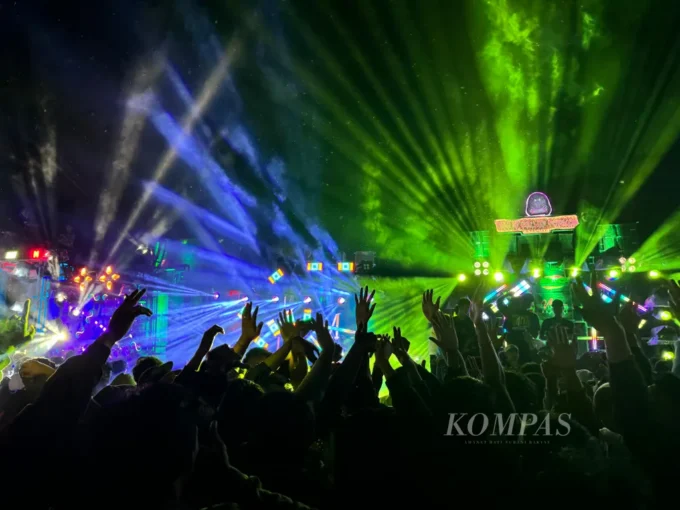
Public debates surrounding sound horeg have increasingly framed the phenomenon in two opposing ways: as a form of cultural expression or as a disturbance to the community. However, researchers from the Center for Indigenous & Cultural Psychology (CICP), Faculty of Psychology, Universitas Gadjah Mada (UGM), highlight that sound horeg is a far more complex social phenomenon shaped by economic, political, and cultural dynamics.
Through an ethnographic study entitled “Yang Penting Horeg!: Sound Horeg dan Klaim atas Ruang Kuasa Pedesaan” (“What Matters Is Horeg!: Sound Horeg and Claims to Spaces of Power in Rural Communities”), F.A. Nurdiyanto, Ahmad Yusrifan, and Kristoforus Lintang Mahadewa examine sound horeg not merely as entertainment, but as a space in which people negotiate recognition, participation, and power.
The research stems from the researchers’ observation that public discussions about sound horeg often focus solely on whether the phenomenon should be supported or opposed. According to the researchers, however, understanding sound horeg requires a broader perspective that goes beyond a single point of view.
“Our concern is that our paper is discussed selectively to support either pro or con arguments. In fact, the paper does not position itself in support of or opposition to sound horeg. We want to understand the complexities behind the existence of sound horeg,” Yusrifan explained.
The researchers found that sound horeg cannot be separated from the various conditions shaping rural communities’ lives. Behind these celebrations lie issues of economic vulnerability, social hierarchies, local politics, and the ways people gain recognition within their communities.
“A phenomenon should not be separated from the conditions surrounding it, as social phenomena are closely interconnected with the economy, politics, and society,” Yusrifan explained.
According to the study, sound horeg serves as an arena where ordinary people can temporarily experience a sense of power. By taking on roles as event organizers or sound system operators, individuals gain opportunities to make decisions, manage activities, and earn recognition within their social environments.
However, these experiences of gaining power are not without contradictions. A space that allows individuals to gain recognition can also reproduce existing patterns of hierarchy and exclusion. The study highlights tensions between residents who participate in sound horeg events and those who feel they have no space to openly express their opposition.
Rather than viewing sound horeg solely as entertainment or a disturbance, the researchers encourage the public to examine the broader social realities underlying the phenomenon. Sound horeg reflects how communities respond to changing social conditions, negotiate their positions, and create spaces in which their voices can be heard.
Writer: Arrasya Aninggadhira
Editor: Osi Livia S
Photo: kompas.com