
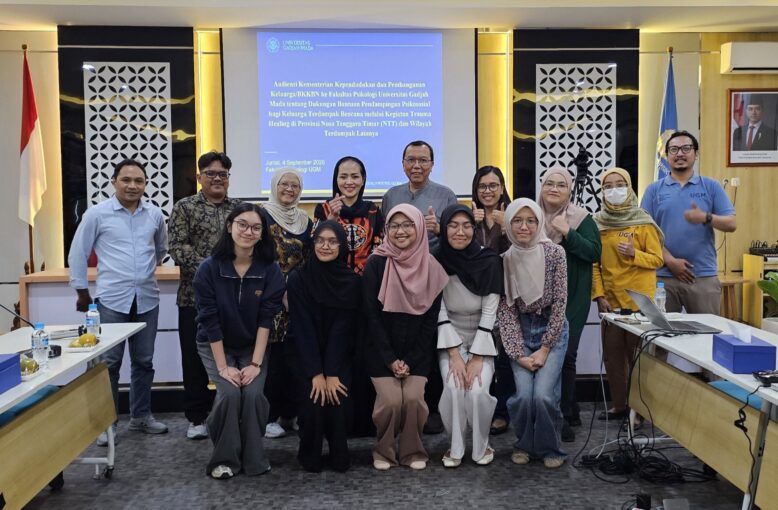
The Faculty of Psychology at Universitas Gadjah Mada (UGM) welcomed a delegation from the Ministry of Population and Family Development/National Population and Family Planning Board (Kemendukbangga/BKKBN) on Friday (4/9). Held in person, the meeting explored opportunities to collaborate in providing psychosocial support for disaster-affected communities, particularly in East Nusa Tenggara (NTT) and several other regions.
Representing Kemendukbangga/BKKBN were Dr. Yuni Hastutiningsih, S.K.M., M.Kes., and Angga Syahban Maulana, S.Kom. The delegation was welcomed by the Dean of the UGM Faculty of Psychology, Rahmat Hidayat, S.Psi., M.Sc., Ph.D.
The meeting was also attended by Vice Dean for Research, Community Service, and Cooperation Pradytia Putri Pertiwi, S.Psi., Ph.D.; Head of the Professional Psychology Program Sutarimah Ampuni, S.Psi., M.Si., M.Psych., Ph.D., Psikolog; representatives of the Association of Indonesian Higher Education Providers in Psychology (AP2TPI); representatives of the Center for Life-Span Development (CLSD) and Psychology Consultation Unit (UKP); and students from the Gadjah Mada Psychology Volunteer Student Activity Unit (REPSIGAMA).
Acting Director for the Engagement of Community Organizations and Institutions, Dr. Yuni Hastutiningsih, S.K.M., M.Kes., explained that disasters not only cause physical and material damage but may also have psychological and emotional consequences for affected communities. Addressing these impacts therefore requires collaboration with universities and institutions that possess expertise in psychology.
“We cannot turn a blind eye to the fact that disasters leave behind not only physical damage, but also psychological and emotional impacts,” Yuni said.
Kemendukbangga/BKKBN expressed its hope that the UGM Faculty of Psychology would contribute to trauma-recovery assistance. This involvement could open opportunities for sustained collaboration that extends beyond a single activity or disaster event.
“Through this collaboration, we hope that our activities will not end as one-off events but will develop into sustainable programs,” she said.
In response, the Dean of the UGM Faculty of Psychology affirmed the faculty’s readiness to contribute during the post-disaster psychosocial recovery stage. This commitment aligns with Kemendukbangga/BKKBN’s recognition that the consequences of disasters are not limited to physical and material damage but also include psychological and emotional impacts.
“We need to be prepared because psychosocial recovery after a disaster requires considerable attention, particularly for vulnerable groups such as children, pregnant women, and persons with disabilities,” Rahmat said.
Both parties agreed that psychological support for disaster-affected communities, particularly vulnerable groups, requires sustained cross-sectoral collaboration. Assistance is needed not only during the emergency-response stage but also throughout the recovery period, enabling community members to resume their daily functions.
The collaboration could be developed through various existing programs at the UGM Faculty of Psychology and across the university, including the involvement of academic staff and students in community service initiatives.
The partnership between the UGM Faculty of Psychology and Kemendukbangga/BKKBN is expected to serve as a concrete step toward strengthening psychological support for disaster-affected communities in Indonesia while reinforcing the role of higher education institutions in community service.
Writer: Arrasya Aninggadhira
Editor: Erna Tri Nofiyana