
Yogyakarta, August 20, 2026 — Collaborative research involving Sri Kusrohmaniah, a researcher from the Faculty of Psychology, Universitas Gadjah Mada (UGM), has revealed the relationship between parenting styles, psychological resilience, social support, and parental mental health in the post-COVID-19 pandemic context. The study of parents in Malaysia shows that parenting styles and the social environment play important roles in shaping the psychological well-being of parents with young children.
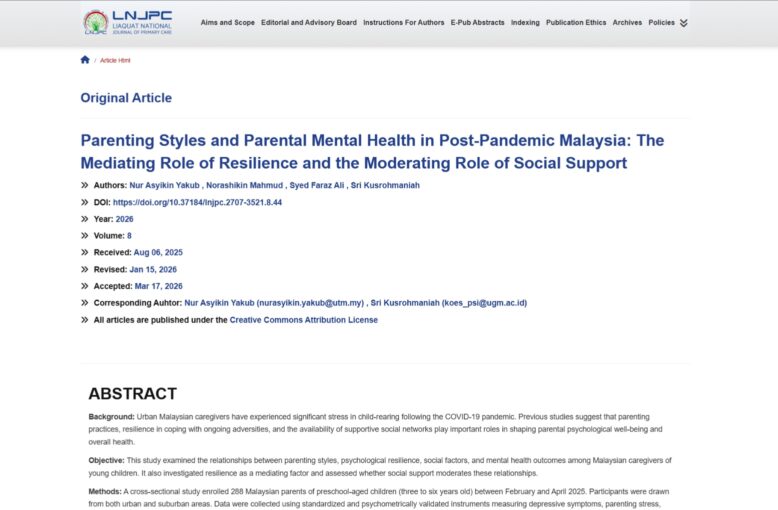
The study, titled “Parenting Styles and Parental Mental Health in Post-Pandemic Malaysia: The Mediating Role of Resilience and the Moderating Role of Social Support,” was authored by Dr. Nur Asyikin Binti Yakub, Prof. Madya Dr. Norashikin Bt. Mahmud, Dr. Syed Faraz Ali, and Dra. Sri Kusrohmaniah, M.Si., Ph.D., Psikolog. The article was published in the Liaquat National Journal of Primary Care, Volume 8, Issue 2, in 2026. Sri Kusrohmaniah is a lecturer at the Faculty of Psychology, UGM, while the other three authors are from Universiti Teknologi Malaysia.
The study employed a quantitative approach involving 288 parents in Malaysia who had preschool-aged children, between 3 and 6 years old. Data were collected from February to April 2025 using standardized and validated instruments to measure depressive symptoms, parenting stress, parenting styles, parental resilience, and social factors. The data were analyzed using regression, mediation, and moderation analyses with SPSS and SmartPLS 4.
The findings showed that an authoritative parenting style was associated with lower levels of stress and anxiety among parents. In contrast, an authoritarian parenting style was associated with higher levels of stress and anxiety. A permissive parenting style also showed a positive association with stress and anxiety, although the relationship was relatively more moderate.
The study further found that psychological resilience serves as an important mechanism linking parenting styles and parental mental health. Parents with higher levels of resilience tended to experience lower levels of stress and anxiety. The study also found that social factors, including perceived social support, educational attainment, and economic stability, were positively associated with resilience.
Social support was also found to have a protective function. Parents who perceived stronger social support tended to report lower levels of stress and anxiety. These findings indicate that parental mental health is not solely related to individual characteristics but is also influenced by parenting patterns and the social environment in which families live their daily lives.
The study provides important insights into parental mental health in non-Western societies, particularly in Southeast Asia. By incorporating resilience as an explanation of the underlying psychological mechanism and social support as a contextual factor, the study offers a more comprehensive understanding of how parenting styles are associated with parents’ psychological well-being in the post-pandemic period.
Malaysia’s parenting culture, which often involves extended family members, is also an important contribution of the study. Although permissive parenting was associated with higher levels of stress, the correlation was not as strong as findings reported in Western populations. The more communal sociocultural context of parenting may help mitigate the associated mental health risks. This demonstrates that the effects of parenting styles cannot be separated from the sociocultural context of a family.
The researchers concluded that interventions aimed at improving parental mental health need to address several aspects in an integrated manner, including strengthening adaptive parenting practices, enhancing psychological resilience, and strengthening social support for families.
These findings further highlight the importance of community-based approaches to improving parents’ psychological well-being and supporting children’s development. In the post-pandemic context, strengthening family capacity and social support is an important component of creating a healthy, adaptive, and supportive parenting environment.
Editor: Zufar
Layout: Fauzi