
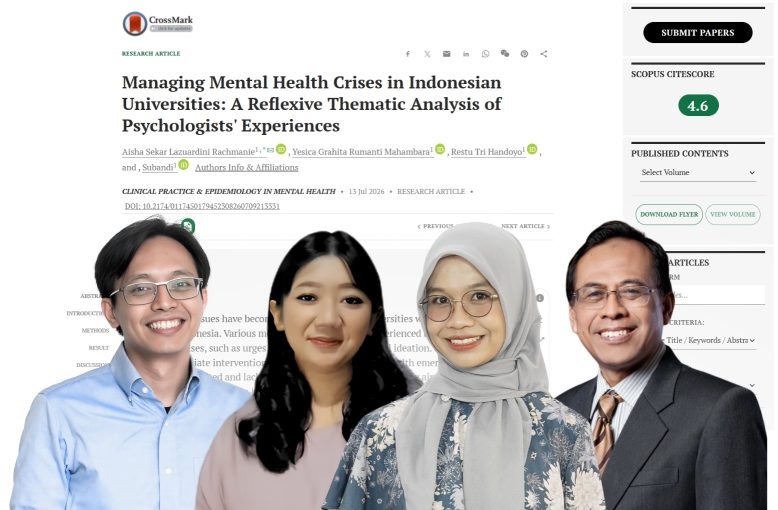
Yogyakarta, August 7, 2026 – The rising number of mental health crises in higher education settings, ranging from self-harm urges to suicidal ideation, highlights the urgent need for a more standardized crisis response system, particularly within universities. Addressing this challenge, a research team from the Faculty of Psychology at Universitas Gadjah Mada (UGM) examined psychologists’ experiences in managing mental health crises at Indonesian universities.
The study, published in Clinical Practice and Epidemiology in Mental Health under the title Managing Mental Health Crises in Indonesian Universities: A Reflective Thematic Analysis of Psychologists’ Experiences, emphasizes the importance of developing standardized guidelines and mental health crisis services for higher education institutions.
The research was conducted by Aisha Sekar Lazuardini Rachmanie, S.Psi., M.Psi., Psikolog, Yesica Grahita Rumanti Mahambara, S.Psi., M.Psi., Psikolog, Restu Tri Handoyo, S.Psi., M.Psi., Ph.D., Psikolog, and Prof. Drs. Subandi, M.A., Ph.D., Psikolog from the Faculty of Psychology, UGM.
The study aimed to explore psychologists’ experiences in responding to students experiencing mental health crises within university settings. The findings are expected to provide an evidence-based foundation for developing more effective campus mental health emergency response services.
To gain an in-depth understanding, the researchers employed a qualitative approach through focus group discussions (FGDs) involving six psychologists working in university mental health services. The collected data were analyzed using Reflective Thematic Analysis (RTA).
The findings revealed that university mental health services face significant challenges in understanding and managing crisis cases. Differences in perceptions of what constitutes a crisis between psychologists and clients emerged as one of the key barriers to effective service delivery. In addition, limited client commitment and inadequate social support further reduced the effectiveness of interventions. The study also found that psychologists contend not only with the complexity of students’ psychological conditions but also with insufficient supporting infrastructure, a lack of standardized procedures, and limited inter-agency coordination. These challenges underscore the need for professional crisis services that are not only timely but also holistic and collaborative.
Aisha Sekar Lazuardini Rachmanie explained that the growing demand for mental health services in higher education must be matched by a clearer and more integrated crisis management system.
“This study shows that psychologists working in universities face highly complex crisis situations. Therefore, a more standardized framework is needed so that assessment, decision-making, and intervention processes can be carried out more consistently and effectively,” she said.
Meanwhile, Restu Tri Handoyo emphasized that university mental health services require stronger institutional support to respond effectively to a wide range of crisis situations.
“Universities need mental health service systems that are not only curative but also prepared to respond to psychological emergencies. Collaboration among psychologists, university leaders, healthcare professionals, and external service networks is essential to building a sustainable crisis management system,” he stated.
According to the research team, the study makes an important contribution to the development of mental health policies in Indonesian higher education. In addition to enriching the literature on crisis intervention in university settings, the findings can serve as a reference for developing operational guidelines, service standards, and capacity-building initiatives for psychologists and support personnel in handling students’ mental health emergencies.
Editor: Zufar
Layout: Fauzi