Arsip:

SDG 9: Industry Innovation and Infrastructure

UGM Research Team Develops AI Technology to Analyze Consumer Cognitive Load During Online Shopping

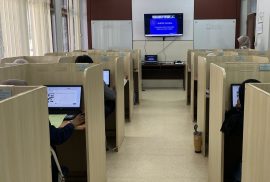
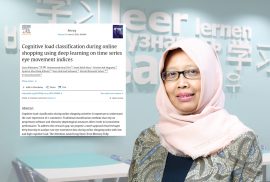
Yogyakarta, January 26, 2026 – Online shopping is not only an economic activity but also involves complex cognitive processes. However, identifying cognitive load during online shopping activities is often inconsistent. To address this, a research team from Universitas Gadjah Mada (UGM) has developed an Artificial Intelligence (AI)-based technology to classify users’ cognitive load levels while shopping online.

Martaria Rizky Rinaldi Develops HypnoDiaCare for Individuals with Type 2 Diabetes

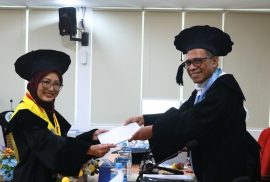
Martaria Rizky Rinaldi, S.Psi., M.Psi., Psikolog, has earned her doctoral degree after completing her Open Dissertation Defense in the Doctoral Program in Psychology on Wednesday (January 14) at Room A203, Faculty of Psychology, Universitas Gadjah Mada (UGM). She graduated as UGM’s 7,093rd doctoral graduate with a dissertation titled “HypnoDiaCare for Individuals with Type 2 Diabetes Mellitus: From Evidence Mapping and Intervention Development to Randomized Controlled Trial and Psychophysiological Evaluation.”

Faculty Member of the UGM Faculty of Psychology Receives Award as Inspiring Lecturer in Social Sciences and Humanities

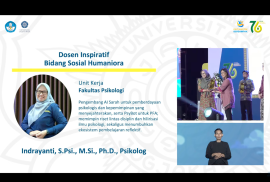
Universitas Gadjah Mada has once again conferred the Anugerah Insan Berprestasi (Outstanding Person Award) to members of its academic community and alumni who have demonstrated exceptional contributions and performance to the university and to society at large. This year, the Faculty of Psychology UGM is proud to receive the Inspiring Lecturer in Social Sciences and Humanities award, which is presented to faculty member IIndrayanti, S.Psi., M.Si., Ph.D., Psikolog.

UGM Faculty of Psychology Research Team Explores Predictors of Cognitive Failures Using Mental Chronometry

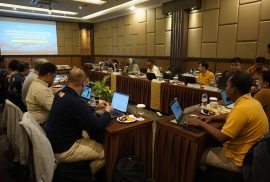
A research team from the UGM Faculty of Psychology will investigate factors that contribute to everyday cognitive failures, ranging from forgetfulness and divided attention to simple errors that can escalate into safety risks, by combining an updated self-report questionnaire with a series of mental chronometry–based cognitive tasks. This initiative places objective, standardized measurement at the core of understanding how different components of cognitive functioning work together and, at times, fail, thereby opening opportunities for more targeted interventions to support psychological well-being and daily performance.

Curbing Bias in Survey Research: UGM Psychology Research Team Maps Solutions for Common Method Bias

A research team from the Faculty of Psychology, Universitas Gadjah Mada (UGM), is examining how Common Method Bias (CMB) affects findings in survey research. CMB refers to bias that arises when the same measurement approach is used for multiple constructs at the same time, for example, administering many questions to the same respondents, at the same time and place, using the same form. As a result, correlations between concepts can appear higher than they truly are, with part of the “high” value coming from the measurement method rather than the actual phenomenon. Internationally, many journals now require authors to demonstrate efforts to reduce CMB. In Indonesia, however, reporting and mitigation of CMB are still uncommon, highlighting the need for trusted guidance.

Bridging Values and Strategy: UGM Study Probes the Keys to Resilient Organizational Performance

The Faculty of Psychology at UGM has launched a study examining how organizational values are translated into effective strategies that enhance company performance. The study stems from the observation that many organizations fail not only due to market pressures, but because shared values are not consistently operationalized in decision-making. “Shared values” here refers to core principles agreed upon and embraced across the organization, from leadership to employees, as a compass for thinking and acting. Examples include integrity, professionalism, innovation, service, and collaboration. Led by Dr. Bagus Riyono, M.A., Psychologist, the research team will test empirical evidence that values must be embedded in strategy to make a tangible impact on performance.

Mapping the Hafiz Brain: Intensive Training, Verbal Memory, and Traces of Neuroplasticity via MRI

A research team from the UGM Faculty of Psychology will examine how intensive Qur’an memorization training shapes verbal memory and leaves measurable traces in brain structure and connectivity. Grounded in the structured pedagogy of Islamic boarding schools, combining talaqqi, muraja’ah, and consistent repetition, this study positions hafiz as a model of learning that demands high perseverance and repeated information processing. In neuroscience, intensive learning experiences are known to trigger neuroplasticity, the brain’s capacity to adapt both functionally and structurally. However, specific evidence of how these adaptations manifest in hafiz remains limited. This study aims to map brain regions relevant to verbal memory, particularly the hippocampus and caudate nucleus, assess the integrity of white-matter tracts such as the inferior fronto-occipital fasciculus (IFOF) and uncinate fasciculus (UF), and concurrently evaluate behavioral performance in verbal memory. Additionally, this study is the first psychology research in Indonesia on mapping the brains of hafiz using structural brain imaging.

From PIMNAS Gold Medal to International Publication: UGM’s Innovative PsyBot

Yogyakarta, October 2, 2025 – An innovation by students from the Faculty of Psychology, Universitas Gadjah Mada (UGM), which initially earned a gold medal at the 36th National Student Scientific Week (PIMNAS), has now achieved a new milestone with its publication in a high-impact international journal. The article titled “PsyBot: A Randomized Controlled Trial of WhatsApp-Based Psychological First Aid to Reduce Loneliness Among 18–22-Year-Old Students in Yogyakarta, Indonesia” was published on July 31, 2025, in SSM – Mental Health (Elsevier), a Scopus Q1-indexed journal with a 2024 CiteScore of 4.2 and an Impact Factor of 2.6.

Workshop on Manuscript Conversion Strategies: Opening Opportunities for Scientific Book Publication at the Faculty of Psychology UGM

The Faculty of Psychology at Universitas Gadjah Mada, through its Publication Unit, recently held a capacity-building event titled “Workshop on Manuscript Conversion Strategies for Book Publication” on Friday, July 25, 2025. Conducted online via Zoom Meeting, the workshop was attended by lecturers, researchers, and postgraduate students actively engaged in academic writing within the Faculty of Psychology UGM.

The workshop featured Abdur Rahim, S.S., M.Pd., Head of Cooperation, Manuscript Acquisition, and Senior Editor at Intrans Publishing, as the main speaker and was hosted and moderated by Syahrul Fauzi, S.Pt., M.Pd. This activity was designed as part of the faculty’s ongoing efforts to disseminate scientific knowledge, aiming to ensure that academic papers and research manuscripts do not remain merely as academic documents, but are further developed into scientific books accessible to a broader academic and professional audience.

Authentic Leaders, Authentic Innovation: UGM Study Reveals Key to SOE Transformation

Yogyakarta, July 2, 2025 — Rigid bureaucratic culture has long been a challenge to fostering innovation in Indonesia’s State-Owned Enterprises (SOEs). A recent study by a team of researchers from Universitas Gadjah Mada (UGM) reveals that authentic leadership and psychological empowerment are critical drivers of innovation within SOEs in Indonesia.

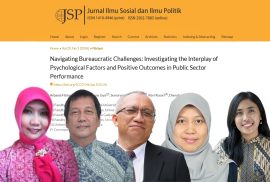
Published in the high-impact international journal Journal of Open Innovation: Technology, Market, and Complexity (Scopus Q1, CiteScore 14.0), the study was authored by Indrayanti, Nida Ulfia, and Taufik Hidayat. The article, titled “From Bureaucracy to Innovation: How Authentic Leadership and Empowerment Drive Change in Indonesian State-Owned Enterprises,” argues that innovation is not just about structure—but about genuine leadership and empowered employees.