
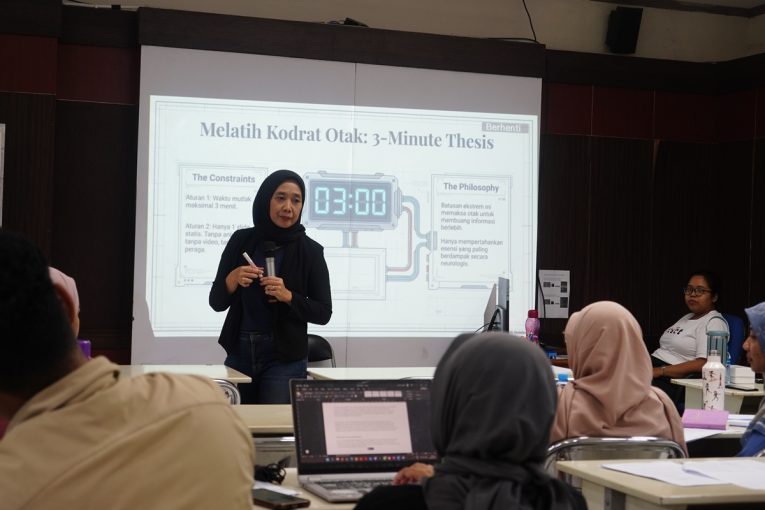
The Faculty of Psychology at Universitas Gadjah Mada (UGM), through its Information and Technology Development Unit (UIPTB), organized Tech in Training on Monday (June 15) and Thursday (June 18). The program was attended by 23 participants, consisting of students and alumni, at Room B-104, Faculty of Psychology UGM.
The training featured UGM Faculty of Psychology lecturer and co-founder of the Gerakan Sekolah Menyenangkan (GSM), Theresia Novi Poespita Candra, S.Psi., M.Si., Ph.D., Psikolog, as the main speaker. She discussed how academic knowledge can be translated into forms of communication that are more accessible, engaging, and impactful.
Novi opened the session by emphasizing the important role of intellectuals in bridging scientific knowledge and the public. She noted that today’s digital landscape requires intellectuals to be active and communicative.
“Social media should serve as a gateway that shows intellectuals are present,” said Novi.
She also highlighted the role of intellectuals in knowledge production and their moral responsibility to disseminate knowledge to society.
“Why are intellectuals placed in the Brahmin class? Because they cannot be bought,” Novi remarked, emphasizing that intellectual value is not transactional but is built through critical thinking, learning, and integrity in conveying ideas.
In the context of disseminating research to the broader community, Novi added that communicating directly with the public presents even greater challenges.
“Engaging directly with society is much tougher,” she said.
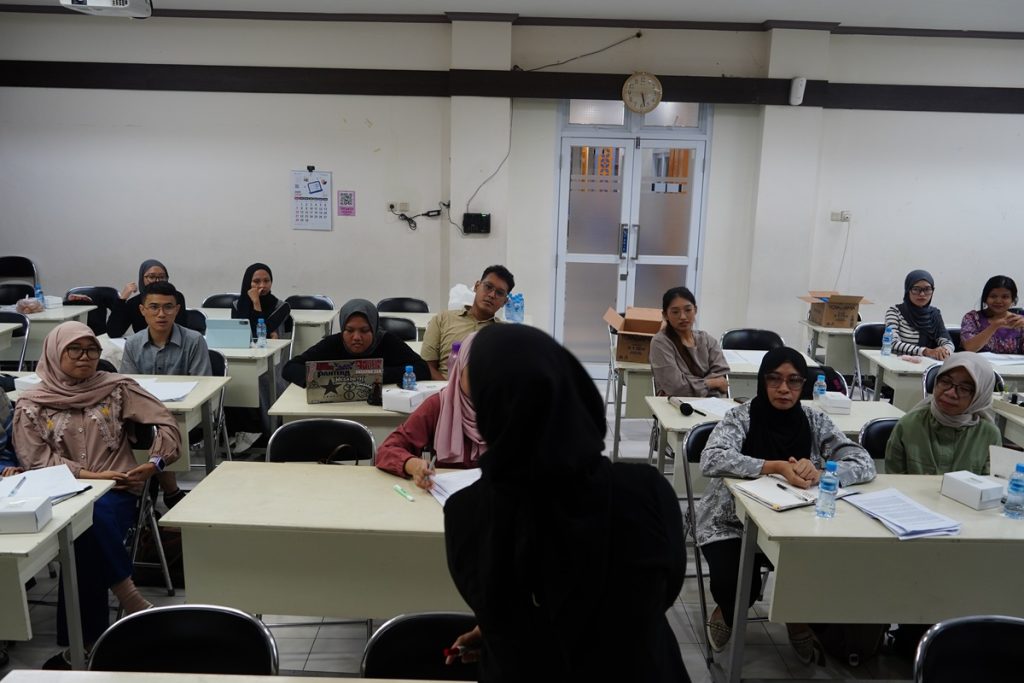
On the second day, the training focused on persuasive communication strategies and storytelling techniques for presenting research findings. Novi also stressed that human communication skills remain essential amid rapid technological development.
“Speaking is something that AI (Artificial Intelligence) still cannot replace,” she stated, underscoring that conveying ideas requires human reasoning, contextual understanding, and sensitivity.
She further explained that the ideas people express are products of their thought processes, which are then communicated to others.
Several participants shared positive impressions of the training. They noted that the sessions offered fresh perspectives on the role of writers in both academic and public spheres.
“This is truly inspiring, like a breath of fresh air,” one participant commented.
“The material was highly substantial and opened new perspectives on the world of writing,” another participant added.
Other participants also highlighted that the program encouraged intellectual courage in expressing ideas. According to them, being a writer is not merely about summarizing knowledge, but also about having the confidence to share one’s own thoughts.
Through Tech in Training, the Information and Technology Development Unit (UIPTB) of the Faculty of Psychology UGM reaffirmed the importance of transforming knowledge from academic settings into public spaces. The program not only equipped participants with technical skills but also fostered awareness that scientific communication is an integral part of intellectual responsibility in the digital era.
Writer: Arrasya Aninggadhira
Editor: Erna Tri Nofiyana