
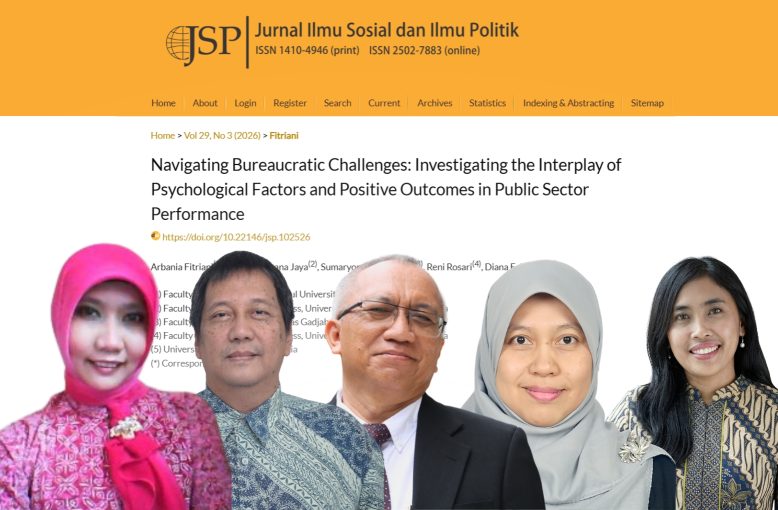
Yogyakarta, May 5, 2026 – Researchers from Universitas Gadjah Mada have once again highlighted their contribution to strengthening governance through a recent academic publication. The study, published in the Journal of Social Sciences and Politics (JSP), examines the psychological mechanisms underlying public sector employee behavior while supporting the global agenda of Sustainable Development Goal 16 on strong, transparent, and accountable institutions.
The research, conducted by Dr. Arbania Fitriani, S.Psi., M.Si, Prof. Wihana Kirana Jaya, M.Soc.Sc., Ph.D., Dr. Sumaryono, M.Si., Psikolog, Dr. Dra. Reni Rosari, M.B.A., and Diana Fajarwati, S.T, M.S.M.,, is titled “Navigating Bureaucratic Challenges: Investigating the Interplay of Psychological Factors and Positive Outcomes in Public Sector Performance” It investigates the role of bureaucratic leadership (BL) in moderating the relationship between public service motivation (PSM) and work engagement (WE).
Using a quantitative approach based on Partial Least Squares Structural Equation Modeling (PLS-SEM), the study involved 2,853 employees of State-Owned Enterprises (BUMN) in Indonesia. The findings reveal that work engagement mediates the relationship between public service motivation and affective organizational commitment as well as innovative work behavior. In addition, bureaucratic leadership was found to moderate the relationship between public service motivation and work engagement. This means that bureaucratic leadership that promotes transparency in the implementation of administrative rules enables public sector employees to make more flexible decisions in their daily work.
The Vice Dean for Human Resources, Finance, and Assets of the Faculty of Psychology at Universitas Gadjah Mada, Sumaryono, who is also a co-researcher, emphasized that the findings are relevant to Indonesia’s bureaucratic reform efforts.
“Strengthening public institutions as emphasized in SDG 16 does not only depend on regulations and organizational structures, but also on the psychological quality of the individuals within them. Work engagement and public service motivation are important foundations for a responsive and integrity-driven bureaucracy,” he said.
Furthermore, Sumaryono explained that the study extends the application of the Job Demands–Resources (JD-R) model in the Indonesian public sector context.
“We found that work engagement serves as a key mechanism linking individual motivation to organizational outcomes. This is important in driving innovation and bureaucratic effectiveness, which ultimately contributes to strengthening public institutions,” he explained.
The study further recommends strengthening bureaucratic leadership practices and fostering a work environment that can translate employees’ intrinsic motivation into tangible commitment and innovation. An approach that integrates psychological aspects is considered capable of accelerating bureaucratic reform that is adaptive, innovative, and service-oriented. This contribution aligns with UGM’s commitment to supporting the Sustainable Development Goals, particularly in strengthening effective, accountable, and inclusive institutions at all levels as mandated in SDG 16.
Layout: Fauzi
Editor: Zufar
Photo of Diana Fajarwati, S.T., M.S.M., has been modified using AI tools