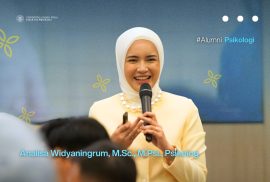

Born and raised in Yogyakarta, Analisa initially dreamed of majoring in Communication Studies. Her interest in psychology grew from her love of reading, particularly The Lost Boy by Charlie Flotman, a story about a psychologist supporting a child with autism. Through the book, she discovered a connection between her passion for communication and her desire to help others, ultimately leading her to pursue her studies at the Faculty of Psychology, Universitas Gadjah Mada (UGM).
SDG 9: Industry Innovation and Infrastructure
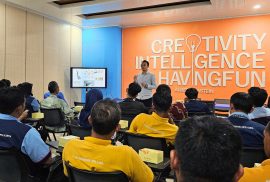
Following the Focus Group Discussion (FGD) on the Acceleration of Psychological Service System Integration and GMST Mandiri held on April 10–11, 2026, the Unit for the Development of Psychodiagnostic Instruments (UPAP) conducted a trial of its new PAPs test platform.
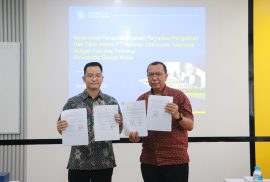
The Faculty of Psychology at Universitas Gadjah Mada has officially received the transfer of Economic Rights for the AJT Cognitive Test from PT Melintas Cakrawala Indonesia (MCI) through a signing ceremony held on Thursday (7/5) in Room D-506 of the Faculty of Psychology UGM.
Yogyakarta, May 5, 2026 – Researchers from Universitas Gadjah Mada have once again highlighted their contribution to strengthening governance through a recent academic publication. The study, published in the Journal of Social Sciences and Politics (JSP), examines the psychological mechanisms underlying public sector employee behavior while supporting the global agenda of Sustainable Development Goal 16 on strong, transparent, and accountable institutions.
The Faculty of Psychology held a Focus Group Discussion (FGD) to accelerate the integration of psychological service systems and GMST Mandiri on Friday (10/4) and Saturday (11/4) at Grand Rohan Hotel, Yogyakarta. This event is a strategic step to answer the digital development demands.
Proud news comes from the Faculty of Psychology at Universitas Gadjah Mada. Beginning April with positive momentum, Jurnal Psikologi UGM has officially been accepted into the APA PsycInfo index as of Thursday (09/04). APA PsycInfo is a prestigious bibliographic database managed by the American Psychological Association (APA). This achievement marks a major step forward in strengthening the journal’s position on the international stage.
This idea is explored in the latest episode of OPSI: Obrolan Psikologi, presented by the Faculty of Psychology UGM in collaboration with TVRI Yogyakarta. In the second episode of OPSI this year, “Main Game Ketahuan Sifat Aslinya? Ngobrol Bareng Kreator ‘The Lost Treasure’,” Dr. Fadillah, an alumnus of the Doctorate of Psychology at UGM, introduces a mobile-based psychological assessment that moves beyond traditional testing methods.
The Psychodiagnostic Instrument Development Unit (UPAP) of the Faculty of Psychology, Universitas Gadjah Mada (UGM), conducted the first pilot test for the development of the Agility Test at SMA Negeri 1 Kalasan on Thursday, February 26, 2026. This activity was part of a program aimed at mapping students’ academic potential, organized through a collaboration between the school and the Faculty of Psychology UGM. The pilot test marked an initial step in the process of developing a more comprehensive and adaptive assessment instrument tailored to the needs of secondary school students.
Yogyakarta, January 26, 2026 – Online shopping is not only an economic activity but also involves complex cognitive processes. However, identifying cognitive load during online shopping activities is often inconsistent. To address this, a research team from Universitas Gadjah Mada (UGM) has developed an Artificial Intelligence (AI)-based technology to classify users’ cognitive load levels while shopping online.
Martaria Rizky Rinaldi, S.Psi., M.Psi., Psikolog, has earned her doctoral degree after completing her Open Dissertation Defense in the Doctoral Program in Psychology on Wednesday (January 14) at Room A203, Faculty of Psychology, Universitas Gadjah Mada (UGM). She graduated as UGM’s 7,093rd doctoral graduate with a dissertation titled “HypnoDiaCare for Individuals with Type 2 Diabetes Mellitus: From Evidence Mapping and Intervention Development to Randomized Controlled Trial and Psychophysiological Evaluation.”