

The Faculty of Psychology, Universitas Gadjah Mada (UGM), provided students of the Professional Psychology Education Study Program with training and certification as AJT Cognitive Test administrators from Monday (20 July) to Friday (31 July). Held in Room A-203, the F3 Building, and the Psychodiagnostics Lab, the program was attended by 41 students.
The training aimed to equip students with the knowledge and skills required to administer, score, and prepare reports based on the AJT Cognitive Test. It also prepared them to become certified AJT test administrators before undertaking professional psychology practice in the field. These competencies are essential for supporting the implementation of General Psychologist Professional Psychology Services (LPPPU).
The AJT Cognitive Test is a psychodiagnostic instrument developed by the UGM Faculty of Psychology to assess children’s cognitive abilities. It is based on the Cattell–Horn–Carroll (CHC) theory of intelligence and uses norms developed according to the characteristics of children in Indonesia.
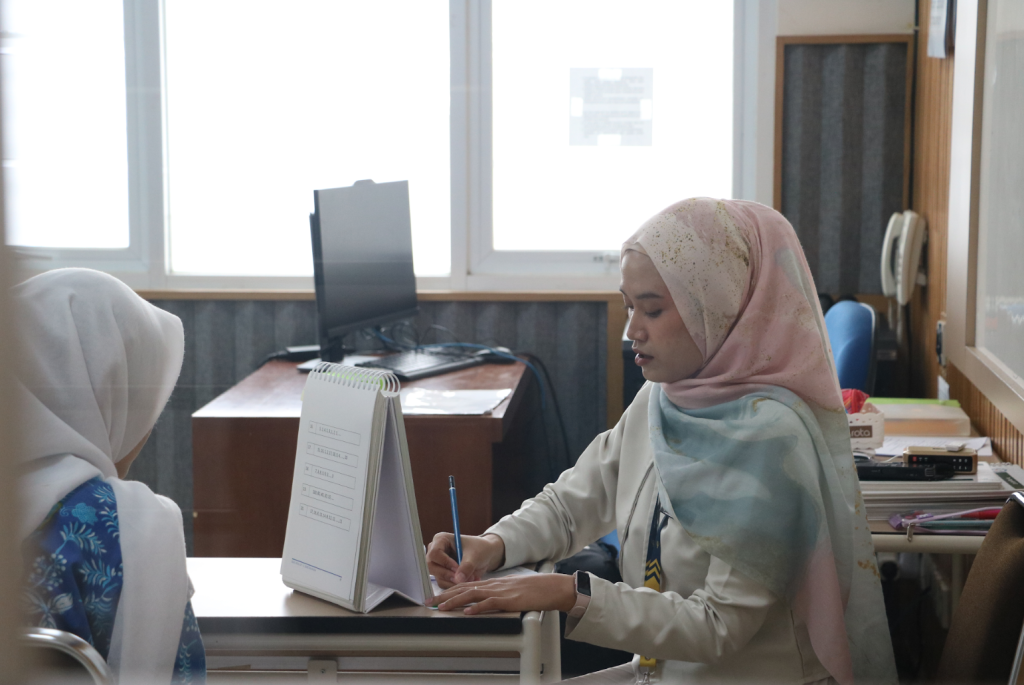
Over ten days, participants attended a series of sessions covering the CHC theory and the AJT Cognitive Test, administration procedures for each subtest, practical exercises, scoring, and certification interviews. They also received training in interpreting results, developing psychograms, integrating data, and preparing psychological assessment reports.
“I gained a valuable and enjoyable experience. I learned about test administration, observation, and how to interpret the results more comprehensively while taking the child’s condition into account. I am proud that Indonesia finally has its own cognitive assessment instrument, especially one developed by the UGM Faculty of Psychology,” said Afifah Hasna Sekaringtyas, S.Psi., a fifth-cohort student of the Professional Psychology Education Study Program.
“I believe that when I become a practitioner, I will be able to identify my clients’ strengths and areas for development because the AJT provides a comprehensive picture of a child’s condition. I see the AJT as a new source of hope for every child,” said Lisa Angela, S.Psi., also a fifth-cohort student of the Professional Psychology Education Study Program.
Through this initiative, the UGM Faculty of Psychology expects participants to use the AJT Cognitive Test accurately, skilfully, and responsibly in psychological practice. The program is also expected to broaden the use of the AJT Cognitive Test and support the development of psychological services that are relevant to the needs of Indonesian society.
The training sessions were delivered by lecturers and psychologists from the UGM Faculty of Psychology: Dra. Retno Suhapti, S.U., M.A., Psikolog; Supra Wimbarti, M.Sc., Ph.D., Psikolog; Dr. Wisjnu Martani, S.U., Psikolog; Dr. Maria Goretti Adiyanti, M.S., Psikolog; Dra. Siti Waringah, M.Si., Psikolog; Edilburga Wulan Saptandari, S.Psi., M.Psi., Ph.D., Psikolog; Wahyu Widhiarso, S.Psi., M.A.; Azri Augustin Suciati, S.Psi., M.Psi., Psikolog; Wirdatul Annisa, S.Psi., M.Psi., Psikolog; Yudhistira Adi Perdana, S.Psi., M.Psi., Psikolog; Valeria Satwika Anindita, S.Psi., M.Psi., Psikolog; Fauzia Aulia Ramadhani, S.Psi., M.Psi., Psikolog; and Adzkia Ra’ida Salma, S.Psi., M.Psi., Psikolog.
The facilitators provided instruction on the theoretical foundations of the AJT Cognitive Test, administration procedures for each subtest, scoring, result interpretation, psychogram development, data integration, and psychological assessment report writing. In addition to attending the instructional sessions, participants completed practical exercises and certification interviews designed to evaluate their understanding and skills in using the AJT Cognitive Test.
Writer: Arrasya Aninggadhira
Editor: Erna Tri Nofiyana