
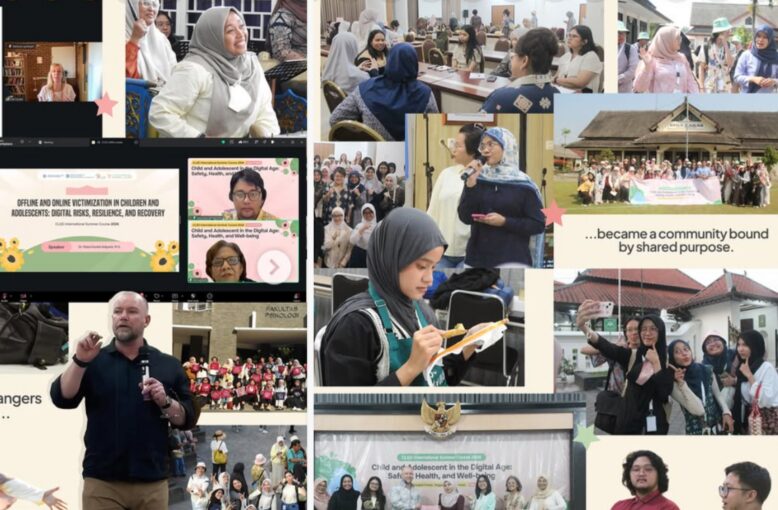
The Center for Life-Span Development (CLSD) at the Universitas Gadjah Mada (UGM) Faculty of Psychology opened its International Summer Course on Monday (6/7). Held under the theme “Child and Adolescent in the Digital Age: Safety, Health, and Well-Being,” the program brought together academics from Indonesia and abroad to discuss the opportunities and challenges surrounding child and adolescent development amid the rapid expansion of digital technology.
The ten-day program comprised an online component held from 6 to 10 July 2026 and an in-person component from 13 to 17 July 2026. The program was officially opened by Dean of the UGM Faculty of Psychology Rahmat Hidayat, S.Psi., M.Sc., Ph.D. In his remarks, he emphasized that promoting the well-being of children and adolescents requires interdisciplinary commitment.
“At Universitas Gadjah Mada, we believe that higher education is not only about acquiring knowledge but also developing future leaders who can make impact on society through semantic inquiry, collaboration, and compassion,” Rahmat said.
Rahmat also encouraged participants to take an active role and make use of the program as a space for learning and exchanging perspectives.
“I recommend you to participate actively throughout the program, learn from one another. I hope this experience will inspire new ideas, lasting collaborations, and contribute commitments to improve the lives of children and adolescents,” he added.
Head of CLSD Aisha Sekar Lazuardini Rachmanie, S.Psi., M.Psi., Psikolog, explained that the program was designed to broaden participants’ understanding of the opportunities and challenges faced by children and adolescents in the digital age. By integrating scientific and practical perspectives, an interdisciplinary approach is essential to understanding and addressing these issues comprehensively.
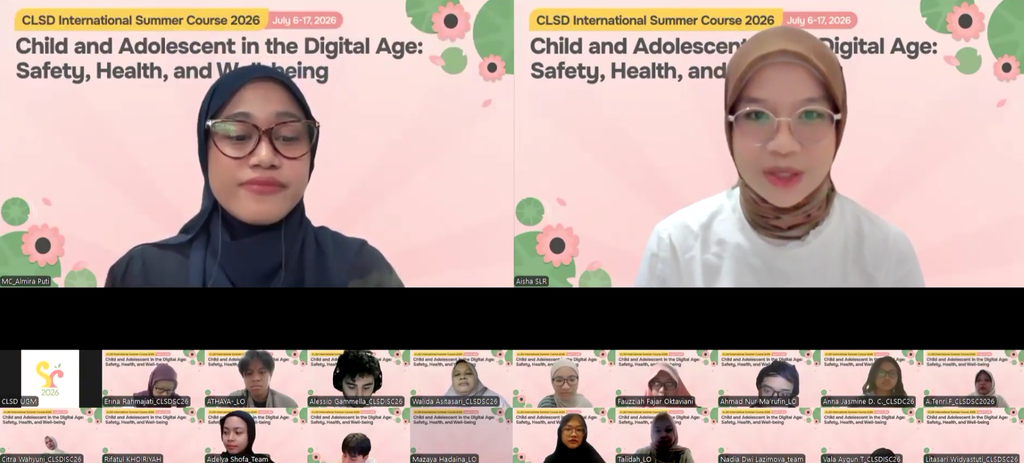
“Digital technology has become an inseparable part of children and adolescents’ daily lives. While it offers opportunities, it also presents new challenges related to mental health, safety, and well-being,” Aisha said.
The International Summer Course featured academics from several countries. Speakers from UGM included Prof. Dra. Yayi Suryo Prabandari, M.Si., Ph.D.; Sutarimah Ampuni, S.Psi., M.Si., M.Psych., Ph.D., Psikolog, and Elga Andriana, S.Psi., M.Ed., Ph.D. The program also featured Prof. Lena Sanci, Ph.D. from the University of Melbourne, Australia, and Prof. Dr. Maaike van der Put from the University of Groningen, the Netherlands.
In addition to attending lectures, participants in the in-person component took part in group workshops. Their understanding was also evaluated through individual assessments conducted throughout the program.
Through this exchange of perspectives, participants were expected not only to gain theoretical knowledge but also to understand how child and adolescent development is shaped by diverse social and cultural contexts.
“We hope that each participant will not only gain new knowledge, but also strengthen the ability to critically analyse real world issues and develop context specific and sensitive solutions that promote children’s safety, health, and well-being,” Aisha said.
The program was expected to broaden participants’ perspectives, strengthen international academic collaboration, and create space for discussions on the protection and well-being of children and adolescents in both Indonesian and global contexts.
Learn more about the Center for Life-Span Development:
https://clsd.psikologi.ugm.ac.id/
www.instagram.com/clsd.ugm/
Writer: Arrasya Aninggadhira
Editor: Erna Tri Nofiyana