
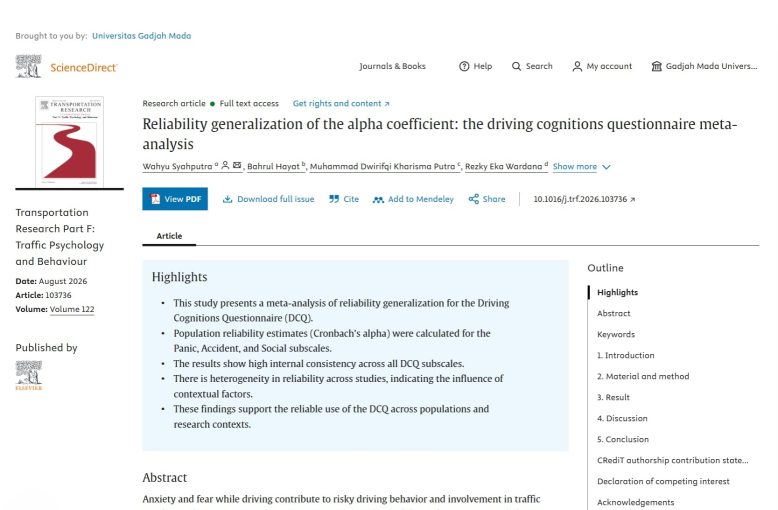
Yogyakarta, August 6, 2026 – A recent study published in the international journal Transportation Research Part F: Traffic Psychology and Behaviour provides a comprehensive evaluation of the reliability of the Driving Cognitions Questionnaire (DCQ), a psychological instrument specifically designed to assess cognitive aspects associated with driving fear and anxiety.
The article, titled “Reliability Generalization of the Alpha Coefficient: The Driving Cognitions Questionnaire Meta-analysis,” was authored by Syahputra Wahyu Hidayat, Hayat Bahrul Putra, Muhammad Dwirifqi Kharisma Putra, and Rezka Eka Wardana. The researchers employed a reliability generalization meta-analysis (REGEMA) approach to evaluate the internal reliability of the DCQ by synthesizing findings from previously published studies.
Using a systematic review following the PRISMA guidelines and REGEMA-based analysis, the researchers compiled data from 16 independent studies that reported Cronbach’s alpha coefficients for the DCQ’s three subscales: Panic, Accident, and Social.
The findings indicate that all three subscales demonstrated good to excellent reliability. The estimated population reliability coefficients were 0.884 for the Panic subscale, 0.870 for the Accident subscale, and 0.854 for the Social subscale. These results suggest that the DCQ is a reliable instrument for assessing negative cognitions related to driving anxiety, making it suitable for both research and clinical assessment.
At the same time, the study identified substantial heterogeneity across the included studies. Meta-regression analyses revealed that participants’ age and the proportion of male respondents significantly influenced reliability variation in the Social subscale, whereas no significant moderators were identified for the Panic or Accident subscales.
According to Rifqi, these findings demonstrate that the reliability of a psychological instrument is not fixed but may vary depending on the characteristics of the study sample.
“This meta-analysis demonstrates that the DCQ exhibits good reliability at the population level. However, its reliability remains context-dependent, meaning that researchers and practitioners should consider respondent characteristics when applying this instrument,” the research team explained.
The study also highlights the importance of reporting sample-specific reliability estimates rather than relying solely on reliability coefficients reported in previous studies. The researchers argue that the reliability generalization approach provides a more accurate understanding of an instrument’s performance across different populations and research contexts.
The findings are expected to serve as an important reference for researchers in transportation psychology, road safety, and psychometrics, particularly in selecting and evaluating measurement instruments for research and clinical applications.
Editor: Zufar
Copy Editor: Fauzi