
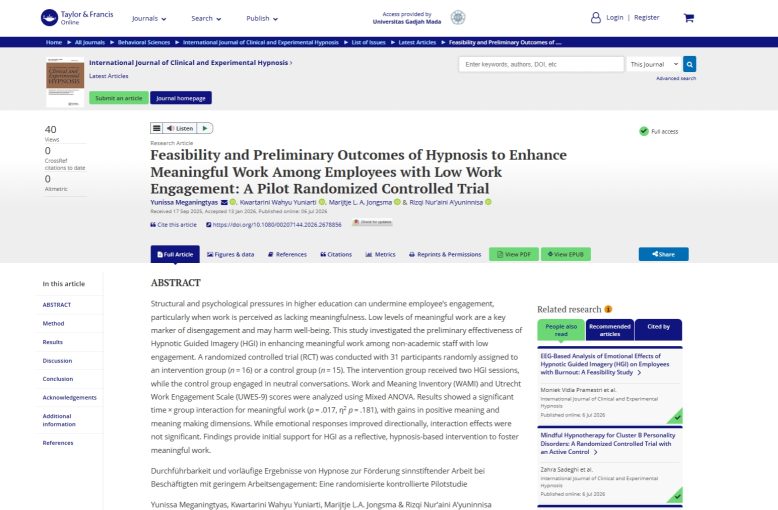
Yogyakarta, August 3, 2026 – A research team from the Faculty of Psychology at Universitas Gadjah Mada (UGM) has found that hypnosis based on guided imagery has the potential to enhance employees’ sense of meaningful work among those with low levels of work engagement. The findings were published in the International Journal of Clinical and Experimental Hypnosis following a pilot study employing a randomized controlled trial (RCT) design.
Conducted by Yunissa Meganingtyas, Prof. Dra. Kwartarini Wahyu Yuniarti, M.Med.Sc., Ph.D., Psikolog, Dr. Marijtje Jongsma, M.L.A., and Dr. Rizqi Nur’aini A’yuninnisa, S.Psi., M.Sc., the study was motivated by growing structural and psychological pressures in the workplace, particularly within higher education institutions. Such pressures can diminish employees’ sense of meaning in their work, ultimately reducing work engagement and psychological well-being.
The study aimed to evaluate both the feasibility and preliminary effectiveness of Hypnotic Guided Imagery (HGI) as a psychological intervention to help employees rediscover meaning in their work.
A total of 31 university administrative staff members with low levels of work engagement were randomly assigned to two groups. Sixteen participants received the intervention consisting of two Hypnotic Guided Imagery sessions, while the remaining 15 participants were assigned to a control group that participated in neutral conversations with a psychologist. The intervention’s effectiveness was assessed using the Work and Meaning Inventory (WAMI), the Utrecht Work Engagement Scale (UWES-9), and the Positive and Negative Affect Schedule–Expanded (PANAS-X). Participants also provided feedback through interviews or online questionnaires, depending on their preference.
The findings revealed that participants who underwent the hypnosis sessions experienced significant improvements in their perception of meaningful work, particularly in the dimensions of positive meaning and meaning making. Although changes in work engagement and emotional responses did not differ significantly from those observed in the control group, the results provide preliminary evidence that hypnosis-based interventions warrant further development for workplace applications.
Post-intervention interviews also revealed diverse experiences. Several participants reported intrinsic motivation driven by a growing interest in mental health and a desire to engage in activities that support both their work performance and personal development. Others, however, experienced challenges during the intervention, including difficulty maintaining focus and achieving relaxation. These findings suggest that hypnosis-based interventions should be further refined and tailored to individual needs.
Yunissa Meganingtyas, the study’s first author, explained that meaningful work is a fundamental component of employees’ psychological well-being and productivity.
“When individuals perceive their work as meaningful, they become not only more motivated but also more resilient in coping with workplace challenges. Our findings suggest that guided imagery-based hypnosis may serve as one approach to facilitate this process,” she said.
She added that this was an initial study and that further research involving larger participant samples and longer follow-up periods is needed.
“Our findings provide preliminary evidence of the potential of Hypnotic Guided Imagery to enhance meaningful work. We hope future studies will examine this approach across a wider range of occupational sectors so that its benefits can contribute more broadly to employee mental health and work engagement,” she added.
Beyond contributing to advances in clinical psychology and industrial-organizational psychology, the study also highlights the potential of hypnosis-based interventions as part of employee well-being programs. As workplace mental health continues to receive increasing attention, approaches that help individuals rediscover meaning in their work are becoming increasingly relevant for organizations and policymakers alike.
Editor: Zufar
Layout: Fauzi