

Expanding the reach of early warning systems does not necessarily mean that warnings reach all communities in the affected areas, nor that they are received, understood, and acted upon appropriately. This was emphasised by Pradytia Putri Pertiwi, S.Psi., Ph.D., a lecturer at the Faculty of Psychology, Universitas Gadjah Mada (UGM), during her participation in the Reaching the Last Mile webinar on Tuesday (June 9).
The webinar is part of the Global Disaster Preparedness Center (GDPC) Research Grants Program, which presented findings from 15 community-based studies across 14 countries, supported by the UK International Development from the UK government.
The program highlights gaps in early warning systems, where certain populations are not covered evenly, and warning messages are not always followed by effective protective actions.
“The issues of lack of access to early warning and the lack of capacity for early action are not only related to whether the information is available, but it also links to structural issues around the disability,” said Pradytia.
The session focused on structural exclusion, exploring how early warning systems often leave communities behind not only due to geography but also because of how warnings are designed and delivered. Pradytia shared her research on inclusive early warning systems for persons with disabilities, particularly in villages near volcanoes in Yogyakarta.
“Social networks are lifelines for them,” Pradytia explained. She emphasised that trust is a crucial infrastructure in early warning systems, as most residents rely on social networks to fill gaps left by formal systems.
However, there remains a missing link between early warning and action. “When you receive information, and it’s not clear enough for you to be able to do something to do with the message, they don’t give the person confidence to evacuate,” said Pradytia. She noted that the effectiveness of early warning depends not only on information delivery but also on the community’s ability to act, influenced by stigma, access to resources, social support, and psychological confidence.
Pradytia stressed the importance of systematically including the perspective of persons with disabilities in early warning guidelines and planning, rather than merely retrofitting accessibility afterwards.
“Inclusion is truly a process; it requires co-design collaboration, not only retrofitting infrastructure to be accessible, but we need to improve the social capital through the social network because it is as important as the infrastructure itself,” she added.
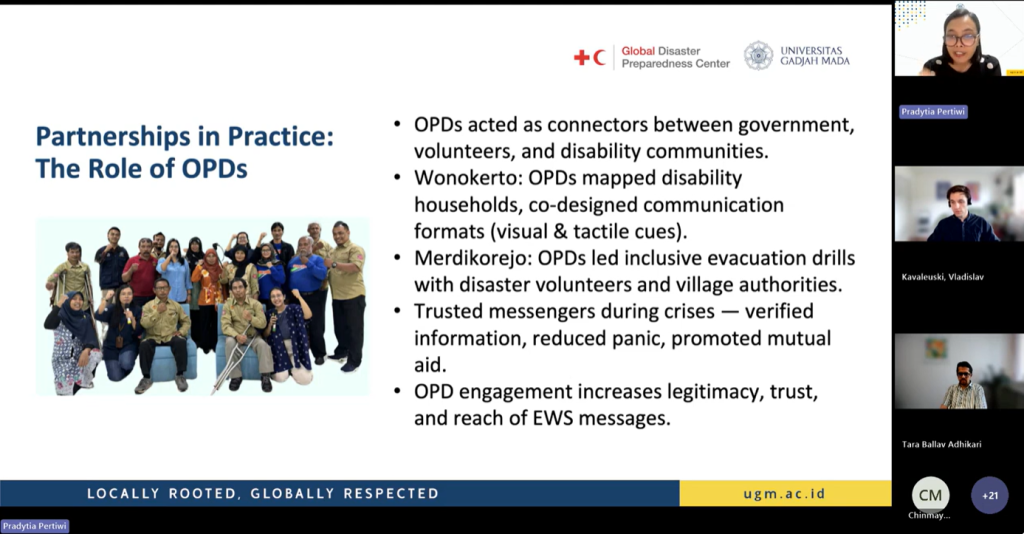
In practice, Organizations of Persons with Disabilities (OPDs) play a critical role in enhancing legitimacy and trust in early warning messages by implementing participatory governance, assigning leadership roles to persons with disabilities, and co-designing accessible communication formats.
To ensure warnings are effectively conveyed, modern and traditional communication systems should operate in tandem. Official sirens can be paired with locally trusted methods such as mosque calls or bamboo drums. Moreover, participatory governance ensures persons with disabilities have leadership roles in the planning of early warning systems.
The webinar provided new insights into the importance of inclusion in disaster mitigation. Evidence-based and participatory approaches not only improve the effectiveness of early warning but also ensure that all community members, including vulnerable groups, have the opportunity to respond and remain protected.
Watch the full session on YouTube!
Author: Arrasya Aninggadhira
Editor: Erna Tri Nofiyana