

The Faculty of Psychology at Universitas Gadjah Mada (UGM), in collaboration with the Indonesian Neuropsychology Association (ANI), continued the first ANI National Scientific Meeting (Temilnas I ANI) on Saturday (September 26) at the UC Hotel Ballroom. Following discussions on the practical applications of neuropsychology through workshops on the first day, the second day addressed broader challenges, including professional workforce development, assessment tool development, and building a scientific ecosystem that meets the needs of Indonesian society.
Chair of the Central Executive Board of the Indonesian Psychological Association (HIMPSI), Dr. Andik Matulessy, M.Si., Psychologist, delivered the keynote presentation. He highlighted the need for collaboration among professional organizations, associations, and educational institutions to develop neuropsychology as a specialization. Clear educational pathways, supervision, competency standards, and scopes of practice are essential requirements.
“Specialist education must be developed collaboratively within the educational ecosystem,” he emphasized.
Supra Wimbarti, M.Sc., Ph.D., Psychologist, a lecturer at the UGM Faculty of Psychology, discussed institutional-level challenges based on her experience in developing neuropsychology within the faculty. These efforts include preparing teaching staff and curricula, as well as developing research, facilities, and professional practice networks. According to her, these elements must be interconnected to ensure the sustainable development of neuropsychology.
“This national scientific meeting would not have taken place without collaboration,” Supra remarked.
In another plenary session, Prof. Dr. Gilles van Luijtelaar discussed the influence of language and cultural backgrounds on cognitive test results. In a diverse society such as Indonesia, differences in scores cannot immediately be interpreted as differences in cognitive abilities. Everyday language use, educational backgrounds, and learning experiences must also be considered when interpreting assessment results.
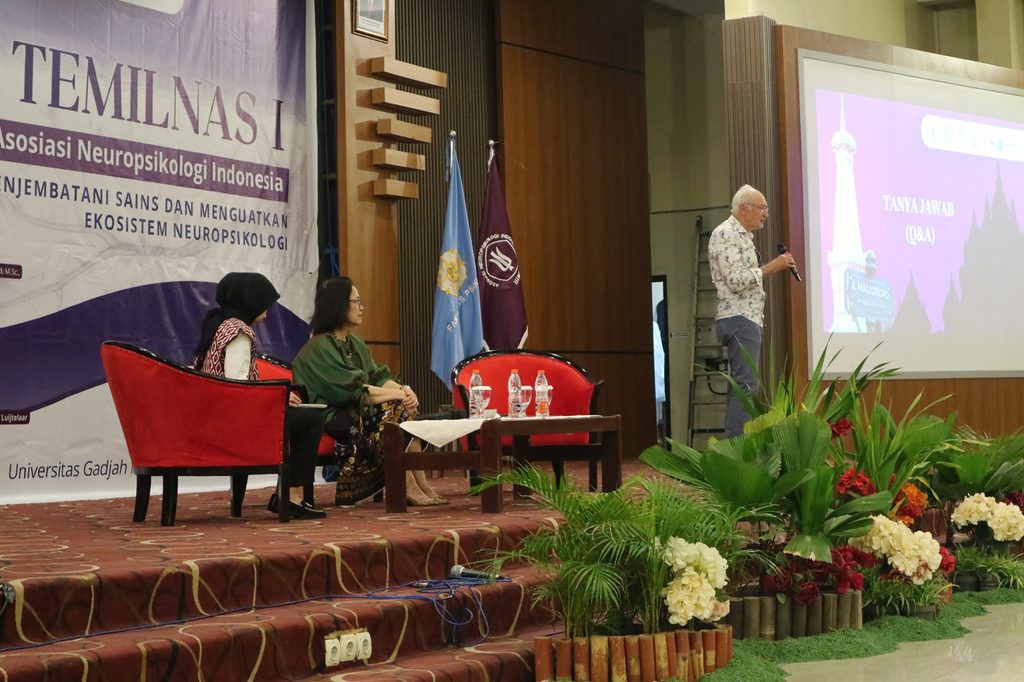
Gilles explained that test results may vary, even when individuals understand Indonesian, because the language they use most frequently in daily life can influence their performance on cognitive assessments.
“The test results may differ, and this presents a challenge in Indonesia,” Gilles explained.
A presentation on the WISC-V by Prof. Dr. Marc P.H. Hendriks highlighted the importance of accurate assessment in measuring children’s cognitive abilities. He emphasized the need to understand validity, reliability, and the appropriateness of norms before using test results to make decisions. He also stressed the importance of reviewing and adapting instruments developed outside Indonesia to ensure their suitability for the populations being assessed.
UGM Faculty of Psychology Professor Prof. Dra. Kwartarini Wahyu Yuniarti, M.Med.Sc., M.B.A., Ph.D., Psychologist, discussed clinical hypnosis and human recovery from psychological and neurophysiological perspectives. The session encouraged participants to examine the relationships among attention, perception, subjective experience, and bodily responses in understanding therapeutic processes.
The second day’s sessions demonstrated that strengthening neuropsychology requires more than advances in knowledge about the brain and behavior. The quality of professional education, the accuracy of assessment instruments, sensitivity to societal diversity, and interdisciplinary collaboration are equally important in ensuring the responsible application of this field.
The interdisciplinary and inter-institutional collaborations established during the event are expected to continue, contributing to a stronger neuropsychology ecosystem in Indonesia.
Writer: Arrasya Aninggadhira
Editors: Sussanti and Erna Tri Nofiyana