
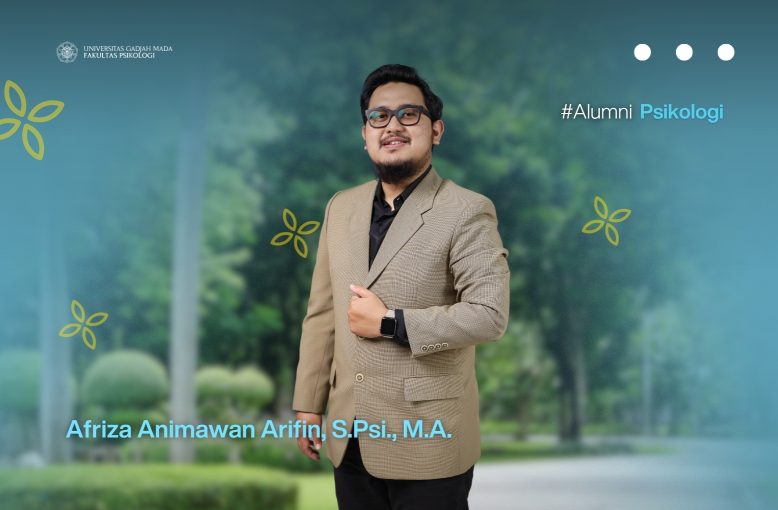
Afriza Animawan Arifin has demonstrated that psychology and his passion for music can go hand in hand. Today, in addition to teaching psychology at Universitas Muhammadiyah Surakarta (UMS), this Universitas Gadjah Mada (UGM) alumnus continues to pursue a career as a professional musician.
His journey began in 2013, when he first enrolled as an undergraduate Psychology student at UGM. Afriza initially intended to be a “campus-and-home” student, focusing solely on his studies without getting involved in any student activity units.
One day, a friend offered him a leaflet announcing auditions for the Gadjah Mada Chamber Orchestra (GMCO). Without any major expectations, he auditioned and was accepted. From then on, he began living in two worlds simultaneously. His mornings were spent exploring psychological theories in the classroom, while his evenings were devoted to playing instruments and performing orchestral melodies until 2017.
Afriza’s interest in music had grown since childhood, following in the footsteps of his father, who was also involved in music. From that point on, he no longer saw the two fields as separate. His undergraduate thesis explored the music community “Manusia Tanpa Arah,” while his master’s thesis focused on gamelan, a form of indigenous music rich in psychological meaning. He even specifically chose to specialize in the Psychology of the Arts. His contributions to music have also taken concrete forms, including composing songs for PPSMB Palapa and PIONIR UGM and coaching an orchestra group at FKKMK UGM.
“The answer to every istikharah prayer lies in a mother’s blessing. When I graduated with my bachelor’s degree, I was unsure whether I should start working immediately or continue my studies. My mother then told me, ‘Become a lecturer.’ In her view, rather than working at a large company preparing exhausting reports that did not align with my passion, becoming a lecturer would give me the space to continue pursuing music alongside my service.” — Afriza Animawan Arifin
Afriza’s academic journey from his undergraduate studies through his master’s degree at UGM took seven years (2013–2020), including a one-year break before continuing to the master’s program. During this break, he was active at UGM’s Center for Public Mental Health (CPMH) and conducted various mental health training programs for schoolchildren. While pursuing his master’s degree, he faced a classic dilemma among psychology graduate students: whether to pursue the Professional track (Psychologist) or the Science track (Master of Psychology).
Afriza ultimately chose the scientist and researcher path, earning a Master of Arts (M.A.) degree. His decision was further strengthened by his admiration for Prof. dr. Adi Utarini, M.Sc., MPH., Ph.D., from FKKMK UGM, who was named one of the world’s most influential women by TIME magazine in 2023. A simple question from Prof. Uut about Afriza’s interest in becoming a lecturer became one of the major catalysts in his career.
In addition to Prof. Uut, Prof. Drs. Koentjoro, MBSc., Ph.D., Psychologist, became another important pillar in his journey. Since his orientation as a new student, Afriza had the courage to approach Prof. Koentjoro and ask whether music could be studied from a psychological perspective, given that there was no dedicated arts curriculum group (Kelompok Bidang Keilmuan/KBK) at the time. Prof. Koentjoro warmly welcomed the idea and agreed to become his supervisor.
Under the guidance of the professor, who had also supervised Rhoma Irama’s son in research on music psychology, Afriza’s master’s thesis on gamelan was successfully published in a reputable international journal (Q2).
Today, at UMS, Afriza does more than teach foundational theories. Together with his colleagues, he successfully initiated and established an elective course in the Psychology of the Arts, creating a supportive academic space for students interested in exploring the intersection between human behavior and creative expression.
For Afriza, becoming a lecturer is the beginning of a journey toward the highest level of academic achievement: becoming a professor. To reach that point, he shares several important tips. According to him, the first step is to establish an academic identity or stepping point early on by identifying an area of expertise or a course that genuinely excites a person and keeps them engaged. Next, academics need to build an umbrella research program by integrating the Three Pillars of Higher Education (Tridarma Perguruan Tinggi) into a consistent career roadmap. Throughout the journey, it is also important to continue building partnerships and nurturing synergistic relationships with students, as research support does not come only from fellow academics. Finally, he encourages people not to be afraid to start, because interests and expertise can grow through practice and familiarity as long as the process is enjoyable.
Afriza’s story is proof that the boundary between an academic career and the world of the arts is merely a barrier that can be overcome through creativity. Teaching in the classroom on weekdays and conducting an orchestra on weekends is not a burden, but a harmonious combination in which the two pursuits strengthen one another.
Reportage: Nur Amalina Naada Sabrina
Writer: Fadia Hayu Godwina
Editor: Erna Tri Nofiyana
Photo: Personal Documentation