
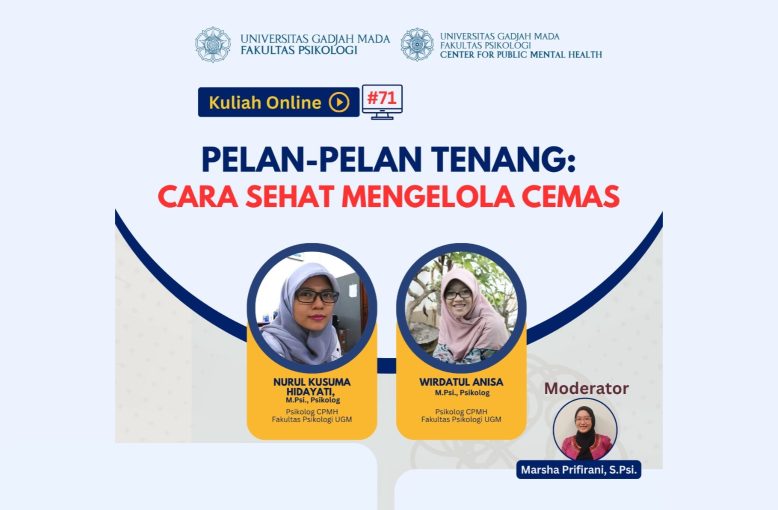
The Center for Public Mental Health (CPMH) at the Faculty of Psychology of Universitas Gadjah Mada held its regular program once again, the Online Lecture (Kulon), now in its 71st edition. Carrying the theme “Take It Slow: Healthy Ways to Manage Anxiety,” the event was conducted online via Zoom on Friday morning (24/4), from 09.00–10.30 WIB, and was moderated by Marsha Prifirani, S.Psi.
As part of its community service activities, the lecture was held free of charge and open to the public. A total of 70 participants attended, representing diverse professional backgrounds, including students, teachers, counselors, psychologists, and creative practitioners such as content creators, designers, and book editors. There were also professionals such as HR staff, civil servants, and village officials. This diversity reflects the high level of public interest in mental health issues, particularly anxiety, which is increasingly relevant in daily life.
The first speaker, Nurul Kusuma Hidayati, M.Psi., Psikolog, explained the basics of anxiety. She described its definition, how it arises, and the various forms commonly experienced by individuals. In her presentation, she emphasized that not all anxiety should be viewed as a disorder. “Not all forms of anxiety are anxiety disorders,” she said, reminding participants to distinguish between normal emotional responses and conditions that require further attention.
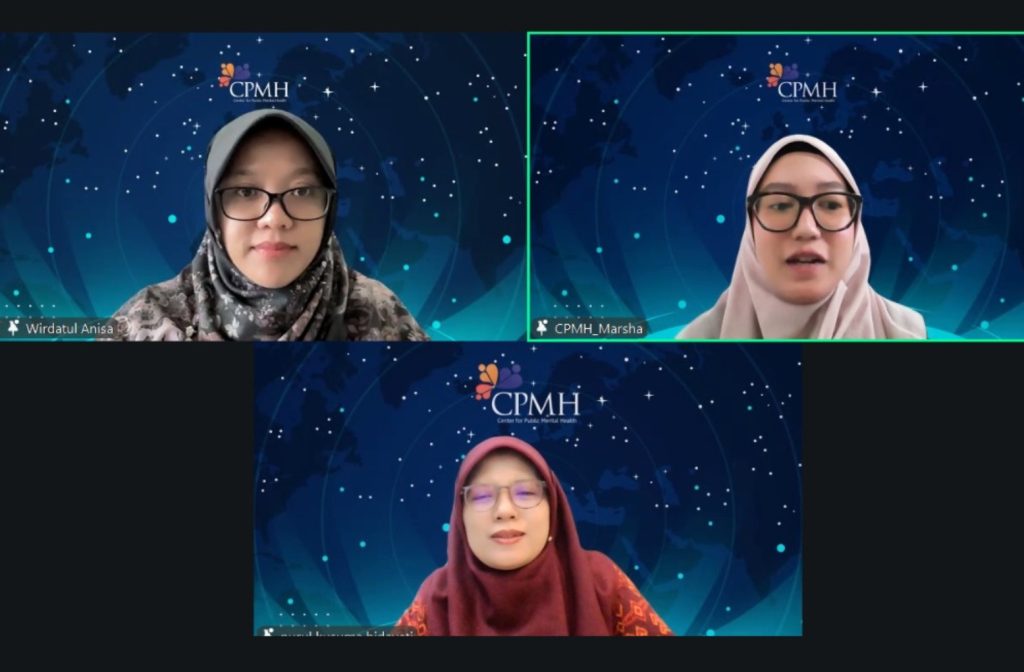
The next session was delivered by Wirdatul Anisa, M.Psi., Psikolog, who discussed self-help strategies for managing anxiety. She explained that self-help can be an effective first step, but it has its limitations. Self-help may no longer be sufficient when anxiety becomes very intense, difficult to control, or begins to interfere with daily functioning such as studying, working, maintaining relationships, and resting.
Furthermore, Wirdatul emphasized the importance of a comprehensive approach to managing anxiety, ranging from identifying triggers, regulating physical responses, to changing thought patterns and lifestyle habits. “We need to recognize what makes us anxious, manage physical responses, change thought patterns, and adjust lifestyle,” she explained.
Participants showed great enthusiasm, reflected in the many questions raised throughout the discussion session. This indicates that anxiety is an issue that is very close to people’s everyday lives today.
Through Kulon #71, CPMH at the Faculty of Psychology UGM reaffirmed its commitment to providing an inclusive and science-based learning space to improve public mental health literacy. The activity is expected to help participants better understand anxiety and find healthy and appropriate ways to manage it.
Writer: Nurul Hidayati