
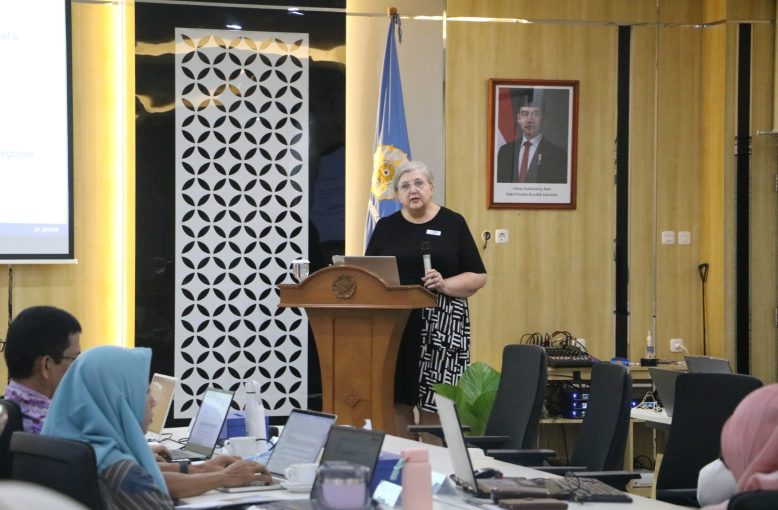
The Faculty of Psychology at Universitas Gadjah Mada (UGM) hosted a Comprehensive Review Training led by the Joanna Briggs Institute (JBI) from July 29 to 31, 2025. Organized by the Indonesian Association of Psychology Higher Education Providers (AP2TPI), the event welcomed 30 participants from various universities across Indonesia. The training was facilitated directly by Dr. Sonia Hines and Dr. Romy Jia from the University of Adelaide, Australia.
The training equipped participants with essential skills to systematically review different types of evidence, with the goal of providing a strong evidence base to support decision-making in healthcare. The program combined both theory and hands-on practice, where participants learned to formulate focused research questions, search for relevant literature, critically appraise, and synthesize evidence from studies.
On the first day (July 29), the trainers introduced the basic principles of Evidence-Based Practice (EBP). Participants learned how to construct Systematic Literature Reviews (SLR) that are methodical, transparent, and replicable. They were introduced to the FAME framework (Feasibility, Appropriateness, Meaningfulness, Effectiveness), the differences between SLRs and traditional literature reviews, and initial steps such as formulating research questions using the PICO/PICo framework and defining inclusion-exclusion criteria. Participants also used JBI SUMARI, a tool that supports protocol development, article screening, appraisal, data extraction, and synthesis.
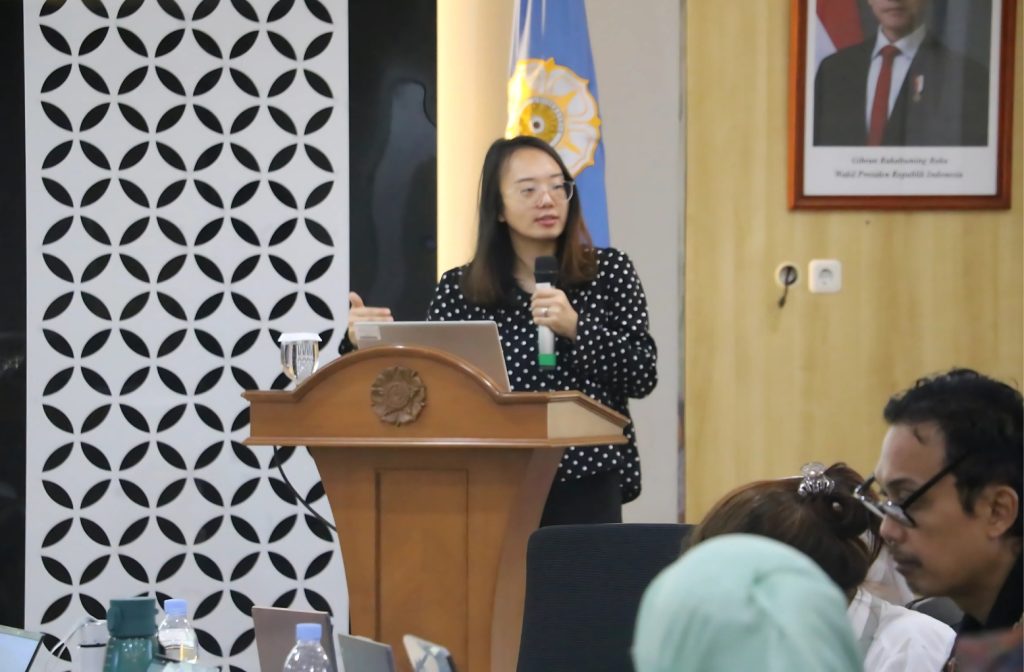
The second session (July 30) focused on quantitative studies and critical appraisal practices. Participants explored quantitative research designs, evidence hierarchies, aspects of validity, risk of bias, and how to apply JBI’s assessment tools. The session also covered practical application of critical appraisal using JBI SUMARI, the importance of having two independent reviewers, and the early stages of data extraction. The day ended with workbook exercises and preparation for presentations.
The final session, held on Thursday (July 31), covered the development of a Summary of Findings Table using the GRADE approach to assess the quality of evidence, along with principles of results reporting in line with PRISMA 2020 guidelines. Participants dove deeper into data synthesis and meta-analysis, including how to use forest plots, analyze effect sizes, check for heterogeneity, and conduct subgroup and sensitivity analyses. Sonia and Romy discussed factors affecting evidence quality, publication bias, and the importance of data management. The platform gradepro.org was introduced as a tool to assist in generating findings tables.
The training concluded with participant presentations of their systematic review ideas, followed by constructive feedback from Sonia and Romy.
Writer: Relung Fajar Sukmawati