
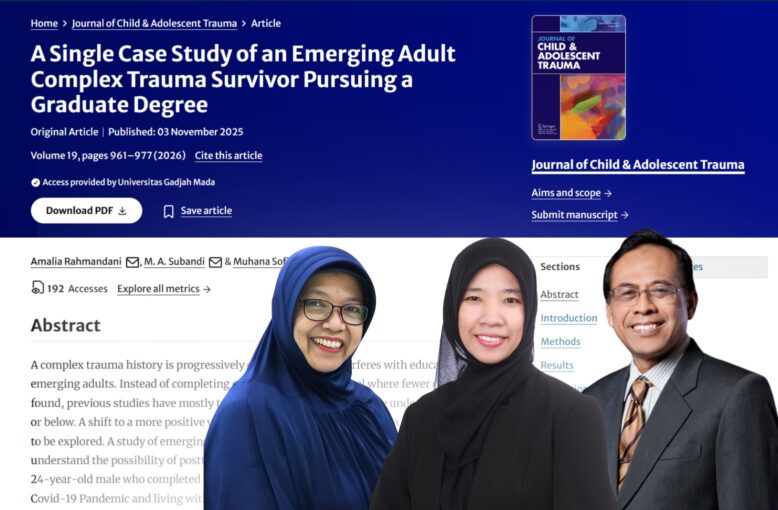
Yogyakarta, October 26, 2026 — Childhood complex trauma can pose long-term challenges in a person’s life, including when pursuing higher education. However, traumatic experiences do not necessarily hinder individual development. A study by the Faculty of Psychology at Universitas Gadjah Mada (UGM) reveals how a complex trauma survivor successfully completed graduate education despite facing various life challenges.
The study, titled “A Single Case Study of an Emerging Adult Complex Trauma Survivor Pursuing a Graduate Degree,” was authored by Dr. Amalia Rahmandani, S.Psi., M.Psi., Psikolog, Prof. Drs. Subandi, M.A., Ph.D., Psikolog, and Dra. Muhana Sofiati Utami, M.S., Ph.D., Psikolog.. The article was published in the Journal of Child & Adolescent Trauma in 2026.
The study addresses how complex trauma can affect individual development and educational achievement. Nevertheless, the experiences of survivors who pursue higher education offer valuable perspectives on recovery, growth, and resilience. Using a single-case study with an interpretative phenomenological approach, the researchers examined the experiences of a 24-year-old student who successfully completed graduate education despite various challenges. These included restrictions on in-person learning during the COVID-19 pandemic and the necessity of living with a parent who had been a source of childhood trauma.
The analysis identified four main themes that illustrate the participant’s adjustment and persistence in academia.
First, the participant compromised with academic demands. The initial decision to pursue graduate education was influenced by parental control. Although the participant felt that graduate study entailed substantial expectations, they chose to compromise and persevered through health problems, financial difficulties, and the challenges of distance learning.
Second, the participant negotiated their potential despite perceived shortcomings. The effects of childhood trauma created barriers to interpersonal communication and led to self-doubt during classroom discussions. However, the participant used cognitive strategies to recognize their academic capabilities and align their career aspirations with their personal characteristics.
Third, the participant navigated destructive relationships while building constructive ones. Recurring parental conflicts were managed through cognitively controlled, emotion-focused coping strategies. In addition, the participant developed healthy and supportive social relationships outside the family, including relationships with a partner and peers.
Fourth, the participant persistently developed a talent related to their studies. Graduate education served as a source of knowledge and a stepping stone for developing an entrepreneurial interest that had been nurtured since childhood.
These findings suggest that the academic journeys of trauma survivors cannot be understood solely in terms of the obstacles they face. Individual experiences, coping strategies, social relationships, and opportunities to develop personal potential are also important aspects of the process.
The study offers insights for higher education institutions seeking to create learning environments that are more responsive to students with traumatic experiences. Support may include recognizing the uniqueness of individual experiences, providing flexibility in addressing academic challenges, and ensuring access to appropriate social and professional support.
Educators and practitioners can also help students recognize their strengths and potential, develop strategies for managing difficulties, and build supportive relationships that facilitate learning. This approach does not mean disregarding the effects of trauma. Rather, it acknowledges both the challenges individuals face and their potential for growth.
The study highlights the importance of understanding academic success among trauma survivors within its specific context. A single experience cannot be generalized to all survivors, but it can provide insights into possible pathways to growth and the importance of appropriate support. Through this understanding, higher education institutions are encouraged to create learning environments that focus not only on academic achievement but also on the diverse experiences and needs of their students.
Writer: Fauzi
Editor: Zufar