
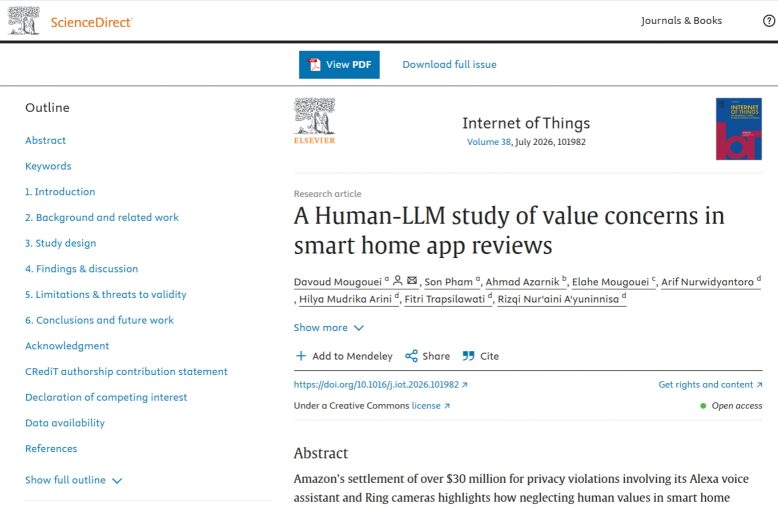
Yogyakarta, June 22, 2026 – Smart home applications such as Amazon Alexa, Google Home, and Samsung SmartThings have become increasingly integrated into daily life, offering greater automation and convenience. However, behind this convenience lies an important question: could these technologies inadvertently violate users’ fundamental values? This question is at the heart of a recent study conducted by researchers from Universitas Gadjah Mada (UGM) in collaboration with researchers from Deakin University (Australia), Universiti Teknologi Malaysia, and Universiti Malaya. The findings were published in the international journal Internet of Things (Vol. 38) in an article titled “A Human-LLM Study of Value Concerns in Smart Home App Reviews.”
The study, conducted by Davoud Mougouei, Son Pham, Ahmad Azarnik, Elahe Mougouei, Arif Nurwidyantoro, Hilya Mudrika Arini, Fitri Trapsilawati, and Rizqi Nur’aini A’yuninnisa, combines Large Language Model (LLM)-based analysis with expert evaluation to identify users’ value concerns expressed in smart home application reviews. As smart home technologies—including voice assistants, security cameras, and home automation systems—continue to evolve rapidly, they not only provide greater convenience but also raise important issues related to privacy, data security, transparency, and human values.
The research was motivated by a number of reported privacy breaches involving smart home devices. According to the researchers, these incidents demonstrate that technological development should not focus solely on functionality but must also consider the values that matter most to users.
In this study, the research team analyzed thousands of user reviews from the three leading smart home platforms: Google Home, Amazon Alexa, and Samsung SmartThings. Large Language Models (LLMs) were employed to identify scenarios that potentially violated users’ values, referred to as value concerns. The AI-generated analyses were subsequently validated by evaluators from computer science and social science disciplines to ensure consistency, feasibility, and accurate interpretation.
The findings revealed several critical issues regarding how application design can negatively affect users. More than 75% of problematic reviews highlighted violations of the value of self-direction–action, where users felt they had lost the freedom to control their own devices because of overly rigid automation systems and interfaces that restricted navigation.
Beyond autonomy-related issues, nearly 25% of complaints were associated with reduced user satisfaction. These complaints were commonly triggered by slow application performance, recurring technical issues, and media playback failures. Around 5% of complaints also involved threats to users’ personal security, with reports of technical vulnerabilities such as unexpected network disconnections and software bugs that exposed users’ private spaces. The researchers hope these findings will serve as valuable guidance for developers in designing more responsible, human-centered smart home systems.
Through this study, the researchers emphasize that although smart home technologies promise significant improvements in efficiency, their implementation often comes at the expense of users’ autonomy, satisfaction, and security. Poor interface and system design decisions can create multidimensional harm to fundamental human values. Therefore, future development of Internet of Things (IoT) technologies should extend beyond technical innovation and place greater emphasis on their impact on individuals and society.
Writer: Fauzi
Editor: Zufar