Arsip:

Doctorate Study Program in Psychology

UGM Faculty of Psychology Welcomes 127 New Graduate Students for the 2026/2027 Academic Year

The Faculty of Psychology at Universitas Gadjah Mada (UGM) welcomed 127 new graduate students for the 2026/2027 Academic Year through the New Student Academic Orientation (OAMABA), which began at Hall D of the Faculty of Psychology UGM on Monday (August 10). The opening and joint orientation session was attended by students from three study programs: 48 students from the Professional Psychology Education Program, 69 students from the Master’s Program in Psychology, and 10 students from the Doctoral Program in Psychology. read more

Radhiatul Fitri Earns Cum Laude Doctoral Degree, Reveals Role of Trauma-Specific Reflective Functioning in Parenting

Radhiatul Fitri, S.Psi., M.Psi., Psikolog, has earned a Doctoral degree in Psychology after graduating with cum laude honors from the Open Examination of the Doctoral Program in Psychology, Faculty of Psychology, Universitas Gadjah Mada (UGM), on Friday (August 7). Radhiatul completed her doctoral studies in three years, 10 months, and 15 days, achieving a cumulative GPA of 3.87 and an A grade in her closed examination. She became the 7,399th doctoral graduate of UGM.

Big Data Training for Doctoral Students

Thursday (27/1) and Friday (28/1) the Center for Indigenous and Cultural Psychology (CICP) in collaboration with the UGM Psychology Doctoral Study Program held a webinar with the title “Big Data Training for Doctoral Students”. This event discusses the application of data collection and analysis techniques from social media in research in the field of psychology. This event is specifically for students of the UGM Psychology Doctoral Study Program.

On Thursday the event took place from 13.00 WIB to 16.00 WIB. Meanwhile, on Friday the event will run from 14.00 WIB to 16.00 WIB. The event was attended by 25 participants of doctoral students from the Faculty of Psychology, UGM.

The event was opened by Haidar Buldan Thontowi, S.Psi., M.A., Ph.D. lecturer at the UGM Faculty of Psychology and the head of the UGM Center of Indigenous and Cultural Psychology (CICP). In addition to opening the event, Buldan also provided material on introduction to Big Data and Analytics.

In his presentation, Buldan explained about the possibility of using data from social media in psychological research. Starting from his introduction to twitter data as a basis for analyzing his research data when completing his doctoral program, Buldan said that there are several advantages or advantages when using social media data as research data.

“So, when distributing surveys there is a tendency that people might fill in according to social norms. (On the other hand) when I see it on Twitter, the emotion comes out. So, they use harsh words or whatever they are free to do that,” said Buldan.

Next, Buldan explained about some software that can be used to retrieve data from social media. Not to forget, theoretical books on the use of social media data were also introduced in this session. Finally, Buldan also explained about the research using Big Data that is currently underway at CICP, which include “Coping During a Pandemic: Twitter Analysis of Psychosocial Responses to the Impact of Covid-19 in Indonesia” and “Changing Risk Perception in the COVID-19”. Pandemic: A Sentiment Analysis of Two Lockdown Periods in Indonesia”.

The next session continued with an explanation of the Twitter data retrieval technique by Syurawasti Muhiddin, S.Psi., M.A. In this session, participants are invited to learn step by step taking data from Twitter social media legally. Therefore, Shura started his training by teaching participants how to create a Twitter API (Application Programming Interface) because it is the main requirement to be able to legally retrieve Twitter data.

Then in the third session, Lalu Tarangga Arief Gunawan presented a training material for Data Preprocessing and Data Cleaning. At this stage the training participants are invited to understand the parts of the data that are important and not important to be separated and cleaned. Some of the techniques he teaches include case folding, URL cleaning, mentions, hashtags, reserve words, emoji, smileys, numbers, removing punctuation marks, spelling correction, and cleaning stop words.

On the second day of the event, the presentation was filled with material about the Orange Application by Yunita Sari, S.Kom., M.Sc., Ph.D. In this closing session, Yunita invites participants to learn from the introduction of the Orange application, data retrieval using the Orange application, and finally data analysis using the Orange application. Yunita invites participants to directly apply what they teach in the Orange application through the data that has been provided.
 

Photo by Adeolu Eletu on Unsplash

Online Workshop: Research Ethics in Mental Health Research

On Wednesday (12/1), the Doctoral Program in Psychology UGM held a second day Research Ethics Series with Dr. Diana Setiyawati, M.HSc., Psy., Psychologist and Aliza Hun from Australia National University. The event began with a speech delivered by the Head of the UGM Psychology Doctoral Study Program, Edilburga Wulan Saptandari, S.Psi., M.Psi., Ph.D Psychologist. “Thank you also to the ladies and gentlemen who were present, both doctoral students and friends from various places and various institutions. Today is the second day of the Research Ethics Series, yesterday we discussed research ethics in general and tomorrow there will be once more webinar session,” said Edilburga through his speech.

“Maybe I’ll repeat some principles because that’s basically ethical, but later we will elaborate further with a discussion with Aliza,” explained Diana as the first session filler. Before delivering the material, Diana had time to give some questions to the participants with the aim of making the interaction better. These questions revolve around when someone is in pasung who can give consent, is it allowed to take data in a familiar environment for researchers, and why we must respect or uphold research ethics.

The number of violations that occur when conducting research makes a research ethics important. One of the efforts to minimize violations during research is the existence of the Declaration of Helsinki. The declaration states several things, that research in humans must protect participants, even the benefits obtained by participants must outweigh the risks. “Even though we are researchers, it does not mean that researchers are in a superior position,” explained Diana.

Based on the Bellmont Report, there are three basic research ethics consisting of Respect for Person, Justice, and Beneficence/Non-Maleficence. There are several forms of respect for person that can be done when conducting research, such as giving informed consent to participants, maintaining confidentiality, and participants’ freedom to withdraw from the research process. In addition, one of the ways to maximize the welfare of research participants is to maximize the benefits of participating in the research process. Finally, fairness includes selecting participants according to research procedures and results can be accessed without commercialization.

Then the next session was delivered by Aliza Hun with the title Research Ethics in Survey Research Method. “I was invited to talk a little about personal reflection when taking data in Indonesia”, explained Aliza. Aliza admitted that her condition as a someone who came not from Indonesia, including her institution’s origin from abroad, influenced her research process. In addition, Aliza also said that there will be many parties who must be contacted regarding research ethics before collecting data. “In fact, there are differences that I have to live with, one of which is that researchers from abroad must obtain permission from the Ministry of Research, Technology and Higher Education, while research from Indonesia is not necessary,” said Aliza


 Photo by Brett Jordan from Pexels

Doctoral Program in Psychology Holds Intensive Statistics Course

The Doctoral Program in Psychology, Faculty of Psychology UGM held an Intensive Course on Advanced Statistical Analysis in Research in the Social Sciences. This intensive course activity is held for 5 days starting on August 30, 2021, until September 3, 2021. This course activity was opened by the Head of the Psychological Science Doctoral Program, namely Rahmat Hidayat, S.Psi., M.Sc., Ph. D

“Just to introduce this intensive course is a form of learning in the 2020 Psychology Doctoral Program curriculum where learning activities are carried out in a modular manner,” said Rahmat through his opening remarks. In addition, Rahmat also said that this intensive course was a refresher activity on statistics, especially for Psychology Doctoral Program students and Psychology Doctoral candidates who still needed to refresh their statistical material.

This intensive course activity begins with the material “Mediator Analysis” delivered by Haidar Buldan Thantowi, M.A., Ph. D. Haidar presents several examples of research titles using the mediator analysis model. “This mediation is one of the analyzes that I think is quite interesting and provides an opportunity for us to test more complicated hypotheses,” said Haidar.

In general, especially at the undergraduate level, they are often taught about the analysis between two variables. While mediation recognizes that the relationship between variables is not as simple as one variable with another variable. In this intensive course, Haidar not only delivered material, but also directly taught course participants how to analyze mediators using SPSS and Jamovi applications.

The activity which lasted for 5 days consisted of several topics, including “Moderator Analysis”, “Longitudinal Analysis, Confirmatory Factor Analysis, Structural Equation Modeling, and various other interesting materials. In addition, these materials were delivered by various competent speakers in their fields, such as Prof. Dr. Faturochman, M.A., Galang Lufityanto, M.Psi., Ph.D., Wahyu Jati Anggoro, M.A., Wahyu Widhiarso, M.A., Muhammad Dwirifqi K.P, M.Si., Helly P. Soetjipto, M.A., and Prof. Dr. Saifuddin Azwar, M.A.


Photo by Scott Graham on Unsplash

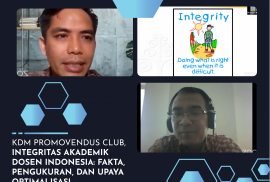
Academic Integrity of Indonesian Lecturers: Facts, Measurements, and Optimization Efforts

The Promovendus Club for the Doctoral Program in Psychology UGM again held a colloquium which is routine every two weeks on Friday (4/6). This colloquium activity raised the topic “Academic Integrity of Indonesian Lecturers: Facts, Measurements, and Optimization Efforts” which was delivered by Dr. Prasetyo Budi Widodo, S.Psi., M.Sc. Prasetyo is an alumni of the UGM Psychology Doctoral Program who is a lecturer at Diponegoro University.

Integrity is one of the problems experienced by officials in Indonesia. In general, integrity can be accessed in two ways. First, fidelity to understand and practice good values ​​according to moral principles that do not conflict with social values. Second, integrity is a complete individual character to carry out moral principles.

Departing from integrity issues which also made Prasetyo decide to conduct research on the topic. Involving 823 subjects who are lecturers in Indonesia, Prasetyo conducted research on academic integrity. “In 2015, 2016 it was very difficult to find articles about academic integrity. Well, what’s surprising is that around 2017 suddenly there were so many articles about academic integrity. I was confused as to why it suddenly became so many,” said Prasetyo.

In the past, integrity was studied in many fields in industry and organizations, especially in integrity research involving employees as subjects. In addition, the preparation of integrity measuring instruments in the industrial field and was originally intended to lie detection test. Apart from industry and organization, integration research is also conducted in education, namely academic integrity research. Academic integrity research conducted is related to the incidence of fraudulent practices, especially cheating by students.

There are 4 keywords that can be used to search the literature on academic integrity consisting of academic integrity, educational integrity, academic honesty, and academic dishonesty. Because honesty is the main of integrity, although along the way, integrity will get additional other values. Therefore, academic integrity can also be interpreted as an individual commitment to realizing the values ​​of honesty, trust, justice, and responsibility. This meaning was pioneered by the International Center for Academic Integrity (ICAI), which is an association of universities in America that focuses on academic integrity.

Initially ICAI defined academic integrity with five values, but in 2013 ICAI added one value, namely courage. The value of courage according to ICAI is a value that can implement the other five values. Without courage, individuals cannot realize other values ​​contained in the meaning of academic integrity.

Furthermore, in this colloquium material, Prasetyo also said that academic integrity is the hallmark of a human learner. Apart from being important for the implementation of the mission of the university, integrity also related to the reputation of a university. According to Prasetyo, the enforcement of academic integration can be done through detection as a form of effort whether there is a lack of academic integrity in lecturers. Therefore, a measuring instrument with high reliability and validity is needed. In addition, the enforcement of academic integrity can be done through the application of rules and socialization that can be delivered through lectures or the installation of banners.

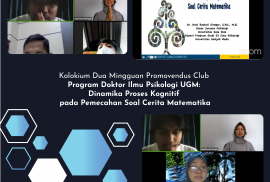
KDM Promovendus Club: Cognitive Process Dynamics in Solving Math Story Problems

On Friday (28/5) the Promovendus Club of the UGM Psychology Doctoral Program again held an event with the topic “Cognitive Process Dynamics in Solving Math Story Problems”. The topic was presented by Dr. Nani Restati Siregar, S.Psi., M.Si who is a lecturer at Halu Oleo University, as well as an alumni of the UGM Psychology Doctoral Program. This event is part of a colloquium which is regularly held every two weeks by the Promovendus Club online.

Through the material presented, Nani explained that solving math story problems is not just doing assignments or exams. However, solving math problems is also related to the four competencies possessed by students. According to the Program of International Student Assessment (PISA), solving math story problems is related to four competencies, namely personal, social, occupational, and scientific. Therefore, learning mathematics, especially related to solving story problems, is an important thing.

If described in more detail these four competencies have their respective effects on students. First, personal competence relates to how solving math story problems trains students to solve personal problems. Second, the narrative of math story problems uses problems that are close to everyday life. This is closely related to social competence. Then, math story problems have an effect on the development of technology and informatics. It is included in the occupational competence. Finally, scientific competence is concerned with training students to not only solve problems, but also collect data that helps when conducting scientific studies.

Besides being related to competence, math story problems also involve several cognitive processes, namely working memory, inhibitory control, and shifting. Working memory is the process of marking/ignoring unimportant information. While inhibitory control is related to how to solve story problems. Students tend to spontaneously and unfiltered use problem-solving strategies that were previously when they find story questions that are similar or have been encountered before. The last, the cognitive process related to the speed with which students understand words and numbers is called shifting.

Based on research conducted by Nani, students with high working memory and shifting capacity consider math story problems to be something “ordinary”. Meanwhile, students with low working memory and only supported by inhibitory control consider math story problems as difficult questions.

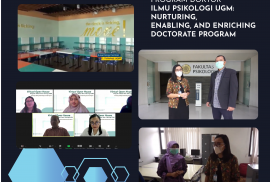
Virtual Open House UGM Psychology Doctoral Program

UGM Psychology Doctoral Program held a Virtual Open House on Thursday and Saturday (6/5 & 8/5). The event can be followed through a zoom link distributed by the committee to participants who have registered or can be followed through the UGM Psychology Faculty Knowledge Channel YouTube channel. This event was held to introduce the Psychology Doctoral Program to the general public by raising the tagline Nurturing, Enabling, and Enriching Doctorate Program. Through this tagline, it is hoped that when someone has joined the extended family of the UGM Psychology Doctoral Program, they can guide, empower, and enrich each other’s knowledge.

On the first day, the event was divided into two sessions. In the first session, Pradyta Putri Pertiwi, S.Psi., Ph.D and accompanied by Etik Setyaningsih as a guide. Starting at 10.00, participants were invited to take a virtual walk for 30 minutes to see the learning environment of the UGM Psychology Doctoral Program. Starting from visiting classrooms used to units where Doctoral Program students can intern and collaborate on scientific research.

Then, in the second session, it was continued with a presentation on the 2020 UGM Psychology Doctoral Program curriculum delivered by Rahmat Hidayat, S.Psi., M.Sc., Ph.D. Prior to the presentation of the latest curriculum, Rahmat invited participants to know the history of the beginning of the formation and the journey of the Psychological Science Doctoral Program over the decades until now.

The virtual open house event continued on the second day which began with the introduction of the academic community of the UGM Psychology Doctoral Program and the promoter and co-promoter by the Dean of the Faculty of Psychology UGM, Prof. Dr. Faturochman, M.A. Afterwards, the event was continued with discussions and questions and answers on the 2020 UGM Psychology Doctoral Program Curriculum which was delivered the previous day.

In the next session, it was filled with how to build chemistry between promoters and students through the topic “Student and Promoter Relationships”. The session was attended by Dr. Avin Fadilla Helmi, M.Si., and Dr. Bagus Riyono, M.A as the promoter representative and Dr. Cicilia Larasati Rembulan, M.Psi., A psychologist as an alumni and Tri Astuti, M.Psi., A psychologist representing students of the UGM Psychology Doctoral Program.

Furthermore, the virtual open house event of the UGM Psychology Doctoral Program was closed with an introduction and presentation of the Promovendus Club which was filled by Arumi Savitri Fatimaningrum, S.Psi., MA, and Sartana, MA who are students of the UGM Psychology Doctoral Program class of 2019. This Promovendus Club is a one of the places where students of the UGM Psychology Doctoral Program gather and are already 9 years old. In addition, the Promovendus Club is one of the special parts of the UGM Psychology Doctoral Program because it acts as an intermediary for the kinship that exists between students.

Understanding and Diagnosing Children with Dyslexia

Promovendus Club, Doctoral Program in Psychology held an event with the topic “Understanding and Diagnosing Children with Dyslexia” on Friday (16/4). The event which takes place at 09.00 WIB is part of the colloquium which is routinely held every 2 weeks by the Promovendus Club online.

Attending this event Dr. Trubus Raharjo, S.Psi., M.Sc., a psychologist as a presenter who is a lecturer at Muria Kudus University and an alumnus of the UGM Psychology Doctoral Study Program. There were several things conveyed by Trubus through this event, including how to recognize the symptoms of dyslexia learning difficulties, how to diagnose children with dyslexia, and how to treat children with dyslexia. “So far, information about dyslexia, especially for teachers, educators, and psychologists is still very minimal. There are several communities and so on, but most of them are held by pediatricians, usually so, “said Trubus.

Dyslexia according to The International Dyslexia Association is a specific learning difficulty that comes from neurological factors. “That dyslexia is a specific learning difficulty because later it will differentiate it from other general learning difficulties, such as autism, retardation, intellectual disorder, intellectual disability,” explained Trubus. Children with dyslexia have problems that generally appear to have difficulty reading, writing and spelling. “Although later there are other behaviors that characterize a child with dyslexia or even an adult with dyslexia.” According to Trubus, early detection of dyslexia can be done in the pre-school period, although it is usually seen in the first year of school children.

Dyslexia is said to be a specific disorder because the reference for the diagnosis of dyslexia is DSM-5 and is included as a neurodevelopmental disorder in the category of specific learning disorders. Furthermore, there are three main things that make dyslexia a specific learning disorder, namely biological factors whose context can be genetic, accident, or collision. Then, there are abnormalities at the cognitive level related to the ability to understand, reason, and also logic. In addition, dyslexia is also associated with behavioral signs, such as the inability to write, read, and spell.

The behavioral disorders seen in children with dyslexia include, like talking to themselves, children at their will, comorbid ADHD or speech delay, and so on, including often saying words or sentences that are upside down. “Now this is what sometimes causes emotions to children because they think the adults around them, father, mother, and siblings do not understand what is being asked,” explained Trubus.

The topic that was raised at the event this time was quite attractive to the community, as evidenced by the registrants who entered beyond the capacity that had been provided. This makes the committee have to provide a YouTube link so that participants can still join even though they don’t get a zoom link. A complete explanation regarding dyslexia can be listened to on the YouTube channel of the UGM Psychology Doctoral Program.

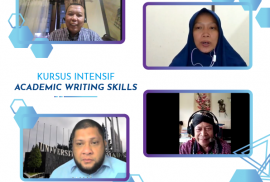
Intensive Academic Writing Skills Course

In order to improve scientific writing skills in Indonesian, the UGM Psychology Doctoral Program held an Intensive Academic Writing Skills Course which will take place on Monday (1/3) and Tuesday (2/3) March 2021. The event is divided into four sessions, each of which focuses on the topics of “Scientific Writing is Fun”, “Diagnosis of Writing Ability”, “Writing Process” and “Examples of Simple Writing” were filled in by Drs. Heru Marwata, M.Hum. Through this event, Heru challenges each participant as well as guiding and correcting mistakes made by the participants. In addition, this event also provides a lot of knowledge in writing that can be continuously trained so that in the future it can be even better.

According to Heru, there are several important things that need to be considered when writing, namely conjunctions, spelling (EYD/PUEBI), diction (choice of words), sentences (effective), paragraphs and writing or essays. The hope is that when participants get to know the Indonesian sentence structure, they will be able to formulate correct and good sentences.

Furthermore, Heru also explained the linguistic aspects related to whether an idea was good or not and how well the idea was conveyed. There are also aspects of aesthetic that are supported by choosing the right diction, for example using a tone ending that sounds the same. The choice of diction can be done when the writer has many choices of diction and increasing the choice of diction can be done by reading. In addition, the choice of words/diction is very important because it contains the spirit of the sentence and the spirit of the sentence will affect the paragraph. The choice of the right words will also affect the effectiveness of the sentences we compose. “Sentences should be read out in one breath”, explained Heru.

On the second day, Heru explained the writing process and showed some examples of simple writing. According to Heru, scientific work is influenced by the writer’s mastery and understanding of the written material, the ability to structure ideas, how to formulate problems, and how to convey goals. Apart from that, Heru also gave tips to the participants regarding the writing process by suggesting an outline. “Using an essay framework will help the writer coordinate ideas before starting to write, make it easier to find relevant material, and can show the main part of the writing to the author,” said Heru.

Apart from the outline of the essay, the selection of topics and titles were also tips offered by Heru to the participants in the writing process. In choosing a topic, the writer is advised to choose a topic that is useful, feasible, interesting, mastered, easy to get written material, actual, not too broad/narrow, and representative. “Topics that are not interesting for writers will later become a burden and hinder the writing process,” said Heru.

At the end of the session, Heru said that writing is not an activity in the heart, but an action that must be tried and tried is a measure of one’s courage. “To process sentences requires experience of skills that are obtained through practice, practice, practice,” explained Heru.