
Mental health information is increasingly accessible through social media, including content about depression, anxiety, ADHD, and burnout. However, this ease of access also carries the risk of misunderstandings, as many individuals attempt self-diagnosis without proper psychological assessment, labeling themselves without fully understanding the context or limitations of the information they receive.
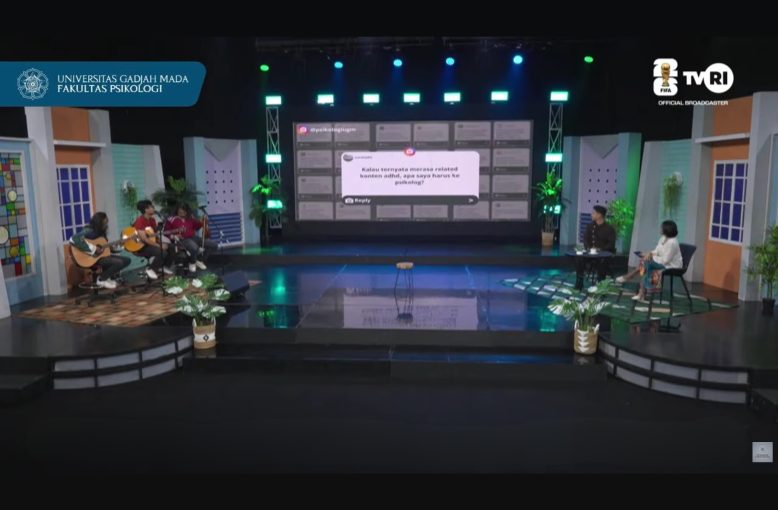
This topic was featured in the latest episode of Obrolan Psikologi (OPSI), a psychology talk show produced collaboratively by the Faculty of Psychology at Universitas Gadjah Mada (UGM) and TVRI Yogyakarta, on Tuesday (2/6). Hosted by Argya Hanisi, the seventh episode featured Patera Adwiko Priambodo, S.Psi., M.Psi., Psikolog, a doctoral student at UGM, discussing the growing phenomenon of self-diagnosis.
Self-diagnosing refers to an individual’s attempt to identify their own psychological condition based on information obtained from various sources, including social media. While the desire to understand oneself is positive, psychological or mental health diagnoses cannot be made solely based on one or two perceived symptoms.
Many psychological symptoms may appear similar, but do not necessarily indicate a diagnosis; for instance, feeling sad for a few days does not automatically mean depression, and difficulty concentrating does not always signify ADHD.
“For example, it is like building a house. When you want to build a house, you would want it done by a competent architect,” said Patera. In professional practice, diagnosis requires a comprehensive process. Psychologists and mental health professionals must conduct interviews, observations, assessments, and consider multiple factors influencing an individual’s condition before drawing conclusions.
Patera emphasized that mental health should be understood holistically. Therefore, if someone experiences psychological difficulties that interfere with daily life, the appropriate step is to consult a qualified psychologist or mental health professional.
“Psychology content on social media can be useful to raise awareness. However, if someone starts to feel they may have a condition based on that content, it needs to be discussed with a mental health professional,” Patera explained.
He added that social media content is often presented briefly and simply to be easily understood by audiences. While useful for initial education, this simplification can lead some individuals to overlook the complexity of actual psychological conditions.
As a result, individuals may experience overidentification, the tendency to feel that all information in a content piece fully describes them. This can trigger anxiety, excessive worry, or the belief that they have a specific disorder without proper evaluation.

“When someone labels themselves based on such content, especially from unclear sources, it can actually increase panic,” said Patera.
Patera also explained the phenomenon of cyberchondria, in which self-diagnosing online increases anxiety and a sense of helplessness due to misleading information. He noted that the first step for professionals is to restructure the client’s thinking so they can understand their condition accurately and regain a sense of agency.
“Self-diagnosis can leave a person unsure how to proceed with treatment. Mislabeling themselves may make them unable to determine ‘what’s next?’” Patera said.
In addition to providing a more accurate understanding, professional consultation allows individuals to receive treatment recommendations appropriate to their needs.
Ultimately, increased public attention to mental health is a positive development. However, this awareness must be balanced with critical thinking to evaluate information and understand the limitations of content on social media. In this way, people can benefit educationally from digital media without falling into misleading self-diagnosis practices.
Don’t miss other interesting episodes of Obrolan Psikologi (OPSI)!
Watch the full replay and follow more psychology discussions through the Faculty of Psychology UGM Knowledge Channel:
Let us know if there are specific psychological issues you would like to see discussed in Obrolan Psikologi (OPSI), a collaboration between the Faculty of Psychology UGM and TVRI Yogyakarta.
Watch the full episode on YouTube!
Share your suggestions and feedback regarding OPSI through:
Email: humas.psikologi@ugm.ac.id
Instagram: @psikologiugm
Author: Arrasya Aninggadhira
Editor: Erna Tri Nofiyana