The rise of social media has changed the way the public expresses its assessment of the performance of public institutions. Negative opinions circulating on social media not only pose challenges to organizational reputation but may also influence the attitudes, motivation, and behavior of public servants in carrying out their duties.
This issue was examined in a study by Muhammad Royhan, Ely Susanto, S.IP., MBA., Ph.D., and Rahmat Hidayat, S.Psi., M.Sc., Ph.D., which investigated the relationship between negative public opinion on social media, public service motivation (PSM), and employee behavior among civil servants in Indonesia.
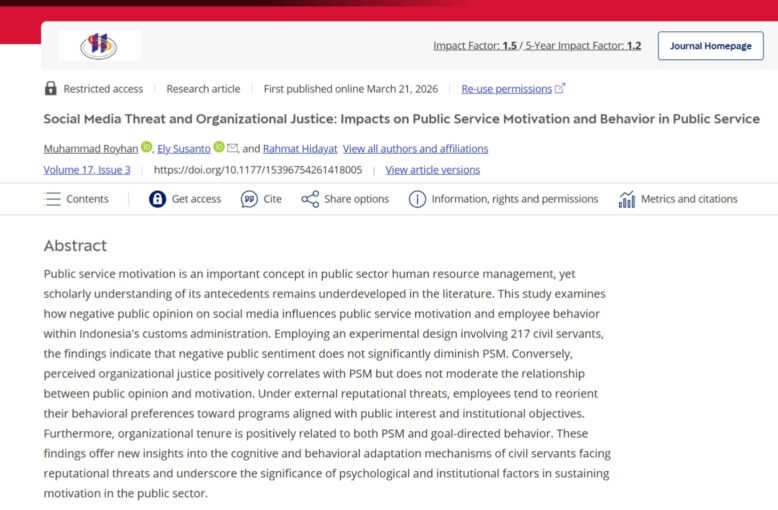
The study, entitled “Social Media Threat and Organizational Justice: Impacts on Public Service Motivation and Behavior in Public Service,” highlights the importance of public service motivation as a concept in public-sector human resource management. However, the factors that shape and sustain such motivation in an era of information openness remain not fully understood in the literature.
To examine these relationships, the researchers employed an experimental design involving 217 civil servants. The study focused on how public servants responded to negative public opinion on social media and how perceptions of organizational justice were associated with their motivation to serve the public interest.
The findings showed that negative public sentiment on social media did not significantly reduce public service motivation among civil servants. This suggests that public servants’ motivation to provide public services does not necessarily decline when they face pressure or negative assessments from the public in the digital sphere.
In contrast, perceptions of organizational justice were positively associated with PSM. Public servants who perceived their organizations as providing fair treatment and fair processes tended to demonstrate higher levels of public service motivation.
However, the study found no evidence that perceptions of organizational justice strengthened or weakened the relationship between negative public opinion and PSM. In other words, while organizational justice was associated with higher public service motivation, it did not appear to moderate the impact of external reputational threats on such motivation.
Interestingly, the study found that external reputational threats could influence public servants’ behavioral preferences. When facing reputational threats, public servants tended to shift their focus toward programs aligned with the public interest and institutional goals.
These findings indicate that public servants’ responses to public criticism do not necessarily take the form of declining motivation. Under certain conditions, external pressure may instead encourage cognitive and behavioral adjustments, leading public servants to align their actions more closely with the interests of the public and organizational objectives.
The study also found that organizational tenure was positively associated with both PSM and goal-oriented behavior. This finding suggests that experience and length of service within an organization may be among the factors associated with stronger public service motivation and a greater tendency to act in accordance with institutional goals.
The study offers a new perspective on how public-sector employees respond to reputational pressures arising through social media. Its findings demonstrate that the relationship between public opinion, service motivation, organizational justice, and employee behavior is more complex than the assumption that negative criticism will automatically reduce motivation.
In the context of increasingly digitalized public administration, social media has become an important space for interaction between citizens and government institutions. Understanding the psychological and behavioral responses of public servants is therefore increasingly important in developing human resource management strategies in the public sector.
The findings also underscore the importance of psychological and institutional factors in sustaining public servants’ motivation. Building an organizational environment perceived as fair, while strengthening an orientation toward the public interest and institutional goals, can form an important part of strategies for managing public servants when organizations face reputational pressures in the digital sphere.
More broadly, this study contributes to the development of public administration scholarship by demonstrating that reputational threats arising from social media can trigger cognitive and behavioral adaptation among public servants. These findings may serve as a consideration for public-sector organizations in managing their reputation, maintaining employee motivation, and ensuring that service quality remains oriented toward the interests of the public.
Editor: Zufar
Layout: Fauzi