
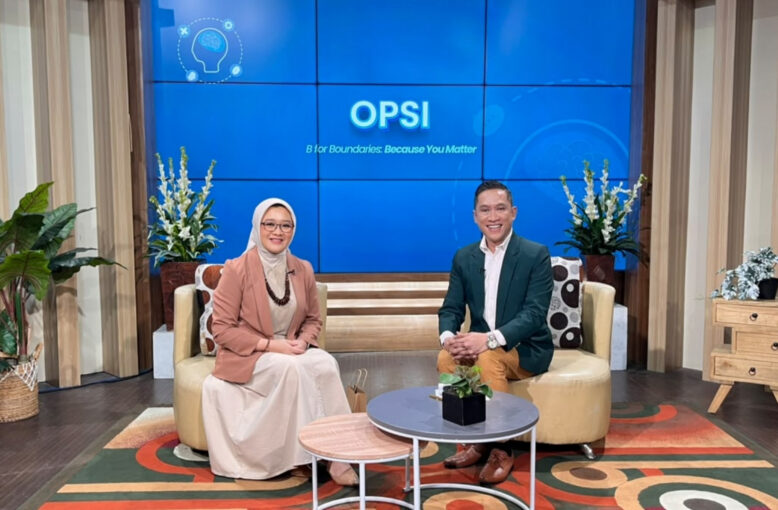
In everyday life, people often become a listening ear for others. Without realizing it, however, they may begin carrying burdens that do not belong to them. They may feel obligated to always understand, help, or be someone others can depend on while gradually neglecting their own needs and well-being.
This topic was explored in the latest episode of Obrolan Psikologi (OPSI), a psychology talk show jointly produced by the Faculty of Psychology at Universitas Gadjah Mada (UGM) and TVRI Yogyakarta, on Tuesday (August 18). Hosted by Ferry Anggara, the twelfth episode of the year featured UGM Faculty of Psychology lecturer Metta Rahmadiana, S.Psi., M.Si., Psikolog, who discussed the importance of personal boundaries in maintaining mental health and respecting oneself.
Having boundaries does not mean being selfish. On the contrary, healthy boundaries can be a way of respecting and protecting oneself.
Personal boundaries are limits established to protect one’s personal space, time, emotions, and values. They help individuals care for others without taking full responsibility for other people’s problems.
Being a good listener does not mean always having to be a rescuer. Without healthy boundaries, people may continuously absorb emotions from those around them, leaving them tired, overwhelmed, or experiencing burnout—a state of physical and emotional exhaustion caused by prolonged stress.
However, setting boundaries does not mean building a wall that separates someone from others.
“It is like having a house with a fence. The fence needs to be flexible—it can open and close,” Metta explained.
Boundaries may change depending on the relationship, situation, and level of trust. People can remain present for others while still preserving the space they need to care for themselves.
Understanding Hurtful Behavior
When dealing with people who continually bring negative energy—such as those who frequently belittle others or take their emotions out on them—it is important to understand that such behavior often stems from their own unresolved issues.
“Haters are hurt people. They carry wounds and want to hurt others so that we feel hurt too,” Metta said.
This understanding can help people recognize that they do not have to accept every emotion directed at them as their personal responsibility. They can remain empathetic without allowing themselves to become an outlet for emotions that continually cause them harm.
How to Build Healthy Boundaries
Building healthy boundaries can begin with clear communication. People should express what makes them uncomfortable and explain how they would like to be treated.
If those boundaries continue to be disregarded, they may need to take firmer action, such as reducing interaction or creating some distance.
Protecting one’s mental health does not mean becoming indifferent. In fact, healthy boundaries allow people to be there for others in more constructive and sustainable ways.
Metta also emphasized the importance of leaving unhealthy relationship patterns behind so that the same experiences and emotional wounds are not passed down to future generations.
“We need to break the cycle so that it does not continue into future generations,” Metta said.
Ultimately, people cannot always control how others behave or whether they choose to change. They can, however, control how they protect and care for themselves.
“We are responsible for our own mental health. Each of us must work toward finding inner peace in our own way,” Metta explained.
Having personal boundaries does not mean shutting other people out. Boundaries enable individuals to continue caring for, helping, and loving others without losing themselves in the process.
Do not miss other engaging episodes of OPSI: Obrolan Psikologi. Watch the full episodes and continue exploring in-depth discussions on psychology through the UGM Faculty of Psychology’s Knowledge Channel:
Let us know if there are particular psychological issues you would like to see discussed on Obrolan Psikologi (OPSI), a collaborative talk show by the UGM Faculty of Psychology and TVRI Yogyakarta.
Watch the full episode on YouTube!
Share your suggestions and feedback regarding OPSI through the following channels:
Email: humas.psikologi@ugm.ac.id
Instagram: @psikologiugm
Writer: Arrasya Aninggadhira
Editor: Erna Tri Nofiyana