
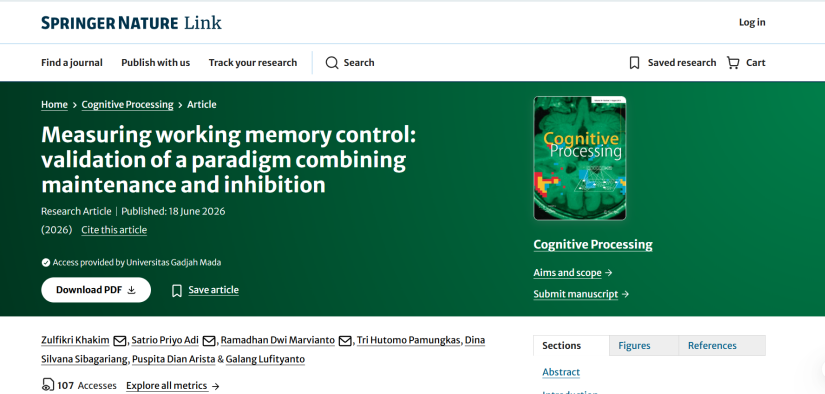
Yogyakarta, July 8, 2026 – A research team from the Faculty of Psychology, Universitas Gadjah Mada (UGM), has successfully developed and validated a new paradigm for measuring working memory control. The findings, published in the international journal Cognitive Processing, offer a more comprehensive approach to understanding a key cognitive ability that plays an essential role in learning, decision-making, and problem-solving.
The study, conducted by Zulfikri Khakim, S.Psi., M.Sc., Satriyo Priyo Adi, S.Psi., M.Sc., Ramadhan Dwi Marvianto, S.Psi., M.A., Tri Hutomo Pamungkas, Dina Silvana Sibagariang, Puspita Dian Arista, and Galang Lufityanto, S.Psi., M.Psi., Ph.D., aimed to develop an experimental paradigm capable of measuring working memory control by integrating two core executive functions: information maintenance and inhibitory control.
Previous research on executive functions has typically assessed cognitive components separately in traditional laboratory settings, including working memory capacity, inhibitory control, and cognitive flexibility. However, this isolated approach has often been criticized for failing to reflect how these cognitive processes dynamically interact in real-world situations.
To address this limitation, the researchers introduced an integrative experimental paradigm that combines cognitive inhibitory control tasks with working memory maintenance tasks into a unified framework.
To validate the paradigm, the research team recruited 238 psychology students, who completed a series of cognitive tasks, including the N-back Task, Stroop Task, and Stop Signal Task. The results showed that performance on the N-back Task—particularly the 2-back condition—and the Stroop Task significantly predicted working memory control performance. These findings demonstrate that working memory control emerges from the active interaction between information maintenance and cognitive interference resolution. In contrast, the Stop Signal Task was not significantly associated with working memory control, suggesting that motor inhibition differs from the cognitive inhibition required for effective working memory management.
The study also found that the relationships among working memory control, cognitive inhibition, and set shifting vary across individuals. Participants with higher working memory control capacity tended to rely more on cognitive inhibition, whereas those with lower capacity depended more heavily on working memory to support task-switching processes.
According to Zulfikri Khakim, the findings suggest that cognitive abilities do not operate independently but interact to support adaptive behavior.
“This study demonstrates that working memory control results from the interaction between the ability to maintain information and the ability to suppress interference. By integrating these two processes into a single paradigm, we hope to provide a more representative measure of executive functions as they operate in everyday cognition,” he said.
He added that the new paradigm could serve as a more valid alternative for future research in cognitive psychology and neuropsychology.
“This paradigm not only strengthens the theoretical understanding of executive functions but also has the potential to support the development of cognitive assessment tools and the evaluation of interventions related to attention, learning, and cognitive rehabilitation,” he explained.
The study makes an important contribution to the development of executive function measurement methods, which have traditionally been conducted in isolation. By introducing a more integrated approach, the researchers hope their findings will provide a foundation for future studies on the mechanisms underlying memory, attention, and decision-making, while also opening opportunities for the development of more accurate assessment instruments in psychology, education, and neuroscience.
Writer: Fauzi
Editor: Zufar