
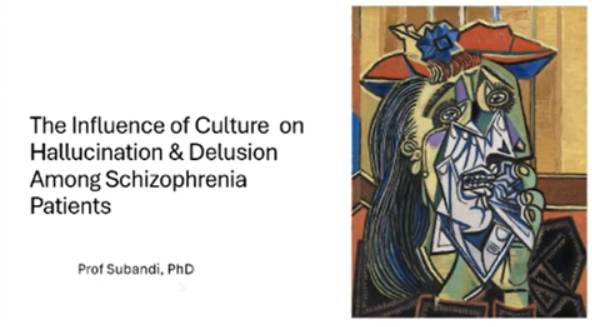
Professor of the Faculty of Psychology at Universitas Gadjah Mada (UGM), Prof. Drs. Subandi, M.A., Ph.D., Psikolog, served as a Visiting Professor at Universiti Malaysia Terengganu (UMT) on Tuesday (10/6). On this occasion, he delivered a presentation entitled “The Influence of Culture on Hallucination & Delusion Among Schizophrenia Patients,” which explored how sociocultural factors shape the experiences of hallucinations and delusions among individuals with schizophrenia.
In his presentation, Prof. Subandi explained that psychotic experiences are influenced not only by biological factors but also by cultural backgrounds and belief systems that develop within society. His research findings indicate that patterns of hallucinations differ across cultural groups.
Patients in Western countries, for example, more frequently report auditory hallucinations, such as hearing voices. Meanwhile, patients in traditional societies, including those in Indonesia, Africa, and Pakistan, are more likely to experience visual hallucinations. These findings suggest that psychotic experiences can be shaped by the cultural contexts in which individuals live and interact.
Through an ethnographic study involving 12 schizophrenia patients in hospitals across the Yogyakarta region, Prof. Subandi found that many participants reported seeing figures commonly recognized in Javanese folklore.
“In Java, patients often report seeing supernatural beings, unseen entities, spirits, such as Pocong, deceased individuals, Buto Ijo (green giant), and Genderuwo (frightening giant),” he explained.
According to Prof. Subandi, the appearance of these figures demonstrates how local culture influences the way individuals interpret their psychological experiences. Yogyakarta was selected as the research site because of its distinctive cultural characteristics, shaped by a blend of Islamic, Hindu-Buddhist, and enduring Javanese beliefs. This context makes the region particularly relevant for examining the relationship between culture and psychotic experiences.
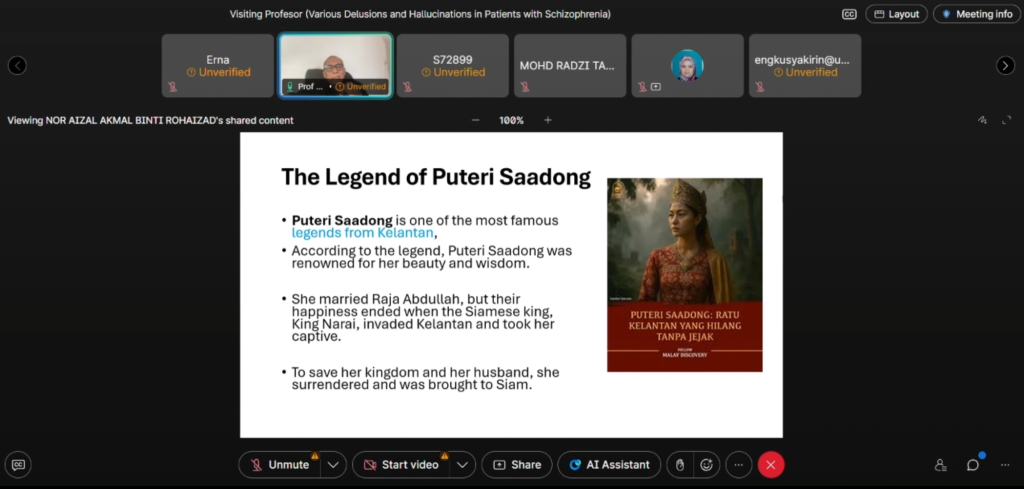
During the lecture, Prof. Subandi also compared findings from Indonesia with research conducted in Malaysia. Malay patients in Kelantan were reported to experience more visual hallucinations with strong religious themes, whereas Chinese patients in Penang more frequently described experiences involving ancestral spirits. The legendary figure of Putri Saadong from Kelantan was even found to appear in the hallucinations of several patients, functioning in ways similar to the role of Nyai Loro Kidul within Javanese cultural contexts.
These findings highlight that cultural backgrounds influence how individuals experience and interpret psychotic symptoms.
“Delusions are not merely products of one’s own thoughts; they are also influenced by the surrounding environment, culture, religion, and values,” he emphasized.
Prof. Subandi also underscored the importance of the stress-vulnerability approach in understanding schizophrenia. Within this framework, an individual’s biological vulnerability interacts with life stressors and the sociocultural environment surrounding them. Cultural sensitivity, he argued, should be integrated into both diagnostic processes and clinical interventions to ensure that mental health services are more appropriate and effective.
The event was attended by students, lecturers, and researchers from UMT. Beyond serving as a platform for knowledge exchange, the activity also formed part of broader efforts to strengthen academic collaboration between the Faculty of Psychology UGM and UMT, particularly in the areas of clinical psychology and cross-cultural mental health.
Author: Erna Tri Nofiyana