
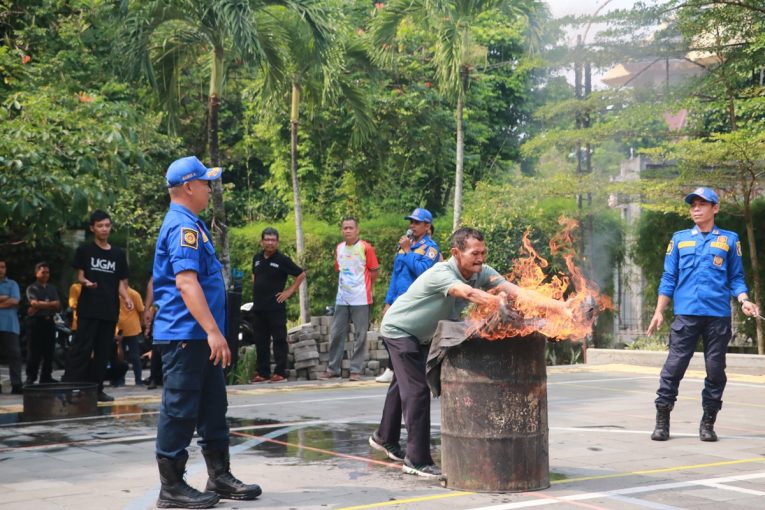
The Faculty of Psychology at Universitas Gadjah Mada (UGM) held a Firefighting Training session on Friday (22/5) at Hall D and the landscape area of the Faculty of Psychology UGM. The activity, organized in collaboration with K5L UGM (Office of Security, Occupational Safety, Emergency, and Environment), was attended by more than 75 members of the academic community.
Head of the Emergency Response Team at K5L UGM, Nunu Lutfi, S.T., M.Ec.Dev., explained that the initial response during a fire greatly determines the scale of its impact.
“UGM’s fire department has a standard response time of fifteen minutes after receiving a call. But in almost every location we arrive at, after fifteen minutes, everything has already been burned down,” he said.
According to him, people present at the location when a fire first occurs play a crucial role before emergency assistance arrives. Therefore, the training was intended not only for security personnel or technical staff, but also for the entire academic community.
During the material session, participants were introduced to the Fire Triangle concept, which consists of oxygen, heat, and fuel. A fire can be extinguished by removing one of these elements.
Nunu explained the three basic methods of firefighting: cutting off oxygen access (smothering), removing the fuel source (starving), and reducing temperature (cooling). These concepts became the foundation for the hands-on practice of using portable fire extinguishers (APAR).
He also reminded participants that fire victims often die not because of the flames themselves, but due to oxygen deprivation and smoke inhalation during evacuation.
“Seventy to eighty percent of fire victims die not from being burned, but from suffocation along evacuation routes,” he said.
Participants also learned about fire classifications based on the materials involved, ranging from solid objects, liquids and gases, electrical installations, to metals. Choosing the appropriate extinguisher type is essential to avoid creating greater risks.
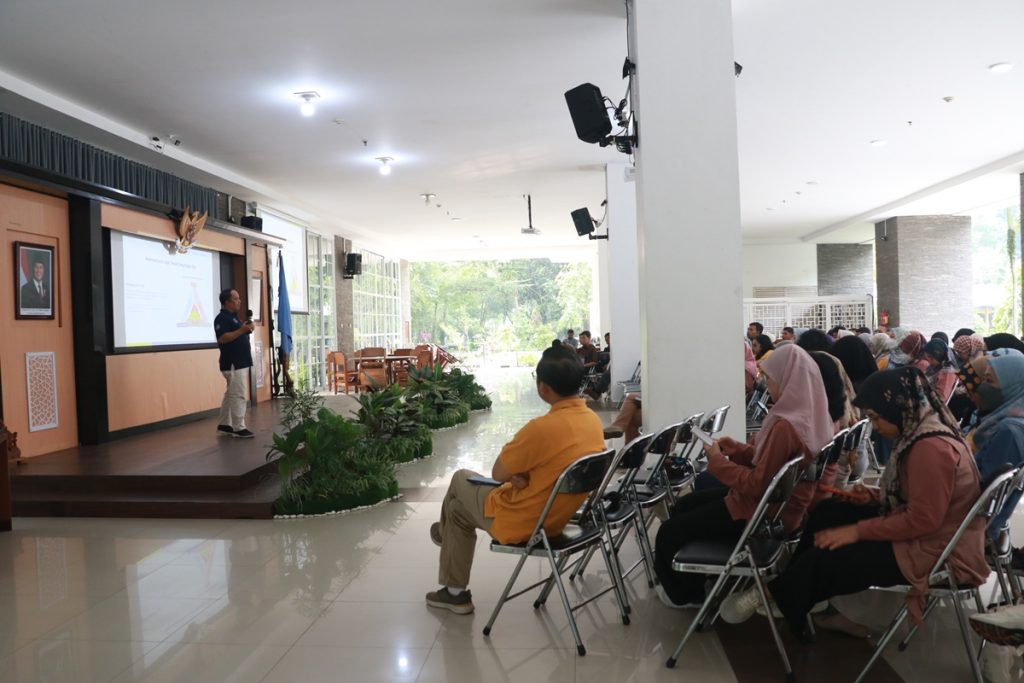
For rooms containing electronic equipment such as computer laboratories or servers, Nunu recommended using CO2 extinguishers because they leave no residue and are safe for electronic devices.
In addition, participants were introduced to the PASS method for operating fire extinguishers: Pull (the pin), Aim (the nozzle at the source of the fire), Squeeze (the handle), and Sweep (the spray from side to side).
In his presentation, Nunu stated that UGM already has various fire protection facilities, including hundreds of hydrants and thousands of fire extinguishers distributed across campus. However, he emphasized that human preparedness remains the most important factor.
“Some hydrant boxes even contain soap and cleaning cloths,” he remarked.
He encouraged all work units to routinely inspect fire extinguishers and ensure that evacuation routes remain safe and unobstructed.
This training was part of ongoing efforts to improve fire preparedness within the campus environment. After the presentation session and post-test, participants joined a live fire extinguishing simulation in the faculty’s landscape area.
Author: Erna Tri Nofiyana