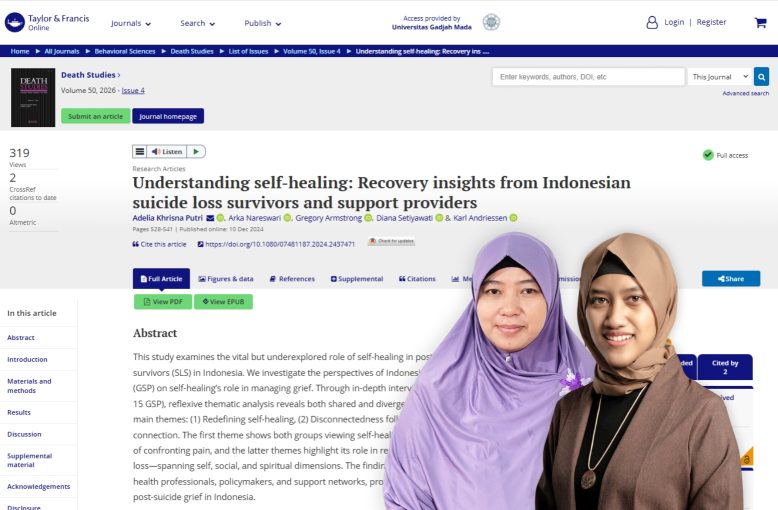
Yogyakarta, March 4, 2026 — Amid growing attention to mental health, a collaborative study by researchers from the Faculty of Psychology at Universitas Gadjah Mada and The University of Melbourne highlights an often-overlooked aspect: the role of self-healing in the recovery of individuals who have lost someone to suicide in Indonesia.
The study, published in the international journal Death Studies, 50(4), reveals that recovery does not occur automatically. Instead, self-healing is an active, conscious, and dynamic process undertaken by survivors as they navigate profound grief.
The research team, led by Adelia Khrisna Putri together with Arka Nareswari, Gregory Armstrong, Diana Setiyawati, and Karl Andriessen, interviewed 31 participants consisting of 16 suicide loss survivors and 15 mental health practitioners who provide professional support to bereaved individuals. The findings show that both survivors and mental health practitioners understand self-healing as a dynamic, active, and intentional process of confronting emotional wounds, with or without professional assistance.
The study also found that losing someone to suicide can create not only social disconnection, but also personal and spiritual disconnection. Self-healing can help restore these broken connections, for example by building relationships with others who have experienced similar losses.
“Recovery is not about erasing grief, but about how individuals gradually rebuild a sense of connection in their lives,” one of the key insights highlighted in the study explains.
These findings are particularly significant for Indonesia, where approaches to supporting people grieving a suicide loss remain relatively limited and often lack sensitivity to survivors’ lived experiences. The study emphasizes the need for more empathetic approaches grounded in real experiences, while also acknowledging cultural and spiritual dimensions.
For mental health practitioners and policymakers, the study delivers a clear message: support for suicide loss survivors should not focus solely on intervention but also on post-intervention services. One example is ensuring that group counseling services are widely accessible and involve local religious leaders or spiritual figures.
By amplifying the voices of survivors, this research not only enriches academic literature but also opens pathways toward more holistic and targeted recovery approaches. In the complex landscape of mental health issues, self-healing emerges not merely as a popular concept, but as a proactive recovery process that fosters survivors’ growth.
Article link:
https://www.tandfonline.com/doi/full/10.1080/07481187.2024.2437471#abstract
Congratulations to Adelia Khrisna Putri, S.Psi., M.Sc., Diana Setiyawati, S.Psi., MHSc., Ph.D., Psikolog, and the research team.
Compiled by: Fauzi
Editor: Zufar