
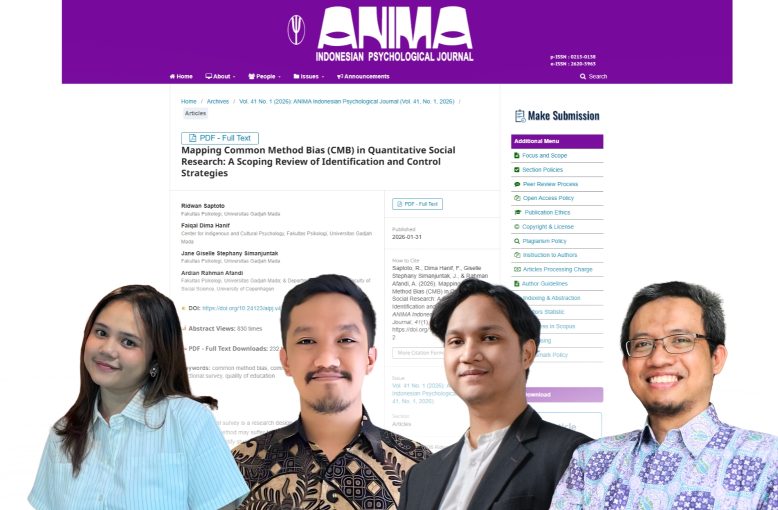
Yogyakarta, May 6, 2026 – Amid growing pressure to publish and the increasing emphasis on global indexing systems such as Scopus, researchers from the Faculty of Psychology at Universitas Gadjah Mada have warned that methodological quality should not be sacrificed for publication quantity. This concern was emphasized through a recent study examining common method bias (CMB) in quantitative research methodologies.
The article, published in ANIMA Indonesian Psychological Journal and titled “Mapping Common Method Bias (CMB) in Quantitative Social Research: A Scoping Review of Identification and Control Strategies”, reveals that many studies still contain latent biases that may weaken the validity of research findings, even when published in reputable international journals.
This phenomenon is often referred to as “fetish indexing,” a tendency to treat journal indexation as the primary goal rather than as a consequence of scientific quality. In practice, this orientation encourages rapid publication without sufficient attention to research design rigor and methodological controls.
Dr. Ridwan Saptoto, S.Psi., M.A., Psikolog emphasized that the major challenge facing academia today is not merely increasing the number of publications, but ensuring scientific integrity.
“Indexation is important, but it is not the ultimate goal. Without methodological rigor, publications risk becoming mere academic formalities. This is dangerous because it can produce biased knowledge and mislead policymaking,” he stated.
The researchers noted that common method bias (CMB) frequently appears in cross-sectional survey-based studies, particularly when variables are measured simultaneously using instruments with similar formats, such as Likert scales. Without efforts to identify and control CMB, the validity of research findings may be questioned.
Furthermore, Faiqal Dima Hanif, a researcher at the Center for Indigenous and Cultural Psychology, explained that the study provides a comprehensive map of strategies for identifying and mitigating CMB.
“We want to shift the focus from merely being ‘publishable’ to being ‘trustworthy.’ Good research is not only research that gets published, but research that can be trusted and replicated,” he explained.
In the context of global development, this issue carries significant implications for United Nations Sustainable Development Goal 16, particularly in ensuring accurate and accountable evidence-based policymaking. Biased data can potentially lead to ineffective or misguided policies.
Additionally, strengthening methodological quality also supports Sustainable Development Goal 4, particularly in building a higher education ecosystem that emphasizes integrity, reflexivity, and research quality.
UGM emphasized that future transformations in academic culture should aim to balance publication productivity with scientific depth. Without such balance, ambitions for global reputation may instead produce fragile foundations of knowledge.
Author: Fauzi
Editor: Zufar