In an effort to expand scientific networks and international collaborations, the Faculty of Psychology at Universitas Gadjah Mada (UGM) has developed various schemes for researchers wishing to join through the Research and Community Service Unit (UPPKM). This program aims to support the implementation of research and the production of scientific knowledge through UPPKM activities. Additionally, the scheme seeks to enhance students’ research capabilities, create a research ecosystem involving trained research resources, and encourage the publication of research results at both national and international levels.
SDG 10: Reduced Inequalities
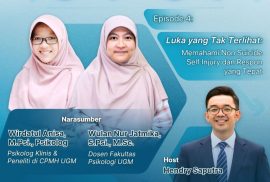
The Faculty of Psychology at Universitas Gadjah Mada (UGM), in collaboration with TVRI Yogyakarta, presents the fourth episode of OPSI: Psychological Talk, which aired on Tuesday, May 20, 2025, from 3:00 to 4:00 PM WIB. This episode addresses an important and sensitive topic titled "The Invisible Wounds: Understanding Non-Suicidal Self-Injury and Appropriate Responses."
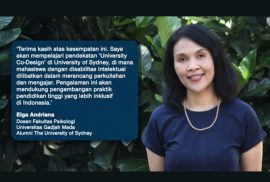
The Faculty of Psychology, Universitas Gadjah Mada, has once again received positive news from the international grant arena. Elga Andriana, S.Psi., M.Ed., Ph.D one of the faculty members, has been selected as a recipient of the Australian Alumni Grant 2025. This grant is a prestigious recognition awarded to Australian alumni who are considered to have significant potential to contribute to the development of education, collaboration, and community empowerment.
The Faculty of Psychology at Universitas Gadjah Mada (UGM) and TVRI Yogyakarta return with the latest episode of OPSI: Psychological Talk. The third episode aired on Tuesday, May 6, 2025, from 3:00 to 4:00 PM WIB, featuring the theme "Thriving Schools as the Foundation of a Golden Generation: Pillars of the Nation’s Future."
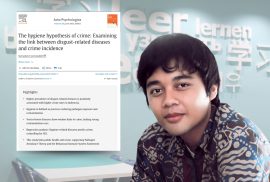
Yogyakarta, April 23, 2025 — An article titled “The Hygiene Hypothesis of Crime: Examining the Link Between Disgust-Related Diseases and Crime Incidence” by Samudera F. Jamaluddin has been published in Acta Psychologica, Volume 256, article number 105013. This journal is indexed in Scopus with a Best Quartile (Q1), an SJR score of 0.854 (2024), and an Impact Factor (IF) of 2.1.
The Center for Public Mental Health (CPMH) at the Faculty of Psychology, Universitas Gadjah Mada, once again demonstrated its commitment to improving mental health and disability literacy among adolescents through the organization of the Adolescent Mental Stability Advocate Competition (AMSAC) Vol. 2. Carrying the theme “Breaking Barriers, Opening Opportunities: Realizing a Generation that Cares about Mental Health and Disabilities,” this year’s AMSAC series took place from April 10 to May 25, 2025, with the main event held at Joglo GIK UGM.
AMSAC Vol. 2 was designed as a platform for junior and senior high school students from across Indonesia to express their concern and ideas on mental health and disability issues. Through various creative competitions such as essay writing, digital poster design, reels, and short story contests, participants were encouraged to highlight the role of youth in building inclusive environments, fostering appreciation for mental health warriors, and breaking down the negative stigma that still exists in society. All submissions were collected online from April 20 to May 4, 2025, and the enthusiasm was evident with around 200 participants taking part.
The Inclusive Learning Innovation Project aims to develop innovative and inclusive learning strategies for students with special needs in higher education. As part of this initiative, each team from funded universities was required to design inclusive learning plans, textbooks, and educational videos. Additionally, the teams conducted research that resulted in journal articles evaluating the effectiveness of the implemented strategies.
The UGM team, composed of faculty members from the UGM Faculty of Psychology, was led by Elga Andriana, S.Psi., M.Ed., Ph.D., and Edilburga Wulan Saptandari, S.Psi., M.Psi., Ph.D., Psychologist. They developed a learning strategy that integrates traditional Photovoice methods with AI-based Photovoice, specifically tailored for the course on Educational Psychology and Character Development.
Key contributors to the project included Naida Shafa Ghozalba, a student from UGM’s International Undergraduate Program (IUP) in Psychology (Class of 2021), and Ukhtina Duhi Anindita, S.Psi., M.Psi., Psychologist, an alumna of UGM’s Professional Psychology program. They played pivotal roles in developing learning materials and acted as peer researchers alongside other team members.
The project also involved three UGM Psychology students with Attention Deficit Hyperactivity Disorder (ADHD) as peer researchers. They contributed to designing inclusive learning strategies and ensured that the approaches accommodated diverse learning needs, particularly for students with special conditions. According to one of the participating students, the project provided them with a sense of gratitude as their challenges during lectures were heard and addressed with effective solutions and support.
Prof. David Evans from the University of Sydney, Australia, also participated in the project, leading focus group discussions and offering valuable insights throughout its implementation.
Elga Andriana expressed, “This award is a recognition of the importance of creating inclusive learning environments where every student feels accepted and supported to reach their full potential. It also reminds us that diversity is not a barrier but a strength that enriches the learning process. Moving forward, we are increasingly motivated to create adaptive, supportive, and empowering learning environments for students with various needs.”
Elga also conveyed a message to the academic community: “Appreciate diversity as a strength. Be open-minded and support your peers, regardless of their backgrounds or needs. By supporting one another, we not only foster an inclusive learning community but also build a more equitable and humane society,” she concluded.
Writer: Relung Fajar Sukmawati

its commitment to supporting the achievement of the Sustainable Development Goals (SDGs) by researching the adaptation of financial well-being measurement tools. This research focuses on Indonesia’s growing middle class, which plays a critical role in national economic growth.
The 10th Gebyar Brawijaya Qur’ani Nasional (GBQN X) 2024 was held at Samantha Krida Hall, Universitas Brawijaya. This year’s theme was “Grounding the Heart in Upholding Eternal Civilization of the Quran.” The event aimed to strengthen Quranic values among students and university youth through nine competition categories focused on religious and Islamic artistic skills.
GBQN X attracted 1,465 participants from 16 provinces across Indonesia. The competition series included registration, administrative selection, submission of written papers (for the Musabaqah Karya Tulis Ilmiah Al-Qur’an or MKTIA), announcement of finalists (for MKTIA), competition rounds, and the final announcement of winners. Universitas Gadjah Mada sent nine delegates to compete in the categories of Musabaqah Tilawatil Qur’an (MTQ), Musabaqah Tartilil Qur’an (MTrQ), Musabaqah Karya Tulis Ilmiah Al-Qur’an (MKTIA), and Musabaqah Khattil Qur’an (MKQ) – Decorative Category.
Tourism has become a vital sector for the Indonesian economy, especially in Bali. However, the influx of tourists has significantly transformed the lifestyle of the Balinese community—including the involvement of children in tourism activities. This illegal involvement has been exacerbated by the disturbing rise of Child Sex Tourism (CST), which includes pedophilia and the sexual abuse of minors.
In response to this alarming issue, four students from Universitas Gadjah Mada (UGM), each from different academic disciplines, joined forces as part of the Student Creativity Program for Social and Humanities Research (PKM-RSH) to conduct field research in Bali.