Arsip:

Release

UPKM Seminar Series: Embrace Vulnerability to Deal With Change at Work

Human Resource Quality Improvement Institute (UPKM) of Faculty of Psychology Gadjah Mada held the fourth Post COVID Quality of Work Life Seminar Series online, on Saturday, August 29, 2020 at 10.00 – 11.30 AM trough Zoom Meeting. It was attended by 150 participants which are UGM students, alumni, public and partners. The event also broadcasted live from UPKM Psikologi UGM Youtube channel. read more

KDM: Theory Building in Psychological Science

Promovendus Club (PC) Doctor of Psychological Science Program, Faculty of Psychology UGM held biweekly coloquioum (KDM) on Friday, August 28, 2020. The event was started at 09.30 AM to 11.30 AM via Zoom Meeting and attended by 120 participants. read more

Online Graduation of 57 Psychology Bachelors

Wednesday (26/8) Faculty of Psychology, Gadjah Mada University held IV period of 2019/2020 Academic Year graduation ceremony for undergraduate program online. There are 57 graduates, consist of 49 students from undergraduate psychology program and 8 students from international undergraduate program. They are attending the graduation ceremony accompanied by their parents. read more

Writing Scientific Journal, The Closing of CLSD Online Class Series

Tuesday (18/7) Center for Lifespan and Development (CLSD) Faculty of Psychology UGM organized online class for students. This fifth session raised a topic about “Writing Scientific Journal” and become the last session and closing session of the CLSD online class that already held from August 4, 2020.

The session was held at 1.00 – 3.00 PM and attended by 90 participants with Adelia Khrisna Putri, S.Psi., Msc, lecturer at Faculty of Psychology UGM, as the speaker.

During the session, Adelia delivered the main ideas in writing scientific journal, among them are the importance of writing it. Researcher need to write scientific journal to enhance their personal and professional capacity. Besides, writing and publish are the responsibility of the researcher. In addition, she also explain about general basic structure in scientific journal, from title, abstract, introduction and conclusion.

After that, the speaker discuss the topic further with participants in question and answer session.

At the end of the class, Dr. Arum Febriani, S.Psi., M.A. as the head of CLSD expressing her gratitude to all the speakers and participants who already contributing in the CLSD online classes series.

CLSD Online Class: Tips for Writing Popular Scientific Articles

Friday (14/8) online class which organized by CLSD (Center for Life-Span Development) has entered 4th session. In this session, CLSD raised “Tips for Writing Popular Scientific Articles” as the topic, with Kurnia Yohana Yulianti, S.Psi., M.Sc, a lecturer at the Faculty of Psychology, Gadjah Mada University as the speaker. The event started at 1.00 PM and attended 114 participants.

“Tips for Writing Popular Scientific Articles” was chosen in order to provide information and useful tips for students for writing popular scientific articles. “As a scientist, writing is one of the embodiment of dedication. Therefore, that is why writing popular scientific articles is considered to be important because it is one of the way to deliver research findings to society in light and interesting language” said the speaker.

After material session about writing popular scientific articles tips and how to write articles using the ABC perspective (Accurate, Brief, and Clear), the participants then asked to express their opinion about 3 articles that have been prepared by the speaker. The online class was closed with discussion and question and answer session.

The Impact Of Counter-narratives On Inclusive Identity And Reconciliation Support In The Context Of Anti-communist Sentiment In Indonesia

Friday (14/8), Promovendus Club (PC) from Doctor of Psychological Science Program, once again held biweekly colloquioum (KDM) online. The event start at 3.30 to 5.00 PM via Zoom Meeting application.

Attended by 35 participants, this week session give the opportunity to Haidar Buldan Thontowi S.Psi, MA, Ph.D (Cand) who also a lecturer at Faculty of Psychology UGM to become the speaker. The topic called “The impact of counter-narratives on inclusive identity and reconciliation support in the context of anti-communist sentiment in Indonesia” which is the topic of his dissertation.

Haidar conveyed about the ideas and background of his research during the session. The study aimed to examine the historical events that occurred during 1965 in Indonesia and their relation to anti-communist sentiment in Indonesia. He also explain about concepts and definitions of narrative and counter-narrative as well as the relation to the topic of reconciliation, methods and conclusions from his research. A Lecturer who is also a Ph.D candidate from the University of St. Andrews Scotland said that “Political events in the past can have impact to our present life, meaning that our presence now are inseparable from the past”.

After deliver the material, he also discussing the topic with participant through Q & A session that guided by the moderator.

Psikologi Menyapa for Postgarduate Students

Thursday (13/8) Faculty of Psychology Gadjah Mada University organized second discussion called Psikologi Menyapa for postgraduate students. It is open for master of psychological science, master of professional psychology and doctor of psychological science students. This event was organized in order to provide discussion between the faculty dean and representatives of postgraduate students about lectures and policies during the COVID-19 pandemic.

According to the Dean of the Faculty of Psychology UGM, Prof. Dr. Faturochman, M.A., the faculty have actuate optimal efforts in order to provide the best service for students. Starting from giving credit assistance, logistical assistance for students who need it and also reducing UKT for students who apply for it based in the terms and conditions that have been set.

On this occasion, representatives of postgraduate students conveyed the obstacles they faced based on the results of a survey conducted to 120 postgraduate students. The obstacles are constraints on tuition fees for students affected by COVID-19, administrative constraints for proposing to reduce the Single Tuition Fee (UKT) and academic obstacles such as access to campus services, conducting research, adapting online learning, and others.

Responding to the situation, Vice Dean for Finance, Assets and Human Resources, Dr. Yuli Fajar Susetyo, M.Sc., appealed to students who need UKT relief to apply immediately. Postgraduate programs will get maximum waiver of 25% from UKT. For students who take final assignments, the faculty applies 100% of UKT returns for students that will be able to graduate per October 16 and 50% for those who graduate per November 30.

For students who want to come to the faculty still have to wait patiently because there are limitation for students to come to the faculty. “According to the Chancellor’s Decree, students that allowed to visit campus are students that working on their final project and have uploading healthy recommendation letter for those who live in DIY, and uploading quick test results for students from outside DIY, on SIT (Integrated Information System), then they can adjusting their needs on campus”, said Rr. Zurida Ramawati, S.IP., M.Sc., Head of the Academic and Student Affairs Section of the Faculty of Psychology UGM.

CLSD Online Class: Basic Quantitative Analysis for Developmental Research

(11/8) Center for Lifespan and Development (CLSD) Faculty of Psychology UGM, once again organized online class for free. This event is the continuation of the previous class that held on August 4 and 7, 2020.

The theme of the session is basic quantitative analysis for research in developmental psychology. Yopina Galih Pertiwi, S.Psi., M.A., Ph.D, one of the lecturer in Faculty of Psychology UGM had the opportunity to become speaker for this event. She mention that, the material aimed to refresh basic concept about quantitative research.

During the presentation, Yopina Galih Pertiwi, S.Psi., M.A., Ph.D briefly reviewing about the basic concept, type of the data and the rule of variable in quantitative research. She also highlight that in experimental, longitudinal and cross-sectional research within the scope of developmental psychology, quantitative analysis can play an important role. Furthermore, she also provide some examples of research in developmental psychology that using quantitative analysis. Also, the participant had the opportunity to do SPSS simulation, guided by the speaker and Q & A session.

The event took time at 1.00 – 3.00 PM via Zoom Meeting and attended by 130 participants, as well as The Head of CLSD, Dr. Arum Febriani, S.Psi., M.A.

Getting To Know Qualitative Approach in Developmental Research

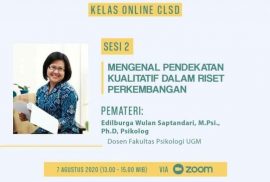
Friday (7/8), the Center for Lifespan Development (CLSD) or the Center for the Study of Human Development Faculty of Psychology UGM held the CLSD Online Class session 2. After the previous session that discussed Various Types of Developmental Research Methods and Recent Research Topics, in this session, participants were invited to getting to know more about a qualitative approach in developmental psychology research. The topic chosen for this session was “Getting to Know Qualitative Approaches in Developmental Research” presented by Edilburga Wulan Saptandari, M.Psi., Ph.D, Psychologist, Lecturer at the Faculty of Psychology UGM.

This event was attended by 120 participants online, using Zoom media. Participants come from UGM and outside UGM, who are students and academics. According to Edilburga, there are three qualitative research paradigms, which are understanding; understand one’s perspective and interpretations, phenomenological; constructs of social phenomenon and dynamic; reality can change when there is a change in the perception.

In this session, Edilburga also explained further about the qualitative approach, including how to formulate research topics and questions, display techniques and data collection, to conduct good and correct qualitative research. The CLSD Online Class session was closed with a question and answer session with participants.