Arsip:

Release

CPMH Faculty of Psychology UGM Successfully Hosts AMSAC Vol. 2: Breaking Barriers and Creating Opportunities for a Mental Health and Disability-Conscious Generation

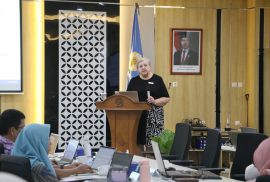
The Center for Public Mental Health (CPMH) at the Faculty of Psychology, Universitas Gadjah Mada, once again demonstrated its commitment to improving mental health and disability literacy among adolescents through the organization of the Adolescent Mental Stability Advocate Competition (AMSAC) Vol. 2. Carrying the theme “Breaking Barriers, Opening Opportunities: Realizing a Generation that Cares about Mental Health and Disabilities,” this year’s AMSAC series took place from April 10 to May 25, 2025, with the main event held at Joglo GIK UGM.

AMSAC Vol. 2 was designed as a platform for junior and senior high school students from across Indonesia to express their concern and ideas on mental health and disability issues. Through various creative competitions such as essay writing, digital poster design, reels, and short story contests, participants were encouraged to highlight the role of youth in building inclusive environments, fostering appreciation for mental health warriors, and breaking down the negative stigma that still exists in society. All submissions were collected online from April 20 to May 4, 2025, and the enthusiasm was evident with around 200 participants taking part.

Two Decades of the Aceh Tsunami: Reflections on Recovery and Action Plans

Banda Aceh, December 17, 2024 – To commemorate 20 years since the Aceh tsunami tragedy, a series of events were held to reflect on the community’s recovery journey and to formulate sustainable steps for the future. One of the opening events was the Mental Health Strengthening Workshop: Reflections on Dreams 20 Years Post-Disaster, held at the Auditorium of the Faculty of Medicine, Syiah Kuala University (USK). read more

Visiting Professor: CLSD UGM’s Efforts to Strengthen International Research Collaboration

The Center for Life-Span Development (CLSD) at the Faculty of Psychology, Universitas Gadjah Mada (UGM), welcomed Prof. Emiko Kashima from La Trobe University, Australia, from July 3 to July 10, 2024. Prof. Emiko Kashima’s visit is part of CLSD’s Visiting Professor Program to foster international research collaboration. The main objectives of this program are to establish partnerships and collaborative research with global partners, publish research manuscripts, and develop research proposals for submission to secure international funding in the coming years. The program was conducted at the Faculty of Psychology, Universitas Gadjah Mada, and led by Sutarimah Ampuni, S.Psi., M.Si., MPsych., Ph.D., Psikolog, as the Head of CLSD. The program also involved lead researchers Zahra Frida Intani, S.Psi., M.Psi., Psikolog, and Smita Dinakaramani, S.Psi., M.Psi., Psikolog, both lecturers at the Faculty of Psychology UGM, along with interns (student trainees) from CLSD. read more

UGM Faculty of Psychology Contributes to Achieving SDGs Through Financial Well-Being Research

Yogyakarta, November 13, 2024— The Faculty of Psychology at Universitas Gadjah Mada (UGM) continues to demonstrate its commitment to supporting the achievement of the Sustainable Development Goals (SDGs) by researching the adaptation of financial well-being measurement tools. This research focuses on Indonesia’s growing middle class, which plays a critical role in national economic growth. read more

Diagnosing Organizational Problems with BOM: A New Approach Towards Work Sustainability and Economic Growth

In a study on organizations, it was found that an organization is a complex institution with interconnected elements, such as mission, leadership, human resources, values, strategy, goals, performance, vision, structure, systems, skills, and time management. To better understand problems within organizations, this research developed and tested a practical method through the Backbone Organizational Model (BOM). read more

Diseases of the Heart and Their Relationship with Mental Disorders

Subandi, Lu’luatul Chizanah, Yuli Fajar Susetyo

Islamic Psychology Study Group

The Indonesian society, which is predominantly Muslim, is already familiar with the term diseases of the heart. This concept originates from a verse in the Holy Quran, Surah Al-Baqarah, verse 10, which means: “In their hearts is a disease, and Allah increases their disease; and for them is a painful punishment because they [habitually] lie.” The heart referred to here is not the physical heart (liver), nor the cardiovascular organ (heart), but rather the spiritual heart, known as qolbu. read more

The Meaning of Becoming Elderly and How Social Support Can Improve Elderly Well-being

The Elderly Phase and Its Characteristics

The elderly phase begins at the age of 60, a period marked by shifts in social roles and often characterized by increased needs for health support. This phase has unique traits, such as emerging physical health issues, the potential loss of social roles, and intensive psychological adjustments. The growing elderly population, as seen in Indonesia today, reflects significant demographic changes and presents both challenges and opportunities to support elderly well-being and active participation in society. The elderly can provide valuable contributions through the life experiences and knowledge they have accumulated, while also facing challenges stemming from social, physical, and psychological changes related to aging. Therefore, understanding the social and psychological context of aging is crucial for supporting their sustainable well-being. read more

UGM Student Team Uncovers the Dark Reality of Child Sex Tourism in Bali

Tourism has become a vital sector for the Indonesian economy, especially in Bali. However, the influx of tourists has significantly transformed the lifestyle of the Balinese community—including the involvement of children in tourism activities. This illegal involvement has been exacerbated by the disturbing rise of Child Sex Tourism (CST), which includes pedophilia and the sexual abuse of minors.

In response to this alarming issue, four students from Universitas Gadjah Mada (UGM), each from different academic disciplines, joined forces as part of the Student Creativity Program for Social and Humanities Research (PKM-RSH) to conduct field research in Bali.

Celebrity Worship: How Do Psychologists and Influencers Respond?

The Islamic Psychology Study Group (KKPI) of the Faculty of Psychology, Universitas Gadjah Mada (UGM) held an online webinar entitled Discover the Truth about Celebrity Worship: Insights from Psychologist and Influencer, on Friday (28/6). The webinar, which is part of the Islamic Psychology Summit 2024, aims to provide in-depth insights into human behavior, social influence, and the significant impact of media on individual values and society.

Chairperson of the Islamic Psychology Summit (IPS) committee, Indrayanti, M.Si., Ph.D., Psychologist, explained the series of events in IPS 2024, “The event towards the Islamic Psychology Summit 2024 will begin with an online webinar every month, discussing specifically about contemporary issues, for example like today which discusses in detail about celebrity worship. In addition, there are also calls for paper activities, pre-conference workshops, and then closed with a peak event that presents 15 expert speakers on Islamic psychology from around the world.”

Fuadh Naim, S.I.Kom, the first speaker who is also a content creator and founder of XKwavers explained why teenagers can become K-pop fans, “The majority of Korean artists have multi-talents that have been formed by entertainment agencies. They can sing and are also good-looking, smart, good at playing musical instruments, and various other advantages. This has resulted in Korean artists being seen as perfect by K-pop fans, K-popers are willing to fight anyone who dares to make fun of their idols”.

Fuad conveyed three factors that can make a person experience celebrity worship, “The first is of course a cool product, the second is an injury that eventually makes the individual look for fun entertainment, the third is the most influential, namely having no life value. As a result, someone who experiences celebrity worship can potentially absorb values contrary to existing norms”.

The second speaker who is a professor of social psychology at the Faculty of Psychology, Prof. Drs. Koentjoro, M.BSc., Ph.D., Psychologist, advised, “When having an idol, try to choose one that is by religious law, exemplify the spirit of your idol instead of copying his lifestyle. In order not to be easily carried away, then make a directed life plan and study with full seriousness. Imagine the tears of your parents because of your achievements, not because of your negative behavior that hurts their hearts.”


Author: Relung Fajar Sukmawati

Photo by John Price on Unsplash