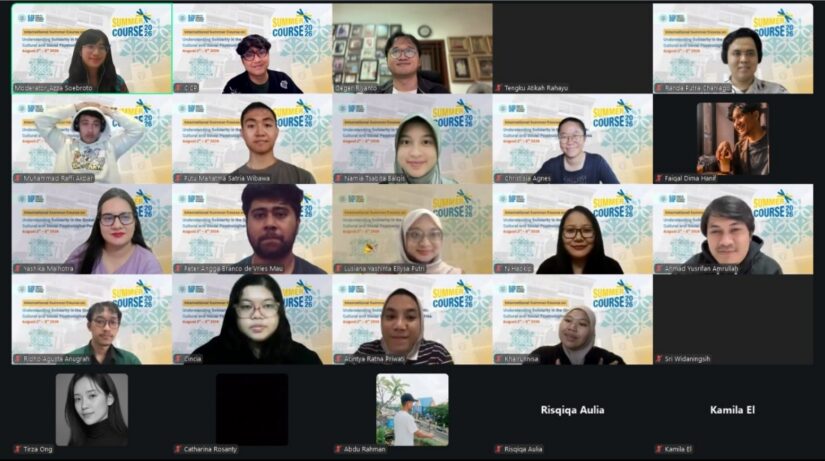
The Center for Indigenous and Cultural Psychology (CICP), Faculty of Psychology, Universitas Gadjah Mada (UGM), organized the International Summer Course CICP 2026 from August 3–8, 2026. Under the theme “Understanding Solidarity in the Global South: Cultural and Psychological Perspectives,” the program explored the formation of solidarity within Global South communities through social and cultural psychology perspectives.
The program was initiated in response to concerns about the construction of psychological knowledge, which has largely been developed within Western contexts. Through this program, CICP invited participants to understand solidarity by taking into account the experiences, cultures, and social dynamics of Global South communities, which are characterized by collective and interdependent cultural orientations.
The program featured seven international experts in social and cultural psychology from various universities, including Aalborg University (Denmark), the University of Salerno (Italy), the University of New Delhi (India), the International Psychoanalytic University Berlin (Germany), the University of Oslo (Norway), and Université Paris Cité (France).
From Indonesia, the program also involved eight experts in social and cultural psychology from Universitas Gadjah Mada, Universitas Indonesia, Universitas Sanata Dharma, and Yayasan Geutanyoe. In addition to bringing together academic and practitioner perspectives, the program incorporated the perspectives of participants, including Rohingya survivors and refugees, to strengthen the participatory approach to discussions on solidarity.
The International Summer Course CICP 2026 consisted of three modules comprising a total of 12 sessions. The first module, “Critical Reflection on Solidarity,” discussed the formation of solidarity from a cultural psychology perspective, emphasizing the importance of local contexts.
The second module, “Psychological and Social Foundations of Solidarity,” examined the processes through which solidarity develops in society through various theoretical frameworks in social psychology. Meanwhile, the third module, “Current Themes and Issues in Solidarity,” explored contemporary social issues, such as disasters and refugees, and their relationship to the emergence of various forms of solidarity.
Through this program, CICP sought to expand opportunities for knowledge exchange and introduce more diverse perspectives into psychological studies. The program also reflected the commitment of CICP and the Faculty of Psychology UGM to disseminating knowledge that is relevant to the contexts and experiences of local communities.
By bringing together the perspectives of academics, practitioners, and participants, the International Summer Course CICP 2026 provided a space to reflect on the meanings and practices of solidarity within Global South communities while contributing to the development of a more contextual and diverse psychology.
Report: CICP UGM
Editor: Erna Tri Nofiyana