
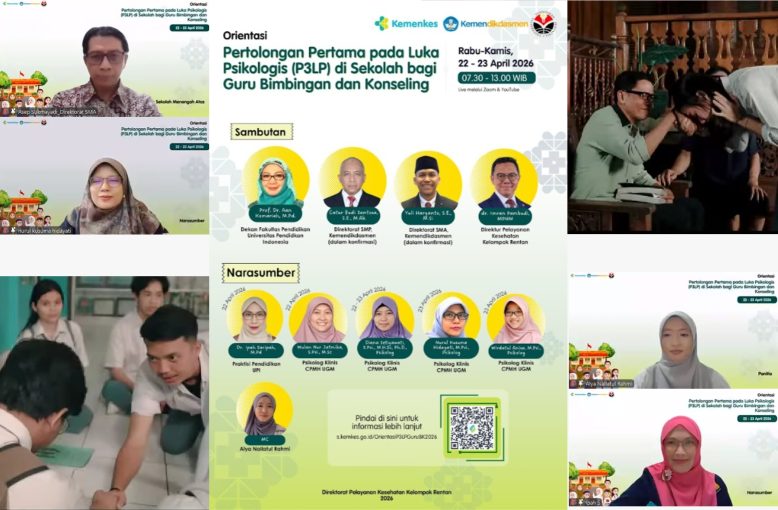
A total of 3,000 participants from across Indonesia took part in the Orientation on Psychological First Aid for Psychological Wounds (P3LP) in Schools for Guidance and Counseling (BK) teachers, held on Wednesday–Thursday, April 22–23, 2026, from 07.30–13.00 WIB. The event was conducted online via Zoom and live streamed on YouTube, as an effort to strengthen the role of schools in promoting mental health as well as enhancing the capacity of BK teachers to provide initial psychological support in crisis situations.
The program is a collaboration between the Directorate of Health Services for Vulnerable Groups of the Ministry of Health of the Republic of Indonesia and Universitas Pendidikan Indonesia (UPI). In its implementation, the Center for Public Mental Health (CPMH) at the Faculty of Psychology of Universitas Gadjah Mada contributed as a speaker, bringing experts in community mental health.
In the session on implementing and managing P3LP in schools, Diana Setiyawati, S.Psi., MHSc., Ph.D., Psikolog, emphasized the importance of creating a school environment that genuinely nurtures students’ psychological well-being. She noted that schools play a crucial role, especially for children who may not receive sufficient emotional support at home. According to her, when schools are able to provide the right psychological support, students can grow into empathetic individuals who are expected to become leaders oriented toward the public good.
Furthermore, Diana stressed that responsibility for mental health in schools should not rest solely on guidance and counseling teachers. “We must involve all stakeholders; whoever is in the school has a responsibility, influence, and contribution to the mental health of everyone in the school community,” she said.
A similar message was conveyed by Wulan Nur Jatmika, S.Psi., M.Sc., who presented material on the role of a first aider in the school environment. She reminded that guidance and counseling teachers do not need to feel alone in facing various challenges in the field. “Mental health is our shared responsibility, and many parties can be involved in sharing roles,” she explained.
Meanwhile, Nurul Kusuma Hidayati, M.Psi., Psikolog, presented basic counseling techniques as supporting skills in implementing P3LP. In closing her session, she emphasized that the essence of the training is not merely understanding the material, but being able to apply it in real practice. She also encouraged participants to be more honest and responsible toward themselves as part of becoming stronger in facing psychological challenges.
In the closing session, Wirdatul Anisa, M.Psi., Psikolog, highlighted the importance of maintaining the mental health of educators themselves. She emphasized that individual limitations make networks and collaboration essential. According to her, building teams and utilizing available resources can help guidance and counseling teachers feel more supported in carrying out their roles.
Wirdatul also reminded participants about the importance of setting boundaries when helping students and parents. “No matter how many tasks we carry out, we still need boundaries. We can help, but we cannot fully control everything,” she said. In addition, she encouraged participants to continue appreciating themselves for their efforts, even when the outcomes do not always meet expectations.
The materials in this program were developed based on the P3LP pocketbook, a collaborative product between the Directorate of Health Services for Vulnerable Groups of the Indonesian Ministry of Health and the CPMH Faculty of Psychology UGM. The pocketbook has been developed for various education levels, from early childhood education to higher education, as a practical guide for providing psychological first aid.
Through this activity, it is hoped that guidance and counseling teachers and all stakeholders in schools will become more prepared and skilled in responding to students’ mental health needs. More than that, this orientation serves as a concrete step in building a school ecosystem that focuses not only on academic achievement, but also on the psychological well-being of all members of the school community.
Writer: Nurul Hidayati