
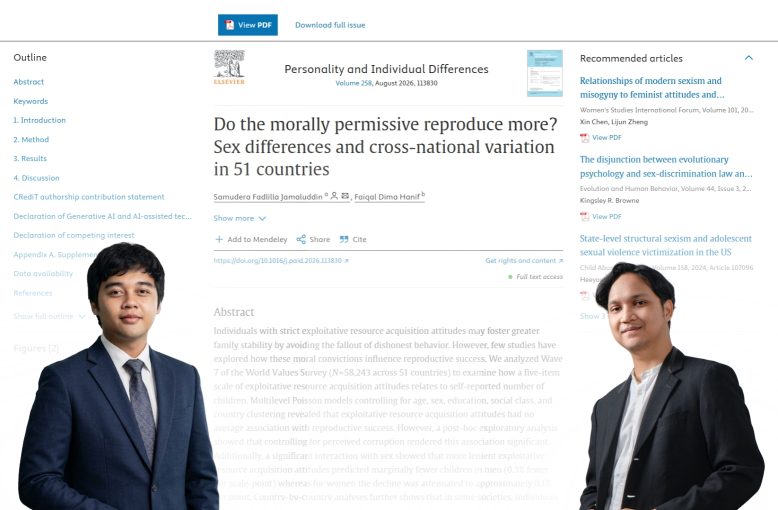
Yogyakarta, May 4, 2026 — The persistence of corruption cases and integrity crises in society indicates a serious issue related to individuals’ attitudes toward how wealth or resources are obtained for their families. A recent study conducted by researchers from the Faculty of Psychology at Universitas Gadjah Mada, published in the journal Personality and Individual Differences, sheds interesting light on this issue.
The study examines the relationship between exploitative attitudes in acquiring resources and reproductive success. The research, conducted by Samudera Fadlilla Jamaluddin, S.Psi., M.Sc., and Faiqal Dima Hanif, S.Psi., analyzed data from more than 58,000 respondents across 51 countries using the World Values Survey database. The results show that the relationship between moral attitudes toward resource acquisition and the number of children is not universal, but highly dependent on social, cultural, and gender contexts.
“These findings show that human reproductive behavior cannot be explained simply through individual traits. Social and cultural contextual factors play a very important role,” the research team explained.
Furthermore, the study found that in some contexts, more permissive moral attitudes are actually correlated with having fewer children, particularly among men. In addition, perceptions of corruption and country-specific social norms also moderate this relationship.
The Dean of the Faculty of Psychology at Universitas Gadjah Mada, Rahmat Hidayat, S.Psi., M.Sc., Ph.D., expressed appreciation for this achievement. “This publication demonstrates the capacity of academics at the Faculty of Psychology UGM to produce global data-based research relevant to fundamental issues of human behavior. We hope these findings enrich scientific perspectives while also contributing to evidence-based policymaking,” he said.
This study uses a multilevel statistical analysis approach to comprehensively capture cross-country variation. As such, the results not only contribute to the development of theories in evolutionary and social psychology but also open opportunities for further research on family dynamics and shifts in social values across societies.
Editor: Fauzi
Editor-in-chief: Zufar