
•  About UGM
  •  Academic Portal
  •  IT Center
  •  Library
  •  Research
  •  Webmail
  • English
    • Bahasa Indonesia
    • English
Universitas Gadjah Mada
  •  About Us
    •  Faculty at a glance
    •  History
    •  Heads of Faculty
    •  Academic Staff
    •  Administrative Staff
    •  Quality Assurance
  •  EDUCATION
    • Undergraduate Program Psychology
    • International Undergraduate Program
    • Professional Psychology Program
    • Master of Psychology Program
    • Doctorate Program
  • Research and Community Service
    • Research and Community Service Roadmap
    • Research
    • Publication
    • Community Service
    • Collaborations
  •  Student
    • Prospective Student
    •  Student Conduct Code
    • Collaboration Agreement Internship Vacancies
    • Scholarship
    •  Student Organization
  •  Facilities
    •  Laboratories
    • Research Group
  • Home
  • Release
  • Unveiling Patterns of Depression Symptoms in the Indonesian Population Based on IFLS-5

Unveiling Patterns of Depression Symptoms in the Indonesian Population Based on IFLS-5

  • Release
  • 12 January 2026, 14.43
  • Oleh: Humas
  • 0

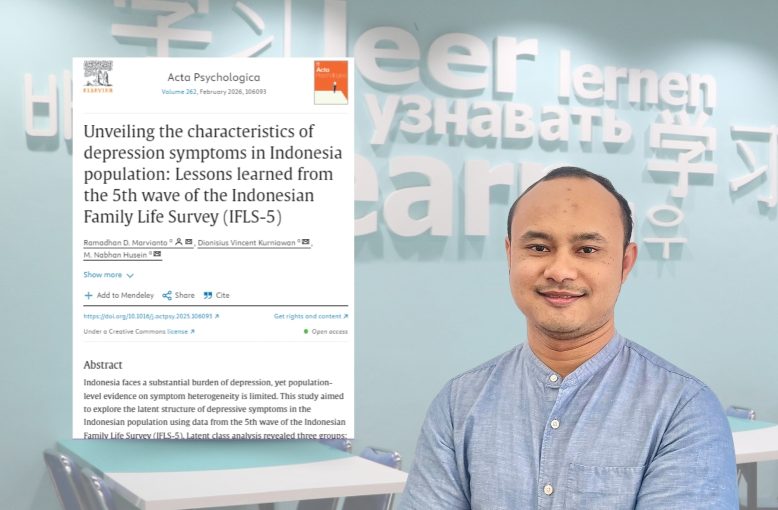
Yogyakarta, January 12, 2026. A recent study titled “Unveiling the characteristics of depression symptoms in Indonesia population: Lessons learned from the 5th wave of the Indonesian Family Life Survey (IFLS-5)” by Ramadhan D. Marvianto et al., published in Acta Psychologica (262), provides a comprehensive overview of the diversity of depression symptoms within the Indonesian population. This research responds to the high burden of depression in Indonesia, which has not been matched by population-level empirical evidence regarding symptom heterogeneity.

The study utilized data from the 5th wave of the Indonesian Family Life Survey (IFLS-5) and applied a latent class analysis approach to identify underlying patterns of depressive symptoms. The analysis revealed three risk groups: high risk (16.8%), moderate risk (36.9%), and low risk (46.3%). Demographic factors such as age, gender, and marital status emerged as significant predictors, with older individuals, married individuals, and women more likely to fall into higher-risk groups.

Interestingly, despite differences in symptom severity, all groups reported relatively high levels of hope and happiness. This finding suggests the influence of cultural values—particularly collectivism and religiosity—on emotional expression in Indonesian society. In addition, cognitive symptoms such as feeling overwhelmed and difficulty concentrating were identified as early indicators of depression. The study highlights the importance of culturally sensitive depression screening and the development of more targeted interventions in Indonesia.

Congratulations to Marvianto and the team of authors.

Layout: Fauzi
Editor: Zufar
Article link: https://www.sciencedirect.com

Tags: Faculty of Psychology UGM SDG 16: Peace Justice & Strong Institutions SDG 3: Good Health and Well-being SDG 4: Quality Education SDGs

Berita Terkini

  • Psychology UGM Sends Off 37 Postgraduate Graduates for Period III Academic Year 2025/2026April 24, 2026
  • Psychology UGM Pushes Master’s Graduates to Find Meaning in Their CareersApril 22, 2026
  • OPSI Discusses Intimate Partner Violence: When Love Masks the WoundsApril 22, 2026
  • The Faculty of Psychology Advances Integration of the Psychological Service System and the GMST MandiriApril 17, 2026
  • Professor from the Faculty of Psychology UGM Appointed as Visiting Professor at Universiti Malaysia TerengganuApril 13, 2026
Universitas Gadjah Mada

Faculty of Psychology
Universitas Gadjah Mada

Jalan Sosio Humaniora Bulaksumur
Yogyakarta 55281 Indonesia
fpsi[at]ugm.ac.id
+62 (274) 550435 (hunting)
+62 (274) 550435 ext 158
psikologiugm
psikologiugm
psikologi_ugm
Kanal Psikologi UGM

© Universitas Gadjah Mada

KEBIJAKAN PRIVASI/PRIVACY POLICY

[EN] We use cookies to help our viewer get the best experience on our website. -- [ID] Kami menggunakan cookie untuk membantu pengunjung kami mendapatkan pengalaman terbaik di situs web kami.I Agree / Saya Setuju