
•  About UGM
  •  Academic Portal
  •  IT Center
  •  Library
  •  Research
  •  Webmail
  • English
    • Bahasa Indonesia
    • English
Universitas Gadjah Mada
  •  About Us
    •  Faculty at a glance
    •  History
    •  Heads of Faculty
    •  Academic Staff
    •  Administrative Staff
    •  Quality Assurance
  •  EDUCATION
    • Undergraduate Program Psychology
    • International Undergraduate Program
    • Professional Psychology Program
    • Master of Psychology Program
    • Doctorate Program
  • Research and Community Service
    • Research and Community Service Roadmap
    • Research
    • Publication
    • Community Service
    • Collaborations
  •  Student
    • Prospective Student
    •  Student Conduct Code
    • Collaboration Agreement Internship Vacancies
    • Scholarship
    •  Student Organization
  •  Facilities
    •  Laboratories
    • Research Group
  • Home
  • Release
  • UGM Research Team Develops AI Technology to Analyze Consumer Cognitive Load During Online Shopping

UGM Research Team Develops AI Technology to Analyze Consumer Cognitive Load During Online Shopping

  • Release
  • 26 January 2026, 12.52
  • Oleh: Humas
  • 0

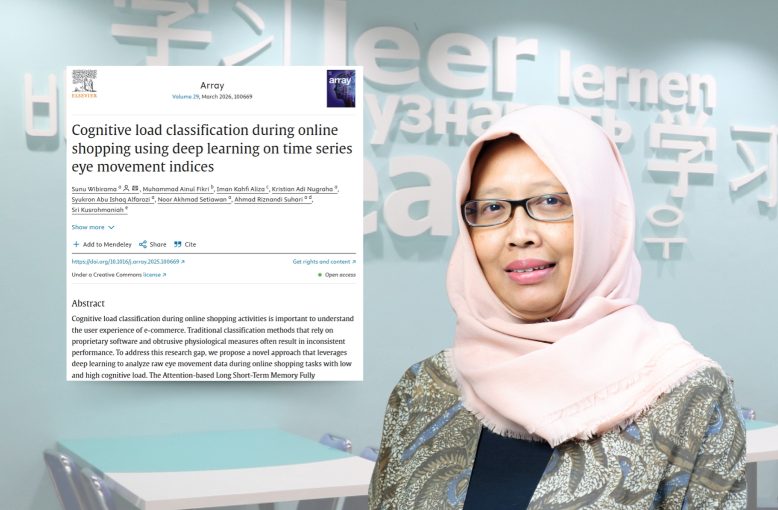
Yogyakarta, January 26, 2026 – Online shopping is not only an economic activity but also involves complex cognitive processes. However, identifying cognitive load during online shopping activities is often inconsistent. To address this, a research team from Universitas Gadjah Mada (UGM) has developed an Artificial Intelligence (AI)-based technology to classify users’ cognitive load levels while shopping online.

The findings of this study were published in the journal Array, Vol. 29, 100669, in an article titled “Cognitive load classification during online shopping using deep learning on time series eye movement indices.” The article was authored by Sunu Wibiarna, Muhammad Ainul Fikri, Iman Kahfi Aliza, Kristian Adi Nugraha, Syukron Abu Ishaq Alfarizi, Noor Akhmad Setiawan, Ahmad Riznandi Suhari, and Sri Kusrohmaniah.

This research focuses on user experience (UX) in e-commerce by analyzing consumers’ eye movements during online shopping activities. The eye movement data are processed as time series to distinguish between low and high cognitive load conditions.

The novelty of this study lies in the application of a deep learning model using an Attention-based Long Short-Term Memory–Fully Convolutional Network (ALSTM-FCN). This approach enables accurate classification of cognitive load without requiring exclusive software or intrusive physiological measurements that may disrupt user comfort. The ALSTM-FCN model outperformed other machine and deep learning models, achieving an average accuracy of 97.70%. It also demonstrated strong alignment with subjective cognitive load measurements obtained using the NASA-TLX instrument. This alignment highlights the importance of integrating both objective and subjective measures in understanding cognitive load during online shopping.

These findings have the potential to be applied in designing more adaptive, efficient, and user-friendly online shopping platforms, while also helping industry practitioners better understand consumers’ cognitive load in decision-making processes. This publication underscores UGM’s contribution to interdisciplinary research that bridges psychology, AI technology, and consumer behavior at the international level.

Article link: https://doi.org/10.1016/j.array.2025.100669

Congratulations to Sri Kusrohmaniah and colleagues.

Layout: Fauzi
Editor: Zufar

Tags: Faculty of Psychology UGM SDG 12: Responsible Consumption and Production SDG 8: Decent Work and Economic Growth SDG 9: Industry Innovation and Infrastructure SDGs

Berita Terkini

  • UGM Collaborates with IHC to Hold Clinical Hypnotherapy Certification TrainingMarch 31, 2026
  • OPSI | Uncovering True Traits Through a Game: A Conversation with the Creator of “The Lost TreasureMarch 17, 2026
  • Researchers from the Faculty of Psychology UGM Validate a Work Motivation Measurement Instrument for Generation Z in IndonesiaMarch 16, 2026
  • UGM–Melbourne Study Reveals the Key to Suicide Loss Survivors’ “Self-Healing”: Rebuilding Broken ConnectionsMarch 4, 2026
  • UPAP Conducts Initial Pilot Test for the Development of the Agility Test at SMA Negeri 1 KalasaFebruary 27, 2026
Universitas Gadjah Mada

Faculty of Psychology
Universitas Gadjah Mada

Jalan Sosio Humaniora Bulaksumur
Yogyakarta 55281 Indonesia
fpsi[at]ugm.ac.id
+62 (274) 550435 (hunting)
+62 (274) 550435 ext 158
psikologiugm
psikologiugm
psikologi_ugm
Kanal Psikologi UGM

© Universitas Gadjah Mada

KEBIJAKAN PRIVASI/PRIVACY POLICY

[EN] We use cookies to help our viewer get the best experience on our website. -- [ID] Kami menggunakan cookie untuk membantu pengunjung kami mendapatkan pengalaman terbaik di situs web kami.I Agree / Saya Setuju