
Yogyakarta, May 7, 2026 – Amid the euphoria surrounding scientific publication and the obsession with global indexing systems, one fundamental question is rarely asked: are we truly producing knowledge, or merely fulfilling academic administrative standards?
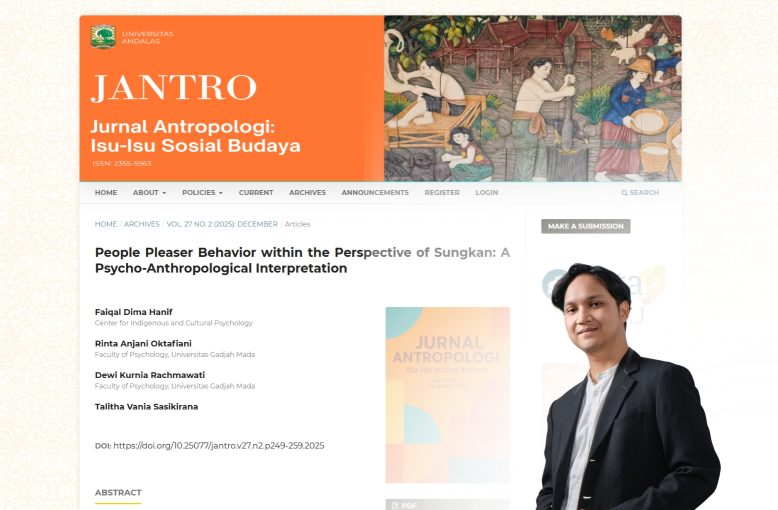
Research from the Faculty of Psychology at Universitas Gadjah Mada on people-pleasing behavior from the perspective of the Javanese concept of sungkan opens the door to broader reflection. The article titled “People Pleaser Behavior within the Perspective of Sungkan: A Psycho-Anthropological Interpretation” demonstrates that the tendency to please others is not merely an individual trait, but rather the result of deep cultural constructions rooted in values of respect, harmony, and social relationships.
This study highlights the importance of recognizing local concepts in psychological research. However, local concepts such as these are often not well supported by editors and reviewers from reputable international journals. At the same time, researchers are expected to publish in internationally indexed journals to meet academic indexing requirements. This creates a dilemma for psychology researchers.
Faiqal Dima Hanif, a researcher at the Center for Indigenous and Cultural Psychology, explained that this reflects a phenomenon of colonialism in academic publishing, where publication in indexed journals such as Scopus or Web of Science becomes the primary goal rather than a consequence of scientific quality. Articles are written to be “publishable” and attractive to the academic “market,” rather than because they address the most important issues to study.
“In situations like this, contextualization and socio-cultural uniqueness are often neglected. This is a form of colonialism in the world of academic publishing,” said Faiqal.
The research reveals that people-pleasing behavior strongly intersects with the culture of sungkan. This local cultural framework offers deeper insight that the habit of pleasing others is not simply an innate psychological issue, but a product of cultural formation. The study demonstrates an integration between psychology and anthropology, where people-pleasing behavior essentially represents an expression of the symbolic cultural structure of sungkan within Javanese society. The problem is that international publication systems often fail to adequately recognize this kind of complexity.
As a result, researchers in developing countries face a dilemma: remain faithful to local contextual uniqueness at the risk of being considered “not publishable,” or adapt to global standards by sacrificing contextualized analysis.
Within the framework of Sustainable Development Goal 4 and Sustainable Development Goal 16, the quality of higher education and the integrity of knowledge serve as essential foundations. Without methodological rigor and intellectual courage, it is difficult to imagine the emergence of truly strong and accountable institutions.
Author: Fauzi
Editor: Zufar