
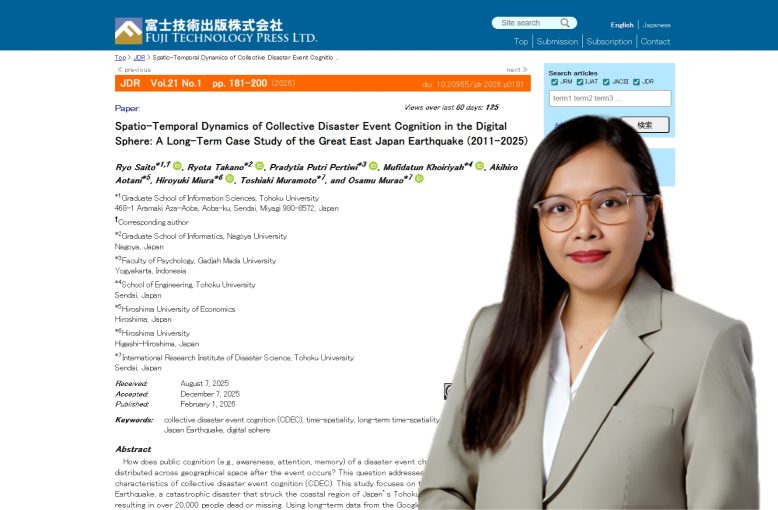
Yogyakarta, 10 February 2026 – How do public memory and attention toward disasters change over time? This question is at the center of a recent study involving researchers from the Faculty of Psychology, Universitas Gadjah Mada (UGM), in an international research project on the dynamics of collective disaster cognition in the digital era.
The study was published in the Journal of Disaster Research in an article titled “Spatio-Temporal Dynamics of Collective Disaster Event Cognition in the Digital Sphere: A Long-Term Case Study of the Great East Japan Earthquake (2011–2025).” The research is a collaboration between scholars from Japan and Indonesia, with academics from UGM’s Faculty of Psychology participating as members of the author team.
This research examines how public awareness, attention, and memory of disaster events develop over time within the digital sphere. As a case study, the researchers analyzed public responses to the 2011 Tohoku Earthquake in Japan, one of the most devastating disasters in modern Japanese history.
Using long-term data from Google Trends, the researchers tracked patterns of information searches related to the disaster over more than a decade. This approach enabled them to observe fluctuations in public interest and attention, as well as how annual commemorations and other disaster events influence collective memory.
The findings show that public attention tends to increase significantly during anniversary commemorations and when other major disasters occur. This phenomenon indicates an association effect, in which one disaster event can reactivate public memory of previous disasters.
The study also found that the relationship between geographical distance and the level of public attention is not always linear. In other words, proximity to the affected area does not necessarily determine the intensity of public attention. Instead, the pattern is more complex and influenced by various social factors and digital information dynamics.
These findings underscore the crucial role of the digital sphere in shaping collective memory of disasters. The ways in which people search for, access, and share information online help determine how an event is remembered—or forgotten.
This research has important implications for risk communication strategies and disaster education. By understanding patterns of public attention in digital spaces, stakeholders can design more effective communication strategies to maintain public awareness of disaster risks. The study also demonstrates that disaster cognition is no longer confined to affected regions alone, but has become a shared responsibility as a consequence of an increasingly interconnected world.
The involvement of UGM researchers in this study highlights UGM’s active contribution to global disaster research. Such studies are considered especially important for disaster-prone countries like Indonesia, where mitigation and preparedness efforts can be strengthened through a better understanding of public information behavior.
Through this research, the Faculty of Psychology at UGM once again reaffirms its commitment to advancing knowledge that is relevant to real societal challenges, including efforts to reduce disaster risk in the digital era.
Congratulations to the research team.
Article link: https://www.fujipress.jp/jdr/dr/dsstr002100010181/
Compiled by: Fauzi
Editor: Zufar