
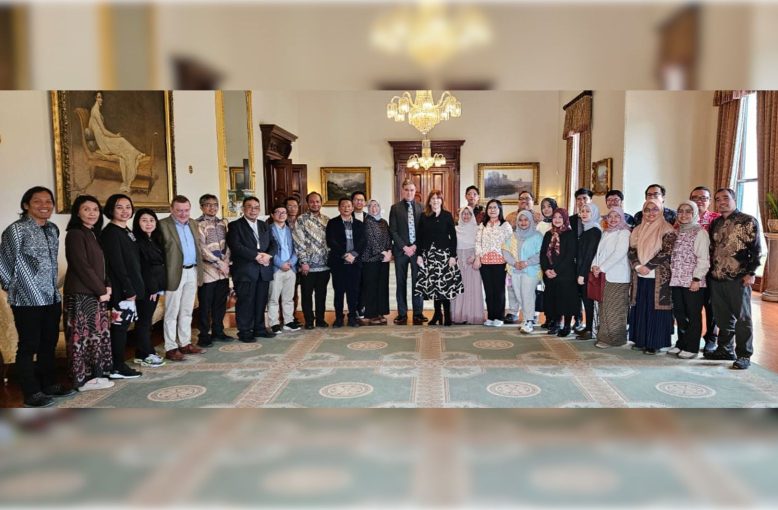
The final event of AAI – Strengthening Higher Education System in Indonesia, an afternoon tea reception in the Governor House with Her Excellency Professor the Honourable Margaret Gardner AC.
In August 2025, we joined 27 fellow academics from universities across Indonesia in a short course on Strengthening the Higher Education System in Indonesia (SHESI), delivered through the Australia Awards Indonesia program. The Crawford School of Public Policy hosted the course at the Australian National University (ANU) in Canberra, and gave us the opportunity to engage with policymakers and universities.
In Canberra, we visited the Department of Education and the Tertiary Education Quality and Standards Agency (TEQSA), gaining insights into national policy and regulations. In Victoria, we visited leading universities, including the University of Melbourne, RMIT, and Deakin, as well as Study Melbourne, the government body supporting international students. These experiences offered a comprehensive view of how Australia manages internationalisation across policy, governance, and practice.
One of the strongest lessons we drew from these visits is that internationalisation should be more than promoting global exchange, it must center on ensuring a high-quality, inclusive experience for all students, especially those with disabilities.
Student-Centered Internationalisation
In Australia, internationalisation places the student experience at its heart, with growing attention to the needs of students with disabilities. Institutions and governance bodies work together to create environments that are not only welcoming but also equitable and supportive.
A strong example is Study Melbourne, a government initiative offering holistic support for international students. Their wellbeing services include qualified social workers who provide confidential support and referrals to specialist services. They also offer MOST, a free digital mental health platform providing personalized guidance from clinicians and peer workers to address study stress, emotional wellbeing, and other challenges. These services show how a government can invest in mental health and disability support as an integral part of internationalisation.
Student Experience in Practice
The commitment to inclusion is not only visible in policies but also in the lived experiences of students. In our interviews, an Indonesian international student with a disability shared how the university supported their learning journey:
“I was first referred to the Psychology and Wellness Unit for treatment guidance, then to a Student Advisor for academic support, and finally enrolled in the Equitable Learning Service program where I received an individualised learning plan.” Through this plan, the student received flexible deadlines (with extensions of up to seven days when needed), and adjusted attendance requirements, reduced from 80% to 60%, to accommodate the challenges. The student emphasised that these adjustments were optional: “If I didn’t need the extra time, I could still submit on the same deadline as everyone else.”
This example illustrates how Australian universities integrate counselling, advisory services, and equitable learning adjustments to ensure that students with disabilities are not disadvantaged, while also maintaining their agency in deciding whether to use accommodations.
Increased Government Funding (2025)
During our visit to the Department of Education in Victoria, we learned about a major policy development: from 2025, the Australian Government will quadruple the Disability Support Fund for higher education. Funding will rise from AUD 13.3 million to AUD 53.1 million, significantly expanding the resources available to students with disabilities. This investment reflects a strong national commitment to accessibility and equity in higher education, ensuring that all students, regardless of ability, can succeed and thrive.
TEQSA’s Inclusive Standards
Australia’s higher education regulator, TEQSA, embeds inclusion into its quality assurance framework. The Threshold Standards set clear expectations for universities, for example:
- Institutional policies, practices, and approaches to teaching and learning are designed to accommodate student diversity, including the disadvantage experienced by identified groups, and create equivalent opportunities for academic success regardless of students’ backgrounds.
- Timely, accurate advice on access to personal support services is available, including emergency services, health services, counselling, legal advice, advocacy, and accommodation and welfare services.
- The extent of support services must be informed by student cohort needs, including mental health, disability, and wellbeing.
These standards ensure that diversity, equity, and wellbeing are not optional, but systematically monitored and mandated at a national level.
Reflection for Indonesia
The Australian experience offers important lessons for Indonesia. Internationalisation should not only be measured by student numbers or global visibility but by the lived experiences of students, especially those who face additional challenges. By adopting a student-centered model, investing in disability and mental health supports, ensuring government funding, and embedding inclusion into quality assurance, Indonesian universities can strengthen internationalisation in a way that is both equitable and sustainable.
At the same time, it is important to recognise that Indonesia is still at the beginning of its journey toward inclusivity, both for national and international students. For instance, ITB has recently made special efforts to facilitate the learning process of a Kemitraan Negara Berkembang (KNB) student with visual impairment, providing tailored academic support and accessibility measures. Meanwhile, UGM, supported by the Inobel grant from the Ministry of Higher Education, Science and Technology, developed innovative learning programs for students with ADHD. Such initiatives, though still limited in number, demonstrate the growing awareness and commitment needed to ensure inclusivity becomes a core element of higher education internationalisation in Indonesia.
Writer: Elga Andriana, PhD (UGM), Karlia Meitha, PhD (ITB), Fadhilah Muslim, PhD (UI)