
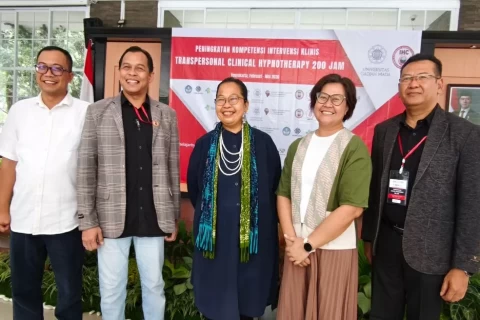
YOGYAKARTA – Universitas Gadjah Mada (UGM) has partnered with the Indonesian Hypnosis Centre (IHC) to organize a Transpersonal Clinical Hypnotherapy certification training program. The training, attended by around 100 participants, aims to strengthen the position of hypnotherapy as a science-based mental health practice.
The program is held at the Faculty of Psychology UGM, Yogyakarta, with a duration of 200 hours, running from February to May 2026. This initiative follows up on a collaboration formalized through a memorandum of understanding (MoU) signed in February.
Head of the Doctoral Program in Psychology at UGM, Edilburga Wulan Saptandari, stated that the program is also integrated into the academic process of doctoral students. According to her, all stages of the training are carefully structured to ensure standardization and scientific accountability.
“This collaboration is part of academic research, so the process is measurable and data-driven,” she said on Saturday (March 28, 2026).
Professor at the Faculty of Psychology UGM, Kwartarini Wahyu Yuniarti, emphasized the importance of a scientific approach in clinical hypnosis practice. She noted that the initiative also aims to eliminate the stigma often associated with hypnotherapy.
“We focus on scientific mitigation so that clinical hypnosis is not perceived as something irrational, but rather as an academically accountable practice,” she explained.
In addition, the collaboration is directed toward testing the effectiveness of hypnotherapy in treating various medical conditions, such as chronic pain, diabetes, and cancer. Based on internal data, the method is reported to have a high success rate. “Its effectiveness can reach up to 93% in just six sessions, making it more efficient compared to conventional methods such as psychoanalysis,” she added.
IHC Director Avifi Arka stated that this collaboration provides strong legitimacy for hypnotherapy practitioners in Indonesia. He mentioned that the training curriculum has been aligned with national education standards and supported by official certification.
“We want to ensure that our graduates possess competencies aligned with academic standards. The synergy with UGM is expected to enhance quality and professional recognition,” he said.
UGM, as an educational institution with a strong research track record, is considered a crucial foundation for developing science-based hypnotherapy. This collaboration is expected to serve as a model for partnerships between academia and practitioners in improving the quality of mental health services in Indonesia.
This initiative also represents an effort to shift public perception—that hypnotherapy is not merely entertainment, but part of a measurable scientific approach capable of delivering real impact. (cip)