
What if the place you call home no longer feels like a place you belong?
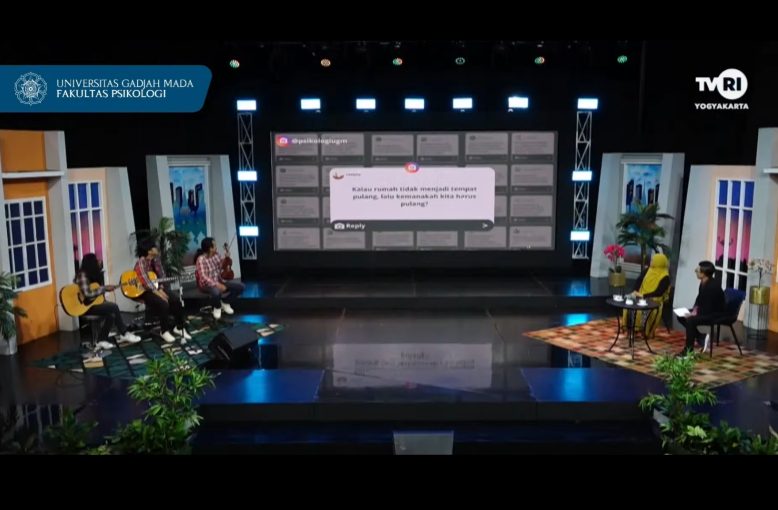
This topic is explored in the latest episode of OPSI: Obrolan Psikologi, presented by the Faculty of Psychology UGM in collaboration with TVRI Yogyakarta. In the third episode of OPSI this year, Istiana Tajuddin, S.Psi., M.Psi., student of the Doctoral Program in Psychology at Universitas Gadjah Mada (UGM), discusses the phenomenon of when home no longer feels like a place to return to.
Ideally, home is not merely a physical structure, but a safe and comfortable space where individuals can rest and be themselves. However, in reality, conflicts and overwhelming expectations within the family often make individuals feel reluctant to go home.
“Nowadays, many of us wear thicker ‘masks’ at home… there are too many demands, but the direction is unclear,” Istiana explains.
In such conditions, family members often feel the need to hide their true feelings or identity in order to meet expectations. As a result, the home no longer serves as a safe space, but rather becomes a source of emotional pressure.
Why do so many people feel this way?
One of the main causes is poorly managed emotions within the family. Communication often turns into arguments, even when conversations have just begun.
“I go home, and it turns into a debate,” or “I’ve just started speaking, and I’m already being dismissed.”
These patterns raise questions about family functioning. According to Istiana, a healthy family fulfils five key functions: (1) a space for problem-solving, (2) clear roles for each member, (3) affective involvement, (4) appropriate emotional responsiveness, and (5) balanced behavioural control.
However, in practice, these emotional needs are often unmet. When children try to open up, the responses they receive can be excessive or disproportionate—like a “soda bottle” that easily explodes. In reality, what they often need is simple validation and emotional support.
As a result, many individuals choose to confide in friends or even turn to social media, where they feel more heard and accepted. Nevertheless, Istiana also emphasises the importance of being cautious when sharing on social media by applying filters and critical thinking.
Over time, communication within the family can become increasingly distant. Children may choose not to share anything with their parents unless the situation becomes urgent, and instead spend more time outside the home.
So, what can we do?
- Reach out. Families need to create a safe and supportive environment, both within and beyond the household.
- Validate feelings. Family members should learn to listen without judgment, understand emotions, and rebuild trust through consistent actions.
- Practice understanding. It is important to recognise that each family member carries their own burdens and life journey. Often, we forget that parents also face pressures that are not always visible.
- Shared responsibility in communication. Every family member plays a role in maintaining connection and mutual understanding.
- Build family rituals. Set aside intentional time for meaningful conversations, free from gadget distractions.
In addition, individuals also need to return to themselves before attempting to repair relationships with others. For example, engaging in reflection, finding moments of stillness, and beginning to heal their own emotional wounds.
“…when we place our hands too close, everything looks unclear. But when there is some distance, things become clearer—just like when we face our own problems…” said Istiana
Ultimately, change within a family cannot be forced instantly. It begins with the individual, who becomes someone who creates a sense of safety and comfort for others.
Don’t miss other engaging episodes of OPSI: Obrolan Psikologi!
Watch the live replay and stay updated with insightful discussions on psychology through the Faculty of Psychology UGM Knowledge Channel:
Note:
Let us know if there are specific psychology topics you would like us to explore on the talk show Obrolan Psikologi (OPSI), a collaboration between the Faculty of Psychology UGM and TVRI Yogyakarta.
Watch the full episode on YouTube!
Share your suggestions and feedback regarding OPSI through the following channels:
Email: humas.psikologi@ugm.ac.id
Instagram: @psikologiugm
Author: Arrasya Aninggadhira