
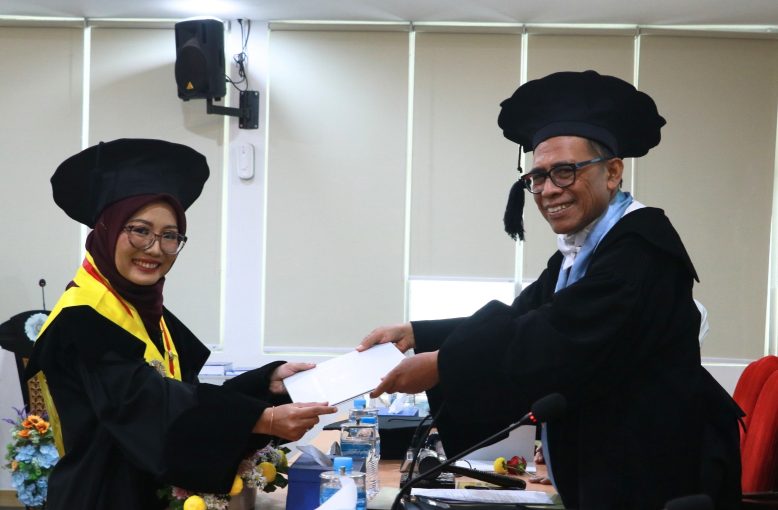
Martaria Rizky Rinaldi, S.Psi., M.Psi., Psikolog, has earned her doctoral degree after completing her Open Dissertation Defense in the Doctoral Program in Psychology on Wednesday (January 14) at Room A203, Faculty of Psychology, Universitas Gadjah Mada (UGM). She graduated as UGM’s 7,093rd doctoral graduate with a dissertation titled “HypnoDiaCare for Individuals with Type 2 Diabetes Mellitus: From Evidence Mapping and Intervention Development to Randomized Controlled Trial and Psychophysiological Evaluation.”
The dissertation defense was chaired by Prof. Drs. Subandi, M.A., Ph.D., Psikolog. The dissertation was supervised by Prof. Dra. Kwartarini Wahyu Yuniarti, M.Med.Sc., Ph.D., Psikolog, as Promotor, along with Prof. Em. Gilles Van Luijtelaar, Ph.D., and Dr. Nida Ul Hasanat, M.Si., Psikolog, as Co-Promotors.
In her dissertation, the lecturer at Universitas Mercu Buana highlighted the challenges of managing chronic diseases, which are not only medical in nature but also closely related to psychological aspects and health behaviors. She developed HypnoDiaCare as an integrative intervention combining diabetes self-management education with clinical hypnosis techniques. The development process included stages of evidence mapping, module design, and effectiveness testing using a Randomized Controlled Trial (RCT) method along with psychophysiological evaluation.
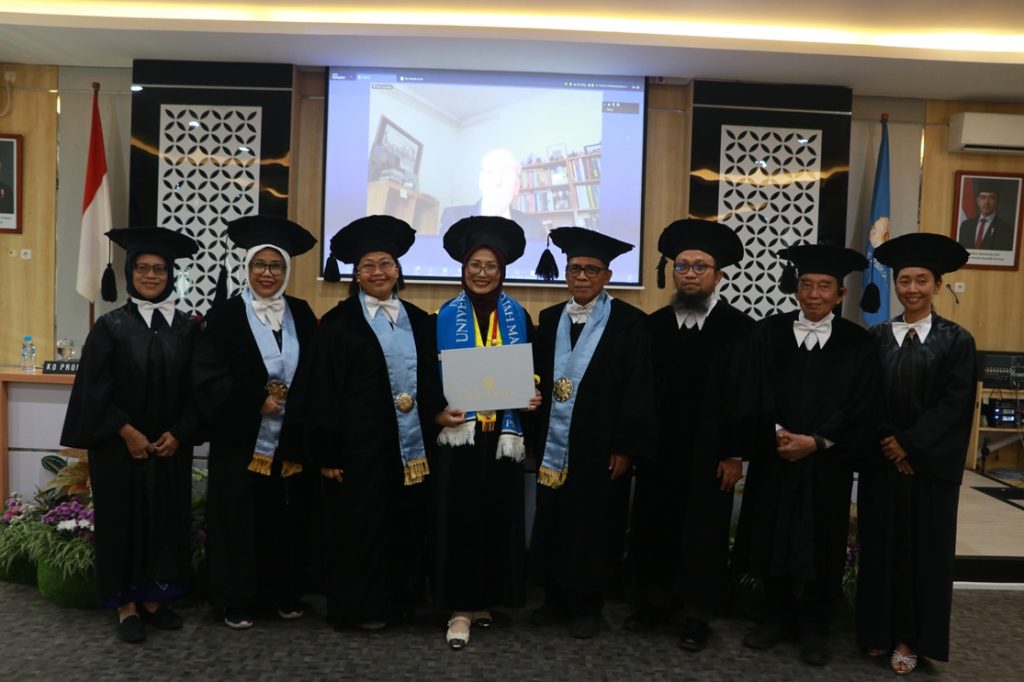
“The limitations of cognitively based educational approaches, along with the need for integrative psychological interventions, form the basis for developing HypnoDiaCare for individuals with Type 2 Diabetes Mellitus,” Martaria stated during her dissertation defense.
Furthermore, the intervention was designed by systematically integrating self-management education and clinical hypnosis components.
“HypnoDiaCare was developed by integrating diabetes self-management education and clinical hypnosis techniques into a structured psychological intervention framework,” she explained.
The results of the study indicate that HypnoDiaCare demonstrates good acceptability and provides benefits in psychological aspects as well as self-care behaviors among individuals with Type 2 Diabetes Mellitus.
“The findings show that HypnoDiaCare is well accepted and leads to improvements in psychological aspects and self-care behaviors among individuals with Type 2 Diabetes Mellitus,” she added.
These findings are expected to serve as a reference for developing psychological interventions for other chronic conditions by utilizing integrated approaches and psychophysiological evaluation.
Author: Erna Tri Nofiyana