•  About UGM
  •  Academic Portal
  •  IT Center
  •  Library
  •  Research
  •  Webmail
  • English
    • Bahasa Indonesia
    • English
Universitas Gadjah Mada
  •  About Us
    •  Faculty at a glance
    •  History
    •  Heads of Faculty
    •  Academic Staff
    •  Administrative Staff
    •  Quality Assurance
  •  EDUCATION
    • Undergraduate Program Psychology
    • International Undergraduate Program
    • Professional Psychology Program
    • Master of Psychology Program
    • Doctorate Program
  • Research and Community Service
    • Research and Community Service Roadmap
    • Research
    • Publication
    • Community Service
    • Collaborations
  •  Student
    • Prospective Student
    •  Student Conduct Code
    • Collaboration Agreement Internship Vacancies
    • Scholarship
    •  Student Organization
  •  Facilities
    •  Laboratories
    • Research Group
    • Non-Academic Supports
  • Home
  • Release
  • Low Self-Compassion as a Distinctive Cross-Cultural Feature of Complex PTSD

Low Self-Compassion as a Distinctive Cross-Cultural Feature of Complex PTSD

  • Release
  • 30 January 2026, 10.46
  • Oleh: Humas
  • 0

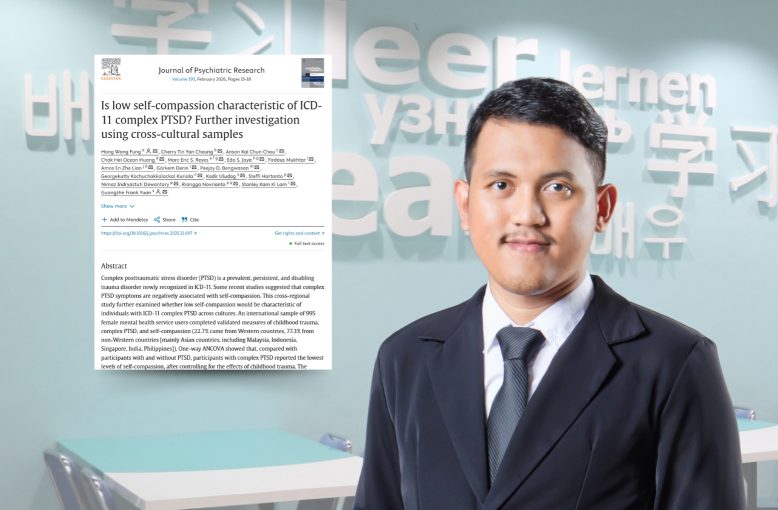
Yogyakarta, 30 January 2026 – A recent study entitled “Is low self-compassion characteristic of ICD-11 complex PTSD? Further investigation using cross-cultural samples,” authored by Hong Wang Fung, …, Riangga Novrianto, et al., and published in the Journal of Psychiatric Research (Vol. 193), examines the association between self-compassion and symptoms of complex posttraumatic stress disorder (complex PTSD) as classified in ICD-11. Complex PTSD is a trauma-related disorder that has been relatively recently recognized in ICD-11 and is reported to have a higher prevalence than standard PTSD.

This study employed a cross-cultural approach involving 995 female users of mental health services from various countries. Approximately 22.7% of respondents were from Western countries, while 77.3% were from non-Western countries, primarily in Asia, including Indonesia, Malaysia, Singapore, India, and the Philippines. Participants completed validated instruments measuring childhood trauma, symptoms of complex PTSD, and levels of self-compassion. Data were analyzed using one-way ANCOVA to examine differences in self-compassion among participants with PTSD, complex PTSD, and no PTSD, while controlling for age and childhood trauma.

The results showed that individuals with complex PTSD consistently exhibited the lowest levels of self-compassion compared to those with PTSD and those without PTSD, in both Western and non-Western samples. These findings confirm that low self-compassion is a cross-cultural characteristic of complex PTSD. The study recommends that self-compassion–based interventions be integrated into the prevention and treatment of complex PTSD.

Congratulations to Riangga Novrianto and the team of authors.

Prepared by: Fauzi
Editor: Zufar
Article link: https://doi.org/10.1016/j.jpsychires.2025.11.007

Tags: Faculty of Psychology UGM SDG 16: Peace Justice & Strong Institutions SDG 3: Good Health and Well-being SDG 4: Quality Education SDGs

Berita Terkini

  • The PREPARED Scale: Measuring the Psychological Preparedness of Indonesian Communities for DisastersFebruary 3, 2026
  • Researchers from the Faculty of Psychology UGM Map the Concept of Digital Well-being in the Technological EraFebruary 3, 2026
  • Researchers from the Faculty of Psychology UGM Develop EduDiaCare, a Culturally Adaptive Type 2 Diabetes Education Module for IndonesiaFebruary 3, 2026
  • Low Self-Compassion as a Distinctive Cross-Cultural Feature of Complex PTSDJanuary 30, 2026
  • Boundless Synergy: CPMH UGM and Local Partners Distribute Hundreds of Humanitarian Aid Packages for Flood Survivors in AcehJanuary 9, 2026
Universitas Gadjah Mada

Faculty of Psychology
Universitas Gadjah Mada

Jalan Sosio Humaniora Bulaksumur
Yogyakarta 55281 Indonesia
fpsi[at]ugm.ac.id
+62 (274) 550435 (hunting)
+62 (274) 550435 ext 158
psikologiugm
psikologiugm
psikologi_ugm
Kanal Psikologi UGM

© Universitas Gadjah Mada

KEBIJAKAN PRIVASI/PRIVACY POLICY

[EN] We use cookies to help our viewer get the best experience on our website. -- [ID] Kami menggunakan cookie untuk membantu pengunjung kami mendapatkan pengalaman terbaik di situs web kami.I Agree / Saya Setuju