
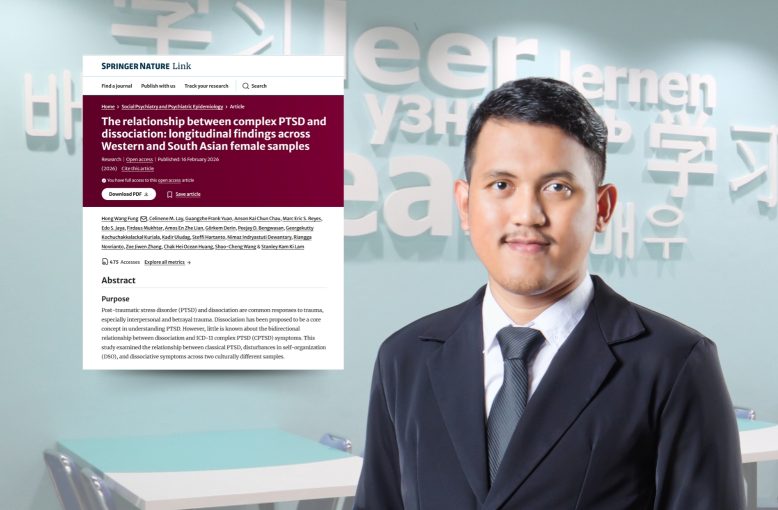
Yogyakarta, February 26, 2026 – Psychological disorders such as post-traumatic stress disorder (PTSD) and dissociative symptoms (feeling “detached” from oneself) are common responses when individuals experience profound trauma. A recent international collaborative study has uncovered the dynamics of the relationship between complex post-traumatic stress disorder (CPTSD) and dissociative symptoms through a cross-cultural approach involving participants from Western and South Asian countries.
The study, conducted by Fung, H.W., Lay, C.M., Yuan, G.F., … Novrianto, R., et al., was published in the journal Social Psychiatry and Psychiatric Epidemiology under the title “The Relationship between Complex PTSD and Dissociation: Longitudinal Findings across Western and South Asian Female Samples.”
The research aimed to understand the bidirectional relationship between complex PTSD and dissociation—two psychological responses that frequently emerge following trauma, particularly interpersonal trauma. Although dissociation has long been considered an important component in understanding PTSD, the dynamics between the two constructs have not yet been fully clarified.
Using a longitudinal design, the study involved female participants from two different cultural groups: 101 participants from Western countries (North America/Canada and the United Kingdom) and 160 participants from South Asia (Malaysia, the Philippines, Indonesia, and Singapore). Data were collected at two time points approximately six months apart, using standardized instruments to measure PTSD symptoms, disturbances in self-organization (DSO), and dissociative symptoms.
The findings showed that 71.7% to 84.2% of participants with CPTSD experienced dissociative symptoms. Meanwhile, 70% to 72.3% of participants with dissociative symptoms were likely to experience PTSD or CPTSD. Additionally, dissociative symptoms were found to predict PTSD severity in both participant groups. Interestingly, this pattern was not observed in the relationship between dissociative symptoms and DSO symptoms. The role of dissociative symptoms as a predictor of DSO appeared only in the South Asian sample, indicating differences in psychological dynamics based on cultural context.
These findings highlight that dissociative symptoms are an important factor in PTSD treatment, although the underlying mechanisms may differ depending on individuals’ cultural backgrounds. Therefore, PTSD assessment and intervention approaches need to consider dissociative symptoms more carefully within their social and cultural contexts.
This study provides an important contribution to the field of global mental health, particularly in understanding PTSD dynamics and treatment approaches. The findings are expected to serve as a foundation for developing prevention and intervention strategies that are more culturally sensitive.
Congratulations to Riangga Novrianto and the team of authors.
Layout: Fauzi
Editor: Zufar