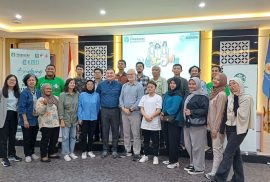

A research team from the Faculty of Psychology, Universitas Gadjah Mada (UGM), is examining how Common Method Bias (CMB) affects findings in survey research. CMB refers to bias that arises when the same measurement approach is used for multiple constructs at the same time, for example, administering many questions to the same respondents, at the same time and place, using the same form. As a result, correlations between concepts can appear higher than they truly are, with part of the “high” value coming from the measurement method rather than the actual phenomenon. Internationally, many journals now require authors to demonstrate efforts to reduce CMB. In Indonesia, however, reporting and mitigation of CMB are still uncommon, highlighting the need for trusted guidance.
The Faculty of Psychology at UGM has launched a study examining how organizational values are translated into effective strategies that enhance company performance. The study stems from the observation that many organizations fail not only due to market pressures, but because shared values are not consistently operationalized in decision-making. “Shared values” here refers to core principles agreed upon and embraced across the organization, from leadership to employees, as a compass for thinking and acting. Examples include integrity, professionalism, innovation, service, and collaboration. Led by Dr. Bagus Riyono, M.A., Psychologist, the research team will test empirical evidence that values must be embedded in strategy to make a tangible impact on performance.
A research team from the UGM Faculty of Psychology will examine how intensive Qur’an memorization training shapes verbal memory and leaves measurable traces in brain structure and connectivity. Grounded in the structured pedagogy of Islamic boarding schools, combining talaqqi, muraja’ah, and consistent repetition, this study positions hafiz as a model of learning that demands high perseverance and repeated information processing. In neuroscience, intensive learning experiences are known to trigger neuroplasticity, the brain’s capacity to adapt both functionally and structurally. However, specific evidence of how these adaptations manifest in hafiz remains limited. This study aims to map brain regions relevant to verbal memory, particularly the hippocampus and caudate nucleus, assess the integrity of white-matter tracts such as the inferior fronto-occipital fasciculus (IFOF) and uncinate fasciculus (UF), and concurrently evaluate behavioral performance in verbal memory. Additionally, this study is the first psychology research in Indonesia on mapping the brains of hafiz using structural brain imaging.
A research team from the Faculty of Psychology, Universitas Gadjah Mada (UGM), will examine job flourishing, an indicator of positive mental health at work, among lecturers and administrative staff at a public university in Indonesia. This study responds to growing global concern about workers’ mental health. WHO data point to the high burden of depression, anxiety, and daily stress affecting productivity. In Indonesia, mental health indicators among working populations likewise call for more precise organizational-level mapping. The research focuses on how emotional, psychological, and social well-being at work relate to work engagement, performance, burnout, anxiety, and depression, while offering an evidence-based picture to inform intervention planning in campus settings.
Pradytia Putri Pertiwi, S.Psi., Ph.D, a lecturer at the Faculty of Psychology, Universitas Gadjah Mada (UGM), was invited by the American Red Cross through the Global Disaster Preparedness Center (GDPC) to present her research on the inclusivity and actionability of volcanic hazard Early Warning Systems (EWS) for persons with disabilities (PwD) in Indonesia. The study has been published on the GDPC–American Red Cross platform under the title “Inclusivity and actionability of volcanic hazard Early Warning System in Indonesia: Perspectives of persons with disabilities”.
The Career Center of the Faculty of Psychology, Universitas Gadjah Mada (UGM), held a blended-format webinar titled “Learning Effectively and Growing as a College Student” on Friday (October 3). The event, attended by first- and third-semester undergraduate students, featured two inspiring speakers: Nadia Puti Dianesti, S.Psi. (Alumna and 2024 Outstanding Student of the Faculty and University) and Alya Nur Faiza (2025 Outstanding Student of the Faculty of Psychology UGM).
Yogyakarta, October 2, 2025 – An innovation by students from the Faculty of Psychology, Universitas Gadjah Mada (UGM), which initially earned a gold medal at the 36th National Student Scientific Week (PIMNAS), has now achieved a new milestone with its publication in a high-impact international journal. The article titled “PsyBot: A Randomized Controlled Trial of WhatsApp-Based Psychological First Aid to Reduce Loneliness Among 18–22-Year-Old Students in Yogyakarta, Indonesia” was published on July 31, 2025, in SSM – Mental Health (Elsevier), a Scopus Q1-indexed journal with a 2024 CiteScore of 4.2 and an Impact Factor of 2.6.
Reny Yuniasanti, M.Psi., Ph.D., Psikolog, is known as an educator who firmly upholds integrity while actively contributing through professional organizations. Her academic journey began as one of the first cohort of the Master of Professional Psychology Program at Universitas Gadjah Mada (UGM) in 2005. She successfully completed her studies despite the fact that the program’s academic system was still in its trial phase.
The Faculty of Psychology, Universitas Gadjah Mada (UGM), has established a partnership with the Civil Service and Human Resource Development Agency (BKPSDM) of Balikpapan City. The signing of the cooperation agreement took place at the Faculty of Psychology UGM on Wednesday (September 24).
The Faculty of Psychology, Universitas Gadjah Mada (UGM), welcomed a visit from 134 twelfth-grade students of SMAN 2 Wonosari on Tuesday (September 23) at Hall-D. The visit aimed to broaden students’ knowledge about higher education, particularly about UGM and its Faculty of Psychology.