
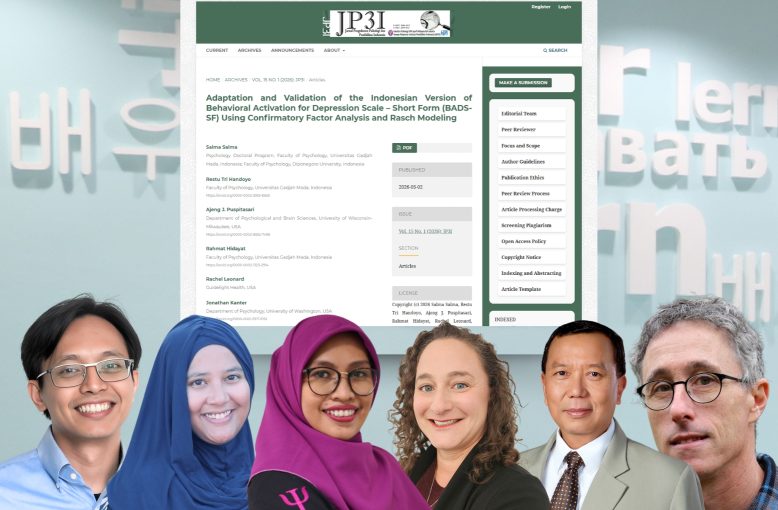
Yogyakarta, May 12, 2026 — Efforts to strengthen mental health services in Indonesia have once again received a contribution from researchers at Universitas Gadjah Mada. A research team from the Faculty of Psychology at Universitas Gadjah Mada, together with national and international partners, successfully adapted and validated an Indonesian-language version of a behavioral activation measurement instrument for depression through a study titled “Adaptation and Validation of the Indonesian Version of Behavioral Activation for Depression Scale – Short Form (BADS-SF) Using Confirmatory Factor Analysis and Rasch Modeling” The study was published in JP3I (Indonesian Journal of Psychological and Educational Measurement) and involved collaboration between researchers from UGM, Universitas Diponegoro, as well as academics from the University of Wisconsin–Milwaukee and the University of Washington.
Depression remains one of the major global health challenges, including in Indonesia. However, the availability of valid psychological measurement tools that are culturally appropriate for the Indonesian context is still relatively limited. In fact, accurate instruments are essential for assessment processes, interventions, and the evaluation of psychological therapy. Through this study, the research team conducted cultural adaptation and psychometric testing of the Behavioral Activation for Depression Scale – Short Form (BADS-SF), an instrument used to measure levels of behavioral activation in individuals with depression. This instrument is important for tracking client or patient progress in behavioral activation therapy, an approach that helps individuals re-engage in meaningful daily activities. This therapy is considered a relatively simple, practical, and easily applicable intervention across various psychological service settings.
The study employed Confirmatory Factor Analysis (CFA) and Rasch Modeling to ensure the reliability and validity of the instrument in the Indonesian context. The results showed that the Indonesian version of the BADS-SF has good psychometric properties and is suitable for both research and clinical practice.
The study was led by Salma and involved several academics across institutions, including Restu Tri Handoyo, S.Psi., M.Psi., Ph.D., Psikolog and Rahmat Hidayat, S.Psi., M.Sc., Ph.D., from the Faculty of Psychology at Universitas Gadjah Mada. This international collaboration reflects the growing strength of UGM’s global psychology research network, particularly in evidence-based mental health issues.
Through cross-cultural adaptation and psychometric testing involving hundreds of Indonesian adult respondents, the researchers found that the Indonesian version of the BADS-SF demonstrated good validity and reliability. Interestingly, however, the most suitable structure of the instrument in the Indonesian context differed from the original version. While the international version consists of nine items and two main dimensions, the study found that the best-fitting model for the Indonesian population was a one-factor model with six items. Several items from the original version did not perform optimally when translated into the Indonesian cultural context.
One of the most interesting findings relates to how respondents interpret the avoidance of negative emotions. In Western psychological perspectives, behaviors such as avoiding unpleasant experiences or distracting oneself from negative feelings are often considered avoidance behaviors associated with depression. However, among some Indonesian respondents, such behaviors were instead perceived as reasonable strategies for maintaining emotional stability and social harmony. This finding highlights the strong influence of culture on how individuals understand and respond to emotional experiences. The researchers noted that international psychological instruments cannot always be directly applied without adequate cultural adaptation.
The results of this study are expected to strengthen mental health assessment services in Indonesia, both in academic settings, hospitals, and community psychology services. With scientifically validated measurement tools, the identification and support of individuals with depression can be carried out more accurately. In addition, this study also highlights the importance of developing psychological instruments that are sensitive to local cultural contexts, ensuring that mental health approaches not only adopt global models but are also relevant to the lived experiences of Indonesian society.
This research directly contributes to the achievement of the Sustainable Development Goals (SDGs), particularly:
SDG 3: Good Health and Well-being through strengthening mental health services and developing evidence-based depression assessment tools;
SDG 4: Quality Education through the development of research capacity and psychology education based on strong scientific methodology;
SDG 17: Partnerships for the Goals through international research collaboration between Indonesian and foreign universities.
The Dean of the Faculty of Psychology at Universitas Gadjah Mada, Rahmat Hidayat, who is also part of the research team, stated that strengthening mental health research is a key commitment of the faculty in addressing contemporary public health challenges. “Research like this shows that the development of psychological science does not stop at the academic level, but also has a real impact on improving the quality of mental health services in Indonesian society,” he said.
Through research based on methodological validity and international collaboration, UGM continues to strengthen its contribution to the development of knowledge that is relevant to societal needs and the global sustainable development agenda.
Editor: Fauzi
Editor-in-chief: Zufar