
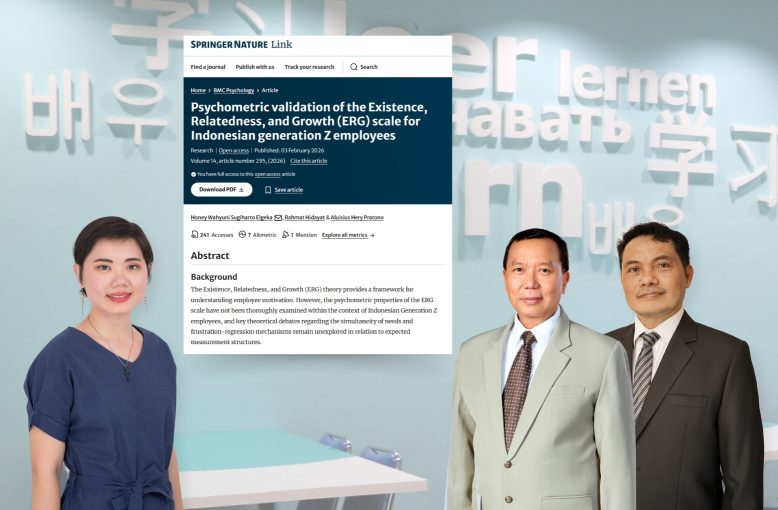
Yogyakarta, March 16, 2026 — The shifting characteristics of the workforce, now increasingly dominated by Generation Z, have created the need for a new understanding of work motivation within organizational settings. In response, researchers from Universitas Gadjah Mada have developed and validated a psychological instrument to measure the motivational needs of Generation Z employees in Indonesia.
The findings were published in the international journal BMC Psychology in an article titled “Psychometric Validation of the Existence, Relatedness, and Growth (ERG) Scale for Indonesian Generation Z Employees.”
The study, conducted by Honey Wahyuni Sugiharto Elgeka, Rahmat Hidayat, and Aluisius Hery Pratono, aimed to examine the validity and reliability of the Existence, Relatedness, and Growth (ERG) scale within the context of Generation Z employees in Indonesia. The ERG theory itself is a key framework in organizational psychology for understanding fundamental needs that influence individual work motivation.
The study involved 751 Indonesian Generation Z employees, born between 1997 and 2008, from various industrial sectors. Respondents were recruited through professional networks, social media platforms, and organizational connections.
In this research, the authors employed several advanced psychometric approaches, including Item Response Theory (IRT), Confirmatory Factor Analysis (CFA), network analysis, and the Rasch model to assess the quality of the measurement instrument.
The results indicate that the ERG scale structure aligns with the theoretical framework, encompassing three core domains with five key dimensions: existence needs, social relationships with supervisors and colleagues (relatedness), and personal development needs (growth). The analysis also demonstrates that the instrument has excellent validity and reliability.
Additionally, the study found that the ERG scale can more precisely identify levels of psychological need satisfaction, particularly at low to moderate levels. This is significant, as it can help organizations better understand factors influencing employee engagement and retention among younger workers.
The researchers conclude that this instrument can serve as a valuable tool for organizations, human resource practitioners, and researchers in designing more effective employee management strategies, especially for the emerging workforce generation.
As Generation Z continues to make up a larger proportion of the labor market, a deeper understanding of their psychological needs is expected to support the creation of healthier, more productive, and sustainable work environments.
The article is available online at:
https://link.springer.com/article/10.1186/s40359-026-04044-0
Congratulations to the Dean.
Prepared by: Fauzi
Edited by: Zufar